



 Chat with AI
Exam 18: International Trade and Public Policy

Exam 1: Introduction: What Is Economics144 Questions
Exam 2: The Key Principles of Economics195 Questions
Exam 3: Exchange and Markets135 Questions
Exam 4: Demand, Supply, and Market Equilibrium279 Questions
Exam 5: Measuring a Nations Production and Income161 Questions
Exam 6: Unemployment and Inflation206 Questions
Exam 7: The Economy at Full Employment165 Questions
Exam 8: Why Do Economies Grow203 Questions
Exam 9: Aggregate Demand and Aggregate Supply189 Questions
Exam 10: Fiscal Policy166 Questions
Exam 11: The Income-Expenditure Model265 Questions
Exam 12: Investment and Financial Markets179 Questions
Exam 13: Money and the Banking System184 Questions
Exam 14: The Federal Reserve and Monetary Policy203 Questions
Exam 15: Modern Macroeconomics: From the Short Run to the Long Run176 Questions
Exam 16: The Dynamics of Inflation and Unemployment186 Questions
Exam 17: Macroeconomic Policy Debates143 Questions
Exam 18: International Trade and Public Policy226 Questions
Exam 19: The World of International Finance189 Questions
Select questions type


If Nation A can produce shirts at a lower opportunity cost than any other nation, Nation A is said to have a(n) _______ in the production of shirts.
(Multiple Choice)
5.0/5  (81)
(81) 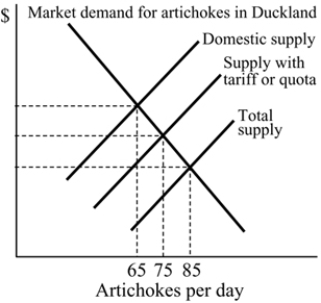 Figure 18.4
-Refer to Figure 18.4. With an import ban, what is the equilibrium price of artichokes in Duckland?
Figure 18.4
-Refer to Figure 18.4. With an import ban, what is the equilibrium price of artichokes in Duckland? (Multiple Choice)
4.8/5 (77)
(77) Which of the following trade agreements provides for the development of a single market among its members?
(Multiple Choice)
4.9/5 (79)
(79) Which of the following situations will arise in the domestic market following the removal of an import quota?
(Multiple Choice)
4.7/5 (79)
(79) The main rationale for anti- dumping policies is to prevent:
(Multiple Choice)
4.8/5 (82)
(82) 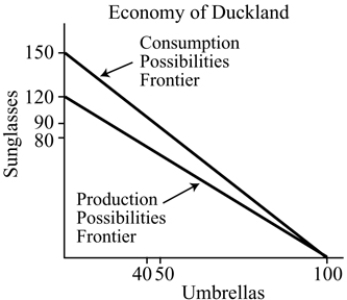 Figure 18.1
-Refer to Figure 18.1. The opportunity cost of producing sunglasses in Duckland is:
Figure 18.1
-Refer to Figure 18.1. The opportunity cost of producing sunglasses in Duckland is: (Multiple Choice)
4.9/5 (89)
(89) 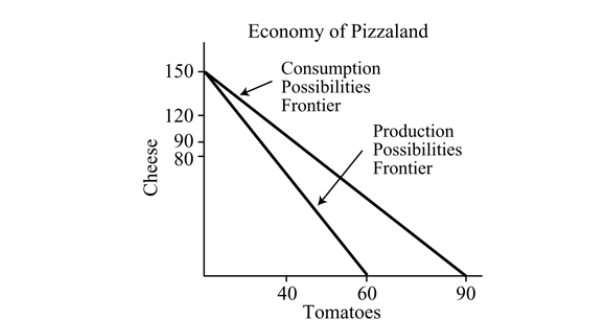 Figure 18.2
-Refer to Figure 18.2. The terms of trade for Pizzaland is:
Figure 18.2
-Refer to Figure 18.2. The terms of trade for Pizzaland is: (Multiple Choice)
4.7/5 (73)
(73) What are the similarities and differences between an import tariff and a voluntary export restraint? What are the differences?
(Essay)
4.8/5 (74)
(74)  -Refer to Table 18.1. The opportunity cost of a bagpipe in Scotland is:
 (Multiple Choice)
4.8/5 (75)
(75) 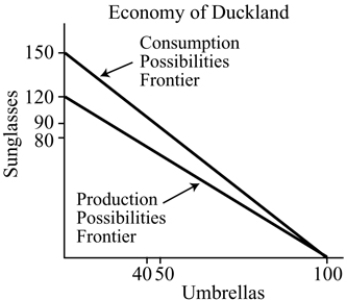 Figure 18.1
-Refer to Figure 18.1. After trade and specialization begin, the maximum amount of umbrellas that Duckland can consume is:
Figure 18.1
-Refer to Figure 18.1. After trade and specialization begin, the maximum amount of umbrellas that Duckland can consume is: (Multiple Choice)
4.9/5 (77)
(77) Import bans, import quotas, voluntary export restraints, and tariffs on goods all:
(Multiple Choice)
4.8/5 (88)
(88) 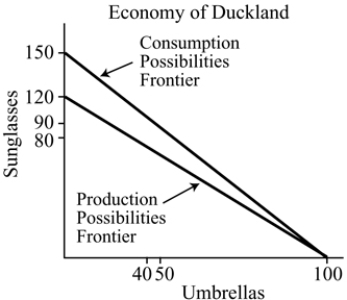 Figure 18.1
-Refer to Figure 18.1. In autarky, the maximum amount of sunglasses that Duckland can produce is:
Figure 18.1
-Refer to Figure 18.1. In autarky, the maximum amount of sunglasses that Duckland can produce is: (Multiple Choice)
4.8/5 (74)
(74) Recall Application 4, "Trade, Consumption and Inequality," to answer the following questions:
-Why did the application claim that Sam Walton "effectively ran an anti- poverty program"?
(Multiple Choice)
4.8/5 (94)
(94) 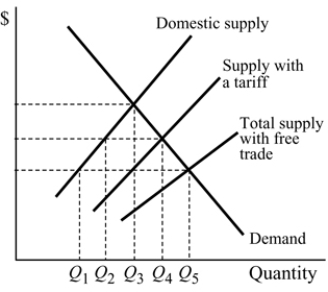 Figure 18.5
-In Figure 18.5, compared to free trade, the tariff causes domestic production of the good to:
Figure 18.5
-In Figure 18.5, compared to free trade, the tariff causes domestic production of the good to: (Multiple Choice)
4.9/5 (73)
(73) Recall Application 4, "Trade, Consumption and Inequality," to answer the following questions:
-According to the application, living standards have not become more unequal because:
(Multiple Choice)
4.8/5 (81)
(81) 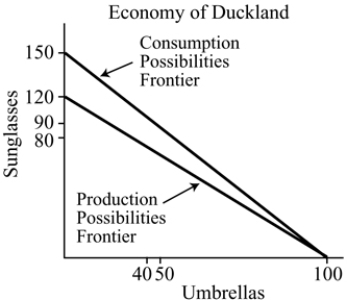 Figure 18.1
-Refer to Figure 18.1. The terms of trade for Duckland is:
Figure 18.1
-Refer to Figure 18.1. The terms of trade for Duckland is: (Multiple Choice)
4.9/5 (78)
(78) Protection can give new industries a chance to get a foothold so that they can later compete in the international market after they become more productive through learning by doing.
(True/False)
4.9/5 (80)
(80) Which of the following was a case in which the WTO concluded that dumping had occurred?
(Multiple Choice)
4.7/5 (91)
(91) 
Filters
- Essay(0)
- Multiple Choice(0)
- Short Answer(0)
- True False(0)
- Matching(0)