



 Chat with AI
Exam 10: Fiscal Policy

Exam 1: Introduction: What Is Economics144 Questions
Exam 2: The Key Principles of Economics195 Questions
Exam 3: Exchange and Markets135 Questions
Exam 4: Demand, Supply, and Market Equilibrium279 Questions
Exam 5: Measuring a Nations Production and Income161 Questions
Exam 6: Unemployment and Inflation206 Questions
Exam 7: The Economy at Full Employment165 Questions
Exam 8: Why Do Economies Grow203 Questions
Exam 9: Aggregate Demand and Aggregate Supply189 Questions
Exam 10: Fiscal Policy166 Questions
Exam 11: The Income-Expenditure Model265 Questions
Exam 12: Investment and Financial Markets179 Questions
Exam 13: Money and the Banking System184 Questions
Exam 14: The Federal Reserve and Monetary Policy203 Questions
Exam 15: Modern Macroeconomics: From the Short Run to the Long Run176 Questions
Exam 16: The Dynamics of Inflation and Unemployment186 Questions
Exam 17: Macroeconomic Policy Debates143 Questions
Exam 18: International Trade and Public Policy226 Questions
Exam 19: The World of International Finance189 Questions
Select questions type


What is the difference between inside lags and outside lags?

Free
(Essay)
4.8/5  (70)
(70) Correct Answer: Verified
Inside lags are the time it takes to formulate policy. For fiscal policy, it is the time between when a problem occurs in the economy and the time when that a policy is implemented.
Outside lags are the time it takes for the policy to work. It occurs between the time when a policy has been implemented and the time when aggregate demand and GDP increases.
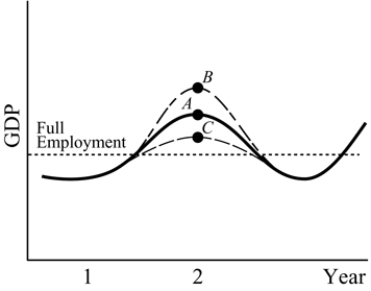 Figure 10.2
-Refer to Figure 10.2 to answer the question below. Points A, B, and C correspond to a GDP level in Year 2. Suppose that in Year 1 the economy was projected to be at Pt. A by Year 2. Which of the following policies could bring the economy to Point C instead?
Figure 10.2
-Refer to Figure 10.2 to answer the question below. Points A, B, and C correspond to a GDP level in Year 2. Suppose that in Year 1 the economy was projected to be at Pt. A by Year 2. Which of the following policies could bring the economy to Point C instead?Free
(Multiple Choice)
4.9/5 (77)
(77) Correct Answer:Verified
VerifiedC
The federal budget works as an automatic economic stabilizer because:
Free
(Multiple Choice)
4.8/5 (70)
(70) Correct Answer:Verified
VerifiedA
Explain why budget deficits are very sensitive to the state of the economy.
(Essay)
5.0/5 (85)
(85) Outside lags in fiscal policy tend to take a long time, usually longer than the inside lags.
(True/False)
4.9/5 (84)
(84) An increase in government spending or a decrease in taxes will cause:
(Multiple Choice)
4.8/5 (82)
(82) The key lesson to remember about budget deficits is that during a recession we should focus on:
(Multiple Choice)
5.0/5 (94)
(94) Inside lags associated with fiscal policy are due to all of the following, except:
(Multiple Choice)
4.9/5 (80)
(80) Recall Application 3, "Evaluating the Obama Fiscal Stimulus" to answer the following questions:
-According to the application, President Obama's economic stimulus package in 2009 had no effect on the US economy.
(True/False)
4.7/5 (100)
(100) The Federal Excise taxes are a major source of revenues for the federal government.
(True/False)
4.8/5 (82)
(82) Which of the following government policies is not considered a fiscal policy?
(Multiple Choice)
4.7/5 (73)
(73) _______ is the school of thought that emphasizes the role of taxes in the supply of output in the economy.
(Multiple Choice)
4.8/5 (75)
(75) 
Filters
- Essay(0)
- Multiple Choice(0)
- Short Answer(0)
- True False(0)
- Matching(0)