



 Chat with AI
Exam 10: Fiscal Policy

Exam 1: Introduction: What Is Economics144 Questions
Exam 2: The Key Principles of Economics195 Questions
Exam 3: Exchange and Markets135 Questions
Exam 4: Demand, Supply, and Market Equilibrium279 Questions
Exam 5: Measuring a Nations Production and Income161 Questions
Exam 6: Unemployment and Inflation206 Questions
Exam 7: The Economy at Full Employment165 Questions
Exam 8: Why Do Economies Grow203 Questions
Exam 9: Aggregate Demand and Aggregate Supply189 Questions
Exam 10: Fiscal Policy166 Questions
Exam 11: The Income-Expenditure Model265 Questions
Exam 12: Investment and Financial Markets179 Questions
Exam 13: Money and the Banking System184 Questions
Exam 14: The Federal Reserve and Monetary Policy203 Questions
Exam 15: Modern Macroeconomics: From the Short Run to the Long Run176 Questions
Exam 16: The Dynamics of Inflation and Unemployment186 Questions
Exam 17: Macroeconomic Policy Debates143 Questions
Exam 18: International Trade and Public Policy226 Questions
Exam 19: The World of International Finance189 Questions
Select questions type


A prolonged budget deficit when the economy is at full employment will eventually crowd out investment spending.
(True/False)
4.9/5  (72)
(72) Recall Application 2, "The Confucius Curve?" to answer the following questions:
-According to the application, the reason why Yu Juo advocated a tax cut if a famine occurs is because:
(Multiple Choice)
4.7/5 (82)
(82) Explain why there is a significant amount of delay in the implementation of a fiscal policy after identifying that the US economy is experiencing a recession.
(Essay)
4.9/5 (90)
(90) The largest category of entitlements and mandatory federal spending is:
(Multiple Choice)
4.7/5 (89)
(89) A government policy that leads to a decrease in aggregate demand is called:
(Multiple Choice)
4.9/5 (78)
(78) Which of the following is an example of a contractionary fiscal policy?
(Multiple Choice)
4.8/5 (84)
(84) The length of time that the U.S. Treasury Department takes to print and mail tax rebate checks to help the economy out of a recession is part of the:
(Multiple Choice)
4.8/5 (69)
(69) Which of the following contributed to the U.S. budget deficit in 2009?
(Multiple Choice)
4.9/5 (81)
(81) 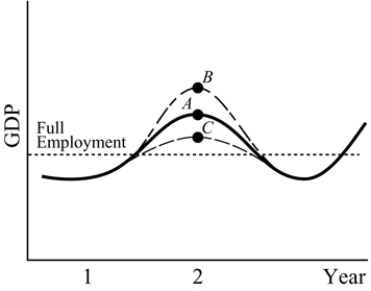 Figure 10.2
-Refer to Figure 10.2 to answer the question below. Points A, B, and C correspond to a GDP level in Year 2. Suppose that in Year 1 the economy was projected to be at Pt. A by Year 2. Which of the following policies could bring the economy to Point B instead?
Figure 10.2
-Refer to Figure 10.2 to answer the question below. Points A, B, and C correspond to a GDP level in Year 2. Suppose that in Year 1 the economy was projected to be at Pt. A by Year 2. Which of the following policies could bring the economy to Point B instead? (Multiple Choice)
4.8/5 (71)
(71) The tax cuts enacted during the first term of President Reagan were proposed to:
(Multiple Choice)
4.8/5 (88)
(88) Proponents of the estate tax argue that the tax is necessary to prevent "unfair" accumulation of wealth across generations.
(True/False)
4.8/5 (88)
(88) Assume that the short- run AS is upward sloping. If the government chooses to reduce government expenditure or to increase taxes, according to the Aggregate Supply - Aggregate Demand model:
(Multiple Choice)
4.7/5 (93)
(93) If the government wants to reduce unemployment, government spending should be_______ and/or taxes should be _______.
(Multiple Choice)
4.7/5 (80)
(80) During the Kennedy Era, the tax cut implemented resulted in
(Multiple Choice)
4.9/5 (77)
(77) If households base their consumption spending on permanent income, then a temporary tax increase will cause a decrease in consumption.
(True/False)
4.9/5 (95)
(95) Recall Application 1, "Increasing Life Expectancy and Aging Populations Spur Costs of Entitlement Programs," to answer
the following questions:
-According to the application, increasing life expectancy would affect the budget because
(Multiple Choice)
4.8/5 (80)
(80) The temporary tax surcharge enacted during the early years of the Vietnam War failed to decrease consumer spending because consumers based their spending on:
(Multiple Choice)
4.8/5 (73)
(73) 
Filters
- Essay(0)
- Multiple Choice(0)
- Short Answer(0)
- True False(0)
- Matching(0)