



 Chat with AI
Exam 14: The Federal Reserve and Monetary Policy

Exam 1: Introduction: What Is Economics144 Questions
Exam 2: The Key Principles of Economics195 Questions
Exam 3: Exchange and Markets135 Questions
Exam 4: Demand, Supply, and Market Equilibrium279 Questions
Exam 5: Measuring a Nations Production and Income161 Questions
Exam 6: Unemployment and Inflation206 Questions
Exam 7: The Economy at Full Employment165 Questions
Exam 8: Why Do Economies Grow203 Questions
Exam 9: Aggregate Demand and Aggregate Supply189 Questions
Exam 10: Fiscal Policy166 Questions
Exam 11: The Income-Expenditure Model265 Questions
Exam 12: Investment and Financial Markets179 Questions
Exam 13: Money and the Banking System184 Questions
Exam 14: The Federal Reserve and Monetary Policy203 Questions
Exam 15: Modern Macroeconomics: From the Short Run to the Long Run176 Questions
Exam 16: The Dynamics of Inflation and Unemployment186 Questions
Exam 17: Macroeconomic Policy Debates143 Questions
Exam 18: International Trade and Public Policy226 Questions
Exam 19: The World of International Finance189 Questions
Select questions type


A decrease in the required reserve ratio:

Free
(Multiple Choice)
4.8/5  (75)
(75) Correct Answer: Verified
D
If the Fed reduces the money supply to reduce inflation:
Free
(Multiple Choice)
4.9/5 (72)
(72) Correct Answer:Verified
VerifiedA
Because the Fed can meet anytime in addition to the 8 scheduled meetings every year, and because the Fed can implement policy changes during any of these meetings, it follows that:
Free
(Multiple Choice)
4.8/5 (85)
(85) Correct Answer:Verified
VerifiedA
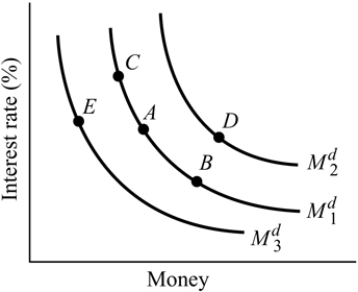 Figure 14.1
-Refer to Figure 14.1. A movement from Point A to Point D can be caused by:
Figure 14.1
-Refer to Figure 14.1. A movement from Point A to Point D can be caused by: (Multiple Choice)
4.8/5 (82)
(82) All else constant, if the economy in experiences a deflation, then:
(Multiple Choice)
4.8/5 (66)
(66) 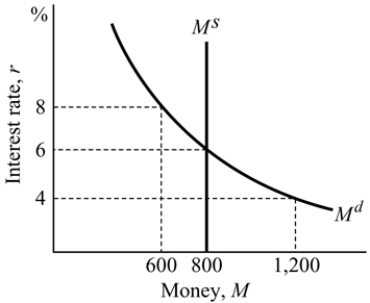 Figure 14.4
-Refer to Figure 14.4. If the Fed wants to reduce the economy's market interest rate from 6 percent to 4 percent, it needs to _______.
Figure 14.4
-Refer to Figure 14.4. If the Fed wants to reduce the economy's market interest rate from 6 percent to 4 percent, it needs to _______. (Multiple Choice)
4.9/5 (81)
(81) What will happen to the equilibrium interest rate when both the money supply and real GDP decrease?
(Multiple Choice)
5.0/5 (77)
(77) 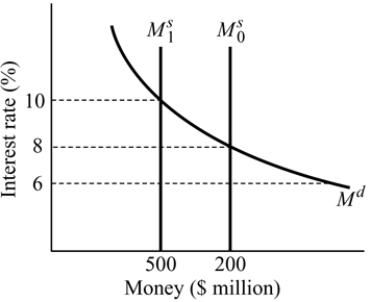 Figure 14.5
-Refer to Figure 14.5. Assume the interest rate equals 8% and the money supply decreases from
 to
 If the interest rate remains at 8% :
Figure 14.5
-Refer to Figure 14.5. Assume the interest rate equals 8% and the money supply decreases from to If the interest rate remains at 8% : (Multiple Choice)
4.8/5 (68)
(68) For a given interest rate, a higher level of output means an increase in the number of transactions and an increase in the demand for money.
(True/False)
4.8/5 (75)
(75) Explain why the Fed does not often choose to use the discount rate to control the money supply.
(Essay)
4.8/5 (81)
(81) When the economy is in a recession and the stock market plunges, the interest rates _______ and the bond prices _______ .
(Multiple Choice)
4.7/5 (81)
(81) The amount of time it takes a given policy action to bring about a change in the state of the economy is called the:
(Multiple Choice)
5.0/5 (92)
(92) The _______ the interest rate, the _______ the opportunity cost of holding money, and the _______ money people will want to hold.
(Multiple Choice)
4.8/5 (90)
(90) Assume the money market is initially in equilibrium. Now, suppose that the price level falls. Graphically illustrate and explain what effect this reduction in the aggregate price level will have on the money market.
(Essay)
4.9/5 (77)
(77) 
Filters
- Essay(0)
- Multiple Choice(0)
- Short Answer(0)
- True False(0)
- Matching(0)