



 Chat with AI
Exam 14: The Federal Reserve and Monetary Policy

Exam 1: Introduction: What Is Economics144 Questions
Exam 2: The Key Principles of Economics195 Questions
Exam 3: Exchange and Markets135 Questions
Exam 4: Demand, Supply, and Market Equilibrium279 Questions
Exam 5: Measuring a Nations Production and Income161 Questions
Exam 6: Unemployment and Inflation206 Questions
Exam 7: The Economy at Full Employment165 Questions
Exam 8: Why Do Economies Grow203 Questions
Exam 9: Aggregate Demand and Aggregate Supply189 Questions
Exam 10: Fiscal Policy166 Questions
Exam 11: The Income-Expenditure Model265 Questions
Exam 12: Investment and Financial Markets179 Questions
Exam 13: Money and the Banking System184 Questions
Exam 14: The Federal Reserve and Monetary Policy203 Questions
Exam 15: Modern Macroeconomics: From the Short Run to the Long Run176 Questions
Exam 16: The Dynamics of Inflation and Unemployment186 Questions
Exam 17: Macroeconomic Policy Debates143 Questions
Exam 18: International Trade and Public Policy226 Questions
Exam 19: The World of International Finance189 Questions
Select questions type


Which of the following represents an action by the Federal Reserve that is designed to increase the money supply?
(Multiple Choice)
4.9/5  (69)
(69) MAKING THE FEDERAL RESERVE MORE TRANSPARENT
What are the advantages and disadvantages of the Federal Reserve becoming more transparent about its actions and
decisions and disclosing more information to the public?
In recent years, the Fed has gradually become more open in its deliberations. For many years, the Fed would not even say if it
had changed interest rates. These policies began to change slowly in the 1990s. Starting in 2000, after each FOMC meeting the
Fed announces its target for the federal funds rate and makes a brief statement
explaining its actions. But should the Fed go further in describing its intended future policies?
There was enough interest on this very topic for the FOMC to hold a special meeting—the first since 1979—to discuss the
issue. Some members of the FOMC, including the current chairman Ben Bernanke, believed that the financial markets
needed more information so that they would have a clearer idea of what future Fed
policy—and short-term interest rates—were likely to be. Other members, including William Poole, the president of the St.
Louis Federal Reserve Bank, disagreed. Poole felt that the financial markets understood the implicit rules that the Fed
followed and that issuing a more complex public statement would just confuse
matters.
The special meeting did not lead to any dramatic change in the Fed’s communication policies. But now the members of the
FOMC participate in drafting statements. The Fed clearly recognizes that its statements
may be just as important as its actions.
-According to the application, the Federal Reserve started announcing its targeted federal funds rate only after:
(Multiple Choice)
5.0/5 (82)
(82) 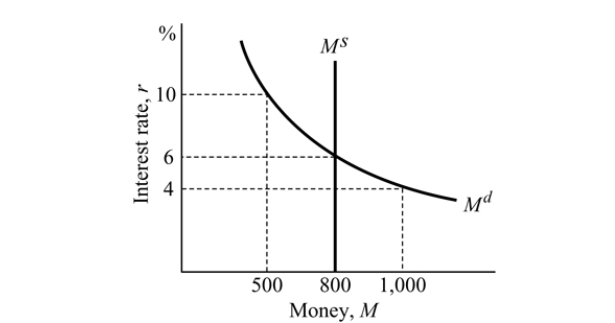 Figure 14.3
-Refer to Figure 14.3. The money market will be in equilibrium at an interest rate of:
Figure 14.3
-Refer to Figure 14.3. The money market will be in equilibrium at an interest rate of: (Multiple Choice)
4.8/5 (68)
(68) An appreciation of the U.S. dollar will likely cause U.S. net exports to _______ and U.S. real GDP to _______.
(Multiple Choice)
4.9/5 (86)
(86) Which of the following is the tool most used by the Fed to control the money supply in the US?
(Multiple Choice)
4.7/5 (76)
(76) Explain how an open market purchase can increase net exports and real GDP.
(Essay)
4.8/5 (78)
(78) Which of the following pairs of events will definitely lead to an increase in the equilibrium interest rate?
(Multiple Choice)
4.8/5 (82)
(82) Recall Application 2, "Rising Interest Rates During an Economic Recovery," to answer the following questions:
-According to the application, an economy that is experiencing a recession (and hence, a lower income) is usually associated with lower interest rates because:
(Multiple Choice)
4.9/5 (84)
(84) A depreciation of a country's currency is likely to decrease its GDP.
(True/False)
4.8/5 (95)
(95) 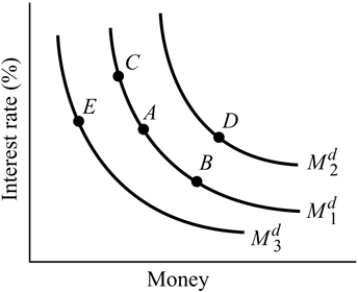 Figure 14.1
-Refer to Figure 14.1. Which of the following events can not cause a movement from Point E to Point A?
Figure 14.1
-Refer to Figure 14.1. Which of the following events can not cause a movement from Point E to Point A? (Multiple Choice)
4.8/5 (80)
(80) Identify the time lags that are associated with stabilization policies.
(Essay)
4.8/5 (77)
(77) The Fed's efforts to stimulate and make the economy grow require that the Fed:
(Multiple Choice)
4.9/5 (73)
(73) Explain what effect a reduction in the U.S. interest rate would have on the exchange rate.
(Essay)
4.9/5 (85)
(85) An increase in the money supply will cause an increase in interest rates, and an increase in investment.
(True/False)
4.7/5 (82)
(82) All else constant, if the GDP in an economy increases then:
(Multiple Choice)
4.8/5 (72)
(72) 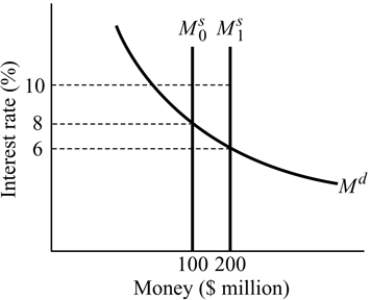 Figure 14.6
-Refer to Figure 14.6. If the money supply increases from
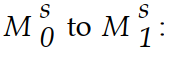
Figure 14.6
-Refer to Figure 14.6. If the money supply increases from (Multiple Choice)
4.9/5 (83)
(83) An increase in the price level in the United States relative to the price level in Mexico will cause an appreciation of the dollar against the peso.
(True/False)
4.9/5 (80)
(80) Explain how each of the following policy actions by the Federal Reserve would affect the quantity of money supplied:
(a) a decrease in the required reserve ratio
(b) an increase in the discount rate
(c) the Fed purchases government bonds from the public
(Essay)
4.8/5 (80)
(80) 
Filters
- Essay(0)
- Multiple Choice(0)
- Short Answer(0)
- True False(0)
- Matching(0)