



 Chat with AI
Exam 14: The Federal Reserve and Monetary Policy

Exam 1: Introduction: What Is Economics144 Questions
Exam 2: The Key Principles of Economics195 Questions
Exam 3: Exchange and Markets135 Questions
Exam 4: Demand, Supply, and Market Equilibrium279 Questions
Exam 5: Measuring a Nations Production and Income161 Questions
Exam 6: Unemployment and Inflation206 Questions
Exam 7: The Economy at Full Employment165 Questions
Exam 8: Why Do Economies Grow203 Questions
Exam 9: Aggregate Demand and Aggregate Supply189 Questions
Exam 10: Fiscal Policy166 Questions
Exam 11: The Income-Expenditure Model265 Questions
Exam 12: Investment and Financial Markets179 Questions
Exam 13: Money and the Banking System184 Questions
Exam 14: The Federal Reserve and Monetary Policy203 Questions
Exam 15: Modern Macroeconomics: From the Short Run to the Long Run176 Questions
Exam 16: The Dynamics of Inflation and Unemployment186 Questions
Exam 17: Macroeconomic Policy Debates143 Questions
Exam 18: International Trade and Public Policy226 Questions
Exam 19: The World of International Finance189 Questions
Select questions type


Explain the effect of an increase in the money supply on an open economy.
(Essay)
4.9/5  (88)
(88) In the money market, the demand and supply of money determine the equilibrium:
(Multiple Choice)
4.7/5 (66)
(66) Why would an individual choose to hold money for speculative purposes when the nominal return to holding money is zero?
(Multiple Choice)
4.8/5 (74)
(74) Assume the money market is initially in equilibrium. Now suppose there is an increase in real GDP. Explain what effect this increase in income will have on the equilibrium interest rate. Also explain what the Fed would have to do if it wants to prevent this change in real GDP from affecting the interest rate.
(Essay)
4.9/5 (83)
(83) All else equal, when the Fed purchases government bonds, the money supply curve shifts to the _______ and the equilibrium interest rate _______.
(Multiple Choice)
4.8/5 (85)
(85) 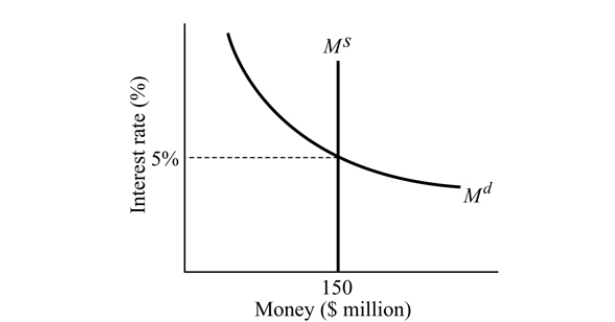 Figure 14.2
-Refer to Figure 14.2. At an interest rate of 8%, there is:
Figure 14.2
-Refer to Figure 14.2. At an interest rate of 8%, there is: (Multiple Choice)
4.8/5 (80)
(80) Which of the following sequence of events follows a rise in the discount rate?
(Multiple Choice)
4.9/5 (69)
(69) 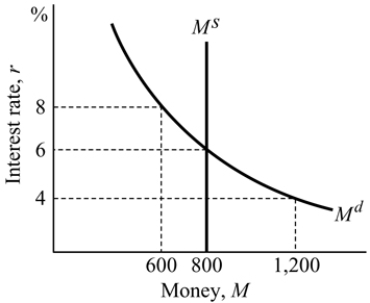 Figure 14.4
-Refer to Figure 14.4. If the Fed wants to raise the economy's market interest rate from 6 percent to 8 percent, and the reserve ratio is 10 percent, then it needs to _______.
Figure 14.4
-Refer to Figure 14.4. If the Fed wants to raise the economy's market interest rate from 6 percent to 8 percent, and the reserve ratio is 10 percent, then it needs to _______. (Multiple Choice)
4.8/5 (97)
(97) MAKING THE FEDERAL RESERVE MORE TRANSPARENT
What are the advantages and disadvantages of the Federal Reserve becoming more transparent about its actions and
decisions and disclosing more information to the public?
In recent years, the Fed has gradually become more open in its deliberations. For many years, the Fed would not even say if it
had changed interest rates. These policies began to change slowly in the 1990s. Starting in 2000, after each FOMC meeting the
Fed announces its target for the federal funds rate and makes a brief statement
explaining its actions. But should the Fed go further in describing its intended future policies?
There was enough interest on this very topic for the FOMC to hold a special meeting—the first since 1979—to discuss the
issue. Some members of the FOMC, including the current chairman Ben Bernanke, believed that the financial markets
needed more information so that they would have a clearer idea of what future Fed
policy—and short-term interest rates—were likely to be. Other members, including William Poole, the president of the St.
Louis Federal Reserve Bank, disagreed. Poole felt that the financial markets understood the implicit rules that the Fed
followed and that issuing a more complex public statement would just confuse
matters.
The special meeting did not lead to any dramatic change in the Fed’s communication policies. But now the members of the
FOMC participate in drafting statements. The Fed clearly recognizes that its statements
may be just as important as its actions.
-According to the application, some members of the FOMC are against making its intended policies more explicit because:
(Multiple Choice)
4.7/5 (72)
(72) Outside time lags are delays in the economy's response to stabilization policies.
(True/False)
5.0/5 (72)
(72) The Fed's management of public expectations is sometimes hindered by its own:
(Multiple Choice)
4.8/5 (85)
(85) 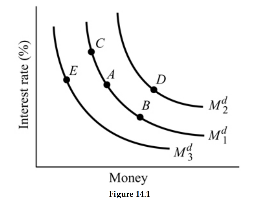 -Refer to Figure 14.1. Which demand for money decreases when income decreases and causes a movement from Point A to Point E?
 (Multiple Choice)
4.8/5 (76)
(76) 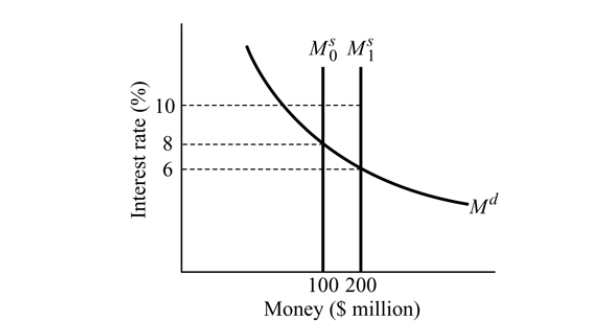 Figure 14.6
-Refer to Figure 14.6. The money supply curve will shift from
 , if:
Figure 14.6
-Refer to Figure 14.6. The money supply curve will shift from , if: (Multiple Choice)
4.7/5 (69)
(69) The discount rate is the interest rate on loans that commercial banks make to the Fed.
(True/False)
5.0/5 (74)
(74) The speculative demand for money states that in the short run, people hold on to money because the return to holding bonds and stocks can be negative.
(True/False)
5.0/5 (67)
(67) The time it takes policymakers to recognize the need for and implement an economic policy to stimulate the economy is known as the outside lag.
(True/False)
4.8/5 (83)
(83) An example of a Federal Reserve action that increases the money supply is:
(Multiple Choice)
4.8/5 (94)
(94) An example of a tool used by the Fed that decreases the money supply is:
(Multiple Choice)
5.0/5 (81)
(81) Suppose Bob holds cash because he expects to need it in the future and it may be costly for him to convert his assets into money later, then the reason Bob holds on to money is the:
(Multiple Choice)
4.9/5 (55)
(55) 
Filters
- Essay(0)
- Multiple Choice(0)
- Short Answer(0)
- True False(0)
- Matching(0)