



 Chat with AI
Exam 18: International Trade and Public Policy

Exam 1: Introduction: What Is Economics144 Questions
Exam 2: The Key Principles of Economics195 Questions
Exam 3: Exchange and Markets135 Questions
Exam 4: Demand, Supply, and Market Equilibrium279 Questions
Exam 5: Measuring a Nations Production and Income161 Questions
Exam 6: Unemployment and Inflation206 Questions
Exam 7: The Economy at Full Employment165 Questions
Exam 8: Why Do Economies Grow203 Questions
Exam 9: Aggregate Demand and Aggregate Supply189 Questions
Exam 10: Fiscal Policy166 Questions
Exam 11: The Income-Expenditure Model265 Questions
Exam 12: Investment and Financial Markets179 Questions
Exam 13: Money and the Banking System184 Questions
Exam 14: The Federal Reserve and Monetary Policy203 Questions
Exam 15: Modern Macroeconomics: From the Short Run to the Long Run176 Questions
Exam 16: The Dynamics of Inflation and Unemployment186 Questions
Exam 17: Macroeconomic Policy Debates143 Questions
Exam 18: International Trade and Public Policy226 Questions
Exam 19: The World of International Finance189 Questions
Select questions type


Free trade will affect a country's employment in different industries.

Free
(True/False)
4.8/5  (85)
(85) Correct Answer: Verified
True
According to the data presented in the text, the effect of Japan's voluntary export restraints on cars was to:
Free
(Multiple Choice)
4.9/5 (76)
(76) Correct Answer:Verified
VerifiedD
 -Refer to Table 18.1. If Poland produces 50 bagpipes, how many accordions can they produce for the rest of the day?
Free
(Multiple Choice)
4.8/5 (73)
(73) Correct Answer:Verified
VerifiedB
Which of the following trade policies will prevent a foreign supplier to sell even one unit of the good in the domestic market?
(Multiple Choice)
4.9/5 (76)
(76) The difficulty with enforcing anti- dumping laws is that predatory pricing is difficult to determine if the lower price is due to:
(Multiple Choice)
4.8/5 (83)
(83) The opportunity cost of a table is 5 chairs in nation A and 1 chair in nation B. If the nations specialize and trade, an acceptable terms of trade for both nations would be 3 chairs per table.
(True/False)
4.8/5 (76)
(76) Recall Application 3, "Are They Really Dumping?" to answer the following questions:
-According to the application, how does the Department of Commerce determine the price of the good in the foreign market?
(Multiple Choice)
4.9/5 (79)
(79) The argument that calls for the trade protection of only newly developing industries is known as the _______ argument.
(Multiple Choice)
4.9/5 (66)
(66) The Asian Pacific Economic Cooperation (APEC) was modeled after NAFTA.
(True/False)
4.8/5 (82)
(82)  -Refer to Table 18.2. Japan has a comparative advantage in the production of
 (Multiple Choice)
4.8/5 (78)
(78) Suppose the United States produces only two goods, textiles and computer chips. If the United States has a comparative advantage in computer chips, a move toward free trade will:
(Multiple Choice)
4.7/5 (87)
(87) If the U.S .government imposes an import ban on German made cars, then:
(Multiple Choice)
4.7/5 (80)
(80) Suppose nation A produces only two goods, apples and oranges . If nation A produces only apples, it can make 20 apples per day. If nation A produces only oranges, it can make 15 oranges per day. If the country has a constant production trade- off between apples and oranges, then the opportunity cost of one apple in nation A is:
(Multiple Choice)
4.7/5 (83)
(83) 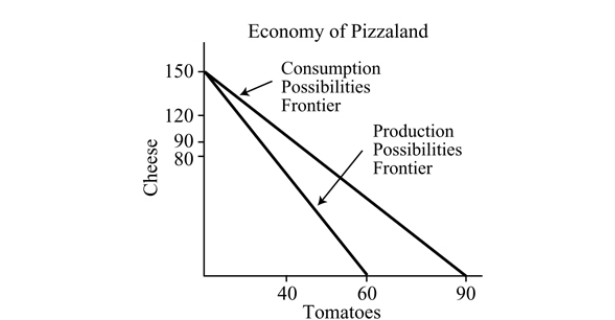 Figure 18.2
-Refer to Figure 18.2. Pizzaland has a comparative advantage in the production of:
Figure 18.2
-Refer to Figure 18.2. Pizzaland has a comparative advantage in the production of: (Multiple Choice)
4.8/5 (85)
(85) In the last few decades there has been considerable progress in lowering the barriers to international trade.
(True/False)
4.9/5 (83)
(83) 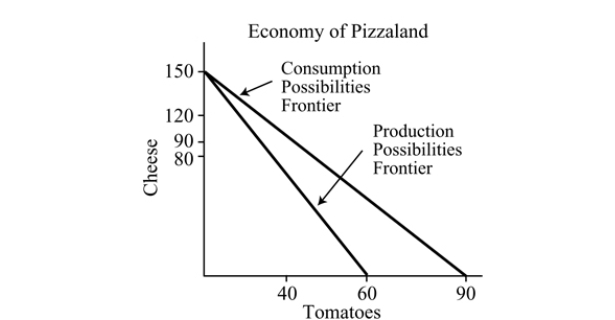 Figure 18.2
-Refer to Figure 18.2. After trade and specialization begin, the maximum amount of cheese that Pizzaland can consume is:
Figure 18.2
-Refer to Figure 18.2. After trade and specialization begin, the maximum amount of cheese that Pizzaland can consume is: (Multiple Choice)
4.9/5 (74)
(74) Among the rationales for protection is that it helps the domestic economy grow.
(True/False)
4.9/5 (79)
(79) 
Filters
- Essay(0)
- Multiple Choice(0)
- Short Answer(0)
- True False(0)
- Matching(0)