



 Chat with AI
Exam 18: International Trade and Public Policy

Exam 1: Introduction: What Is Economics144 Questions
Exam 2: The Key Principles of Economics195 Questions
Exam 3: Exchange and Markets135 Questions
Exam 4: Demand, Supply, and Market Equilibrium279 Questions
Exam 5: Measuring a Nations Production and Income161 Questions
Exam 6: Unemployment and Inflation206 Questions
Exam 7: The Economy at Full Employment165 Questions
Exam 8: Why Do Economies Grow203 Questions
Exam 9: Aggregate Demand and Aggregate Supply189 Questions
Exam 10: Fiscal Policy166 Questions
Exam 11: The Income-Expenditure Model265 Questions
Exam 12: Investment and Financial Markets179 Questions
Exam 13: Money and the Banking System184 Questions
Exam 14: The Federal Reserve and Monetary Policy203 Questions
Exam 15: Modern Macroeconomics: From the Short Run to the Long Run176 Questions
Exam 16: The Dynamics of Inflation and Unemployment186 Questions
Exam 17: Macroeconomic Policy Debates143 Questions
Exam 18: International Trade and Public Policy226 Questions
Exam 19: The World of International Finance189 Questions
Select questions type


The first major international agreement after World War II was the:
(Multiple Choice)
4.9/5  (93)
(93) Suppose there are only 2 nations A and B, and only two goods, x and y. If nation A produces only x, it can make 16x per day. If nation A produces only y, it can make 4y per day. If nation B produces only x, it can make 20x per day. If nation B produces only y, it can make 4y per day. After trade begins, nation _______ will specialize in the production of x and nation _______ will specialize in the production of y.
(Multiple Choice)
4.9/5 (100)
(100) Suppose Japan produces only two goods, rice and electronics. If Japan has a comparative advantage in electronics, a move toward free trade will:
(Multiple Choice)
4.9/5 (77)
(77) A nation can produce anywhere _______ its production possibilities curve.
(Multiple Choice)
4.8/5 (82)
(82) 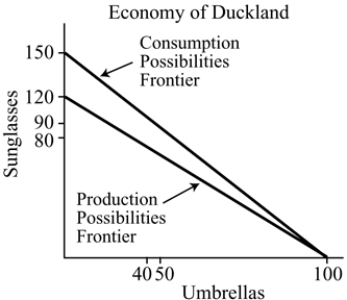 Figure 18.1
-Refer to Figure 18.1. The opportunity cost of producing umbrellas in Duckland is:
Figure 18.1
-Refer to Figure 18.1. The opportunity cost of producing umbrellas in Duckland is: (Multiple Choice)
4.8/5 (80)
(80) Outsourcing occurs when a firm produces components of their good or service in another country.
(True/False)
4.9/5 (92)
(92) Recall Application 1, "The Impact of Tariffs on the Poor," to answer the following questions:
-Because U.S. tariffs are higher on textiles, footwear and apparel items, U.S. tariffs fall relatively most heavily on:
(Multiple Choice)
4.9/5 (89)
(89) If the production possibilities curve is drawn as a straight line it means that:
(Multiple Choice)
4.7/5 (81)
(81) Suppose nation A produces only two goods, apples and oranges . If nation A produces only apples, it can make 12 apples per day. If nation A produces only oranges, it can make 36 oranges per day. If the country has a constant production trade- off between apples and oranges, then the opportunity cost of one apple in nation A is:
(Multiple Choice)
4.9/5 (73)
(73) Suppose there are only 2 nations A and B, and only two goods, x and y. If nation A produces only x, it can make 12x per day. If nation A produces only y, it can make 36y per day. If nation B produces only x, it can make 4x per day. If nation B produces only y, it can make 12y per day. After trade begins, nation _______ will specialize in the production of x and nation _______ will specialize in the production of y.
(Multiple Choice)
4.9/5 (81)
(81)  -Refer to Table 18.1. If Scotland produces 50 bagpipes, how many accordions can they produce for the rest of the day?
 (Multiple Choice)
5.0/5 (81)
(81) 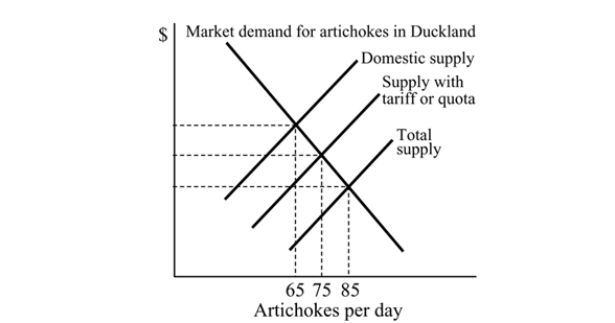 Figure 18.4
-Refer to Figure 18.4. With a tariff or quota, what is the equilibrium price of artichokes in Duckland?
Figure 18.4
-Refer to Figure 18.4. With a tariff or quota, what is the equilibrium price of artichokes in Duckland? (Multiple Choice)
4.9/5 (82)
(82) Environmental regulations increase trade and economic well- being.
(True/False)
4.8/5 (80)
(80) The Dominican Republic- Central American Free Trade Association includes:
(Multiple Choice)
4.9/5 (78)
(78) 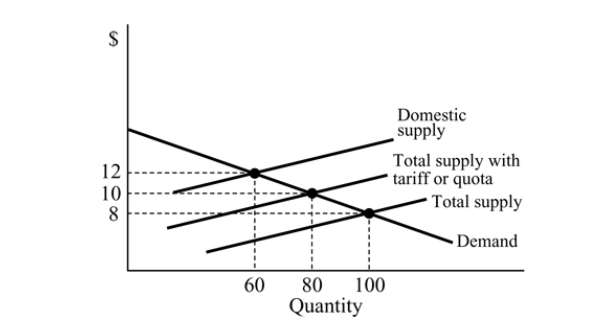 Figure 18.3
-Refer to Figure 18.3. With an import ban, the equilibrium price is:
Figure 18.3
-Refer to Figure 18.3. With an import ban, the equilibrium price is: (Multiple Choice)
4.8/5 (90)
(90) Recall Application 2, "Protection for Candle Makers," to answer the following questions:
-In the application, the French economist Bastiat petitioned for protection of French candle makers from unfair competition from:
(Multiple Choice)
4.8/5 (75)
(75) Consider the following daily production possibilities of apples and bananas in Ireland and Scotland: 
 Supposed that the production of apples require skilled workers while the bananas require unskilled workers. If Scotland and Ireland choose to trade with each other in order to take advantage of their opportunity costs:
a) Who will sell bananas? Who will sell Apples?
b) Which worker will gain in Scotland? Which worker will be hurt?
Supposed that the production of apples require skilled workers while the bananas require unskilled workers. If Scotland and Ireland choose to trade with each other in order to take advantage of their opportunity costs:
a) Who will sell bananas? Who will sell Apples?
b) Which worker will gain in Scotland? Which worker will be hurt? (Essay)
5.0/5 (84)
(84) A possible reason to impose a protectionist policy such as a tariff is to:
(Multiple Choice)
4.7/5 (84)
(84) Which of the following is not an original member of the European Union?
(Multiple Choice)
4.7/5 (61)
(61) 
Filters
- Essay(0)
- Multiple Choice(0)
- Short Answer(0)
- True False(0)
- Matching(0)