



 Chat with AI
Exam 18: International Trade and Public Policy

Exam 1: Introduction: What Is Economics144 Questions
Exam 2: The Key Principles of Economics195 Questions
Exam 3: Exchange and Markets135 Questions
Exam 4: Demand, Supply, and Market Equilibrium279 Questions
Exam 5: Measuring a Nations Production and Income161 Questions
Exam 6: Unemployment and Inflation206 Questions
Exam 7: The Economy at Full Employment165 Questions
Exam 8: Why Do Economies Grow203 Questions
Exam 9: Aggregate Demand and Aggregate Supply189 Questions
Exam 10: Fiscal Policy166 Questions
Exam 11: The Income-Expenditure Model265 Questions
Exam 12: Investment and Financial Markets179 Questions
Exam 13: Money and the Banking System184 Questions
Exam 14: The Federal Reserve and Monetary Policy203 Questions
Exam 15: Modern Macroeconomics: From the Short Run to the Long Run176 Questions
Exam 16: The Dynamics of Inflation and Unemployment186 Questions
Exam 17: Macroeconomic Policy Debates143 Questions
Exam 18: International Trade and Public Policy226 Questions
Exam 19: The World of International Finance189 Questions
Select questions type


 -Refer to Table 18.2. The opportunity cost of stereos in the U.S. is:
 (Multiple Choice)
4.8/5  (81)
(81)  -Refer to Table 18.2. The opportunity cost of stereos in Japan is:
 (Multiple Choice)
4.8/5 (70)
(70) What are some of the reasons why people protest against free trade?
(Multiple Choice)
4.8/5 (87)
(87) 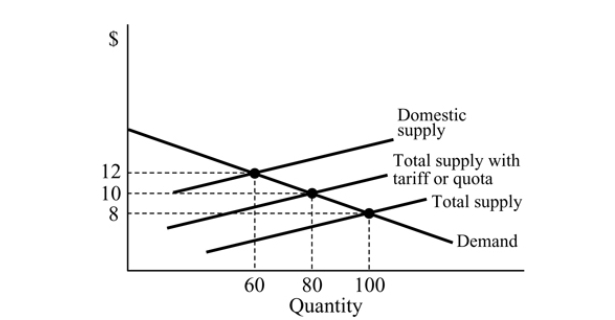 Figure 18.3
-Refer to Figure 18.3. With a tariff or quota, the equilibrium price is:
Figure 18.3
-Refer to Figure 18.3. With a tariff or quota, the equilibrium price is: (Multiple Choice)
4.8/5 (87)
(87) Which of the following situations will arise in the domestic market following the imposition of an import ban?
(Multiple Choice)
4.8/5 (80)
(80) 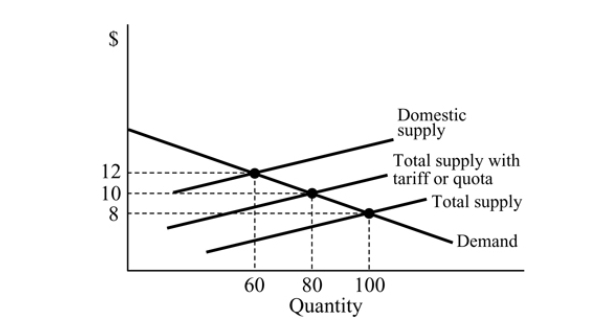 Figure 18.3
-Refer to Figure 18.3. With an import ban, the equilibrium quantity is:
Figure 18.3
-Refer to Figure 18.3. With an import ban, the equilibrium quantity is: (Multiple Choice)
4.7/5 (81)
(81) 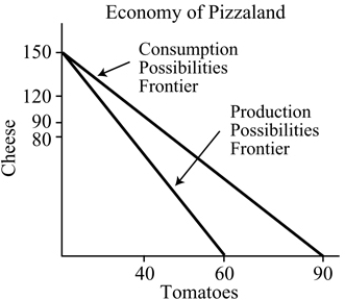 Figure 18.2
-Refer to Figure 18.2. After trade and specialization begin, the maximum amount of tomatoes that Pizzaland can consume is:
Figure 18.2
-Refer to Figure 18.2. After trade and specialization begin, the maximum amount of tomatoes that Pizzaland can consume is: (Multiple Choice)
4.7/5 (71)
(71) Recall Application 1, "The Impact of Tariffs on the Poor," to answer the following questions:
-After reading the application, we can conclude that U.S. tariffs hurt poor consumer's the disproportionately because:
(Multiple Choice)
4.8/5 (89)
(89) 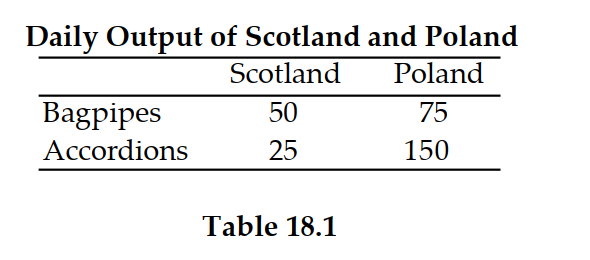 -Refer to Table 18.1. The opportunity cost of a bagpipe in Poland is:
 (Multiple Choice)
4.9/5 (81)
(81) The production possibilities curve represents the set of all:
(Multiple Choice)
4.8/5 (72)
(72) A possible reason a nation might impose a protectionist policy such as a tariff is to:
(Multiple Choice)
4.9/5 (87)
(87) A possible reason a nation might impose a protectionist policy such as a tariff is to:
(Multiple Choice)
4.8/5 (86)
(86) 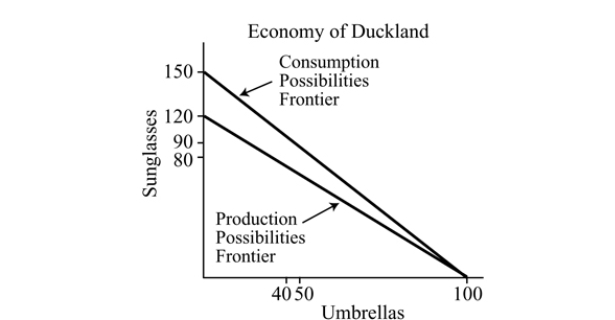 Figure 18.1
-Refer to Figure 18.1. Duckland has a comparative advantage in the production of:
Figure 18.1
-Refer to Figure 18.1. Duckland has a comparative advantage in the production of: (Multiple Choice)
4.9/5 (71)
(71) The World Trade Organization was formed to enforce GATT and other international trade agreements.
(True/False)
4.7/5 (83)
(83) If the opportunity cost of a table is 5 chairs in nation A and 1 chair in nation B, it makes sense for nation B to produce chairs.
(True/False)
5.0/5 (98)
(98) 
Filters
- Essay(0)
- Multiple Choice(0)
- Short Answer(0)
- True False(0)
- Matching(0)