



 Chat with AI
Exam 18: International Trade and Public Policy

Exam 1: Introduction: What Is Economics144 Questions
Exam 2: The Key Principles of Economics195 Questions
Exam 3: Exchange and Markets135 Questions
Exam 4: Demand, Supply, and Market Equilibrium279 Questions
Exam 5: Measuring a Nations Production and Income161 Questions
Exam 6: Unemployment and Inflation206 Questions
Exam 7: The Economy at Full Employment165 Questions
Exam 8: Why Do Economies Grow203 Questions
Exam 9: Aggregate Demand and Aggregate Supply189 Questions
Exam 10: Fiscal Policy166 Questions
Exam 11: The Income-Expenditure Model265 Questions
Exam 12: Investment and Financial Markets179 Questions
Exam 13: Money and the Banking System184 Questions
Exam 14: The Federal Reserve and Monetary Policy203 Questions
Exam 15: Modern Macroeconomics: From the Short Run to the Long Run176 Questions
Exam 16: The Dynamics of Inflation and Unemployment186 Questions
Exam 17: Macroeconomic Policy Debates143 Questions
Exam 18: International Trade and Public Policy226 Questions
Exam 19: The World of International Finance189 Questions
Select questions type


 -Refer to Table 18.1. Poland has a comparative advantage in:
 (Multiple Choice)
4.8/5  (81)
(81) 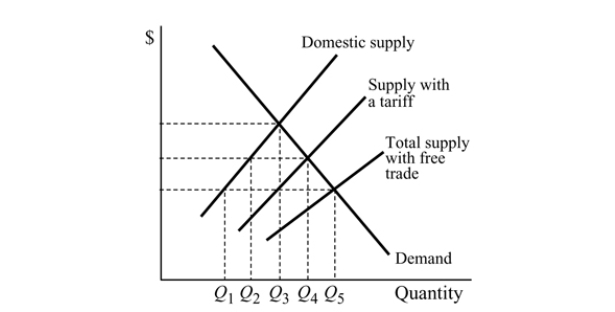 Figure 18.5
-For the good in Figure 18.5 ,with the tariff, the people in the country will produce:
Figure 18.5
-For the good in Figure 18.5 ,with the tariff, the people in the country will produce: (Multiple Choice)
4.9/5 (73)
(73)  -Refer to Table 18.2. After trade begins, _______ will specialize in the production of stereos and _______ will specialize in the production of tractors.
 (Multiple Choice)
4.7/5 (79)
(79) Dumping is sometimes legal under international trade agreements.
(True/False)
4.9/5 (87)
(87) Recall Application 3, "Are They Really Dumping?" to answer the following questions:
-According to the application, how many cases of dumping in 1995- 1998 used the actual price in the foreign market to make a determination if a dumping occurred?
(Multiple Choice)
4.9/5 (69)
(69) If a firm charges a foreign market a lower price than it charges the domestic market that firm is said to be _______ its product.
(Multiple Choice)
4.8/5 (70)
(70)  -Refer to Table 18.1. Possible terms of trade between Scotland and Poland are:
 (Multiple Choice)
4.8/5 (81)
(81)  -Refer to Table 18.1. If Scotland produces and consumes 5 accordions and 40 bagpipes while Poland produces and consumes 25 bagpipes and 100 accordions, then we say that Poland and Scotland are:
 (Multiple Choice)
5.0/5 (75)
(75) Which of the following trade agreements took effect in 1994 and, over a 15- year period, will eliminate all tariffs and other trade barriers between its members?
(Multiple Choice)
4.9/5 (80)
(80) Using a graph, illustrate what the market effects of a quota, a tariff, or a complete ban on imports would be.
(Essay)
4.9/5 (81)
(81) Recall Application 4, "Trade, Consumption and Inequality," to answer the following questions:
-According to the application, what was the moral of the story concerning free trade?
(Multiple Choice)
4.8/5 (68)
(68) Exporting nations often agree to voluntary export restraints in an attempt to:
(Multiple Choice)
5.0/5 (71)
(71) Suppose the United States produces only two goods, grapes and tractors. If the United States has a comparative advantage in tractors, a move toward free trade will:
(Multiple Choice)
4.8/5 (94)
(94) If Cowland can produce milk at a lower opportunity cost than any other nation, Cowland is said to have a(n) _______ in the production of milk.
(Multiple Choice)
4.8/5 (71)
(71) From the perspective of consumers, a quota is preferred to a tariff.
(True/False)
4.9/5 (95)
(95) Recall Application 3, "Are They Really Dumping?" to answer the following questions:
-Based on what you learned from the application, how will the "constructed value" method used by the Department of Commerce affect the number of cases that it will deem as dumping?
(Multiple Choice)
4.9/5 (94)
(94) 
Filters
- Essay(0)
- Multiple Choice(0)
- Short Answer(0)
- True False(0)
- Matching(0)