



 Chat with AI
Exam 18: International Trade and Public Policy

Exam 1: Introduction: What Is Economics144 Questions
Exam 2: The Key Principles of Economics195 Questions
Exam 3: Exchange and Markets135 Questions
Exam 4: Demand, Supply, and Market Equilibrium279 Questions
Exam 5: Measuring a Nations Production and Income161 Questions
Exam 6: Unemployment and Inflation206 Questions
Exam 7: The Economy at Full Employment165 Questions
Exam 8: Why Do Economies Grow203 Questions
Exam 9: Aggregate Demand and Aggregate Supply189 Questions
Exam 10: Fiscal Policy166 Questions
Exam 11: The Income-Expenditure Model265 Questions
Exam 12: Investment and Financial Markets179 Questions
Exam 13: Money and the Banking System184 Questions
Exam 14: The Federal Reserve and Monetary Policy203 Questions
Exam 15: Modern Macroeconomics: From the Short Run to the Long Run176 Questions
Exam 16: The Dynamics of Inflation and Unemployment186 Questions
Exam 17: Macroeconomic Policy Debates143 Questions
Exam 18: International Trade and Public Policy226 Questions
Exam 19: The World of International Finance189 Questions
Select questions type


 -Refer to Table 18.1. If Scotland produces 10 bagpipes, how many accordions can they produce for the rest of the day?
 (Multiple Choice)
4.9/5  (84)
(84) Trade theory suggests that increased trade leads to increased wage inequality.
(True/False)
4.9/5 (86)
(86) If France can produce grapes at a higher opportunity cost than any other nation, France is said to have a(n) _______ in the production of grapes.
(Multiple Choice)
4.8/5 (79)
(79) 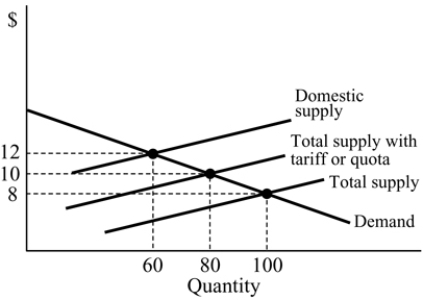 Figure 18.3
-Refer to Figure 18.3. With free trade, domestic production is:
Figure 18.3
-Refer to Figure 18.3. With free trade, domestic production is: (Multiple Choice)
4.9/5 (84)
(84) During the 1980s, firms from _______ were accused of dumping VCRs in Europe.
(Multiple Choice)
4.8/5 (79)
(79) Which of the following organizations has over 149 member nations and oversees the General Agreement on Trade and Tariffs?
(Multiple Choice)
4.9/5 (85)
(85) 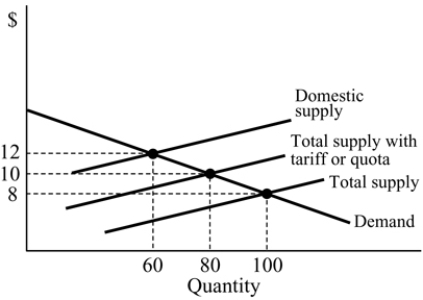 Figure 18.3
-Refer to Figure 18.3. With free trade, the equilibrium price is:
Figure 18.3
-Refer to Figure 18.3. With free trade, the equilibrium price is: (Multiple Choice)
4.8/5 (78)
(78) 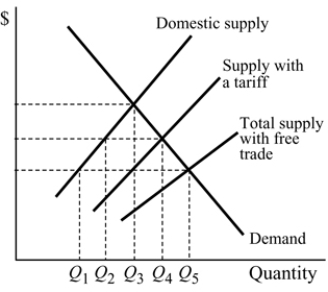 Figure 18.5
-For the good in Figure 18.5, with the tariff, the people in the country will buy:
Figure 18.5
-For the good in Figure 18.5, with the tariff, the people in the country will buy: (Multiple Choice)
4.8/5 (82)
(82) The combinations of goods a nation can consume after trade and specialization begin are illustrated by the _______ curve.
(Multiple Choice)
4.9/5 (80)
(80)  -Refer to Table 18.1. After trade begins, _______ will specialize in the production of accordions and _______ will specialize in the production of bagpipes.
 (Multiple Choice)
5.0/5 (78)
(78) 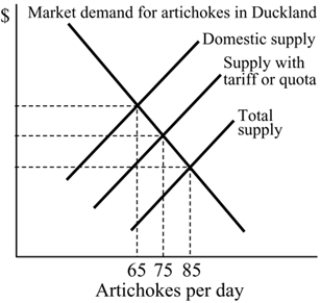 Figure 18.4
-Refer to Figure 18.4. With an import ban, how many artichokes are produced domestically in Duckland?
Figure 18.4
-Refer to Figure 18.4. With an import ban, how many artichokes are produced domestically in Duckland? (Multiple Choice)
4.8/5 (81)
(81) 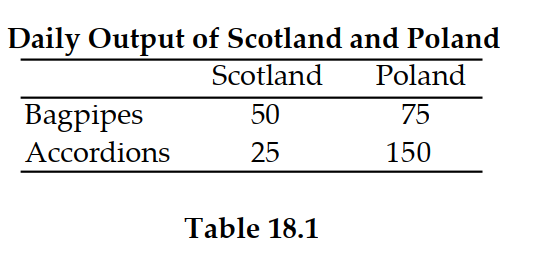 -Refer to Table 18.1. Scotland has a comparative advantage in:
 (Multiple Choice)
5.0/5 (70)
(70) Among the problems associated with subsidizing an industry in the hope of establishing a worldwide monopoly is that if two nations subsidize firms in the same industry, each could lose money.
(True/False)
4.8/5 (92)
(92) _______ occurs when a firm cuts prices below production costs in a deliberate attempt to drive competitors out of business.
(Multiple Choice)
4.8/5 (85)
(85) Which of the following situations will arise in the domestic market following the imposition of a tariff?
(Multiple Choice)
4.9/5 (82)
(82) According to the infant industry argument for trade protectionism:
(Multiple Choice)
4.9/5 (71)
(71) Which of the following trade policies raises prices for domestic consumers?
(Multiple Choice)
4.9/5 (68)
(68) As a whole, nations are better off after trade and specialization because:
(Multiple Choice)
5.0/5 (66)
(66) 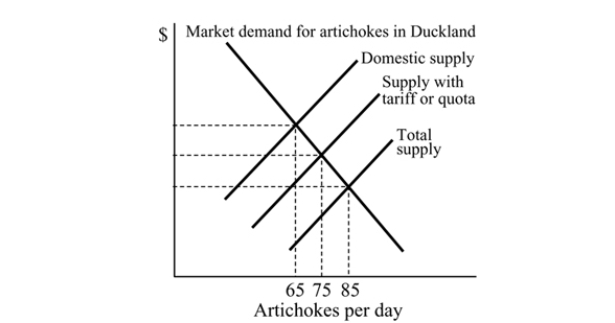 Figure 18.4
-Refer to Figure 18.4. With free trade, what is the equilibrium quantity of artichokes in Duckland?
Figure 18.4
-Refer to Figure 18.4. With free trade, what is the equilibrium quantity of artichokes in Duckland? (Multiple Choice)
4.7/5 (76)
(76) 
Filters
- Essay(0)
- Multiple Choice(0)
- Short Answer(0)
- True False(0)
- Matching(0)