



 Chat with AI
Exam 8: Why Do Economies Grow

Exam 1: Introduction: What Is Economics144 Questions
Exam 2: The Key Principles of Economics195 Questions
Exam 3: Exchange and Markets135 Questions
Exam 4: Demand, Supply, and Market Equilibrium279 Questions
Exam 5: Measuring a Nations Production and Income161 Questions
Exam 6: Unemployment and Inflation206 Questions
Exam 7: The Economy at Full Employment165 Questions
Exam 8: Why Do Economies Grow203 Questions
Exam 9: Aggregate Demand and Aggregate Supply189 Questions
Exam 10: Fiscal Policy166 Questions
Exam 11: The Income-Expenditure Model265 Questions
Exam 12: Investment and Financial Markets179 Questions
Exam 13: Money and the Banking System184 Questions
Exam 14: The Federal Reserve and Monetary Policy203 Questions
Exam 15: Modern Macroeconomics: From the Short Run to the Long Run176 Questions
Exam 16: The Dynamics of Inflation and Unemployment186 Questions
Exam 17: Macroeconomic Policy Debates143 Questions
Exam 18: International Trade and Public Policy226 Questions
Exam 19: The World of International Finance189 Questions
Select questions type


In an open economy, the government can accelerate growth by:

Free
(Multiple Choice)
4.8/5  (68)
(68) Correct Answer: Verified
B
Define human capital. Also explain how it can affect economic growth.
Free
(Essay)
4.8/5 (86)
(86) Correct Answer:Verified
VerifiedHuman capital represents the skills and knowledge possessed by labor. As human capital increases, labor is, therefore, more skilled. This implies that the given workforce can produce a greater quantity of goods and services. This also implies that an increase in human capital will cause an increase in output per capita and, therefore, an increase in economic growth.
If a country uses trade deficits to finance consumption, then the country will experience:
Free
(Multiple Choice)
4.8/5 (78)
(78) Correct Answer:Verified
VerifiedD
Suppose country A has a per capita income of $1000 while country B has a per capita income of $2000. If country A's GDP grows at 7 percent per year, while country B's GDP grows at 3.5 percent per year, how long will it take for country A's income per capita equal country B's?
(Essay)
4.7/5 (77)
(77) Recall Application 2, "Growth Need Not Cause Increased Inequality," to answer the following questions:
-According to the application, Kuznets' theory states that as a country develops:
(Multiple Choice)
4.9/5 (89)
(89) A(n) _______ in the capital stock can _______ output, without a corresponding labor force _______.
(Multiple Choice)
4.8/5 (74)
(74) According to the Solow Model, an increase in technology will always result in an increase in output.
(True/False)
4.9/5 (61)
(61) 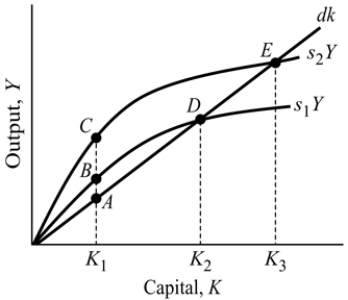 Figure 8.1
-Refer to Figure 8.1. If the saving rate were s1 and the economy's level of K is at K1, then:
Figure 8.1
-Refer to Figure 8.1. If the saving rate were s1 and the economy's level of K is at K1, then: (Multiple Choice)
4.9/5 (72)
(72) Recall Application 4, "Growth Accounting and Information Technology," to answer the following questions:
-According to the application, the proponents of the "New Economy" believe that the increased labor productivity is caused by:
(Multiple Choice)
4.9/5 (82)
(82) Growth promotion through capital deepening is constrained due to:
(Multiple Choice)
4.9/5 (86)
(86) The convergence hypothesis suggests that, all else equal, poor countries grow more rapidly than rich countries.
(True/False)
4.8/5 (67)
(67) Making comparisons of real GDP across countries is difficult because:
(Multiple Choice)
4.9/5 (61)
(61) What is convergence? How is it related to the principle of diminishing returns?
(Essay)
5.0/5 (78)
(78) If total output grows at 4 percent per year while labor and capital grow at 2.0 percent and 2.0 percent pre year, respectively, then:
(Multiple Choice)
4.9/5 (73)
(73) "A trade deficit will always hurt a country." Do you agree or disagree? Explain.
(Essay)
5.0/5 (74)
(74) Explain what else the government must provide along with free public education in order to promote economic growth?
(Essay)
4.8/5 (85)
(85) Governments in developing countries can hinder economic growth by:
(Multiple Choice)
4.9/5 (76)
(76) Due to diminishing returns, the larger the number of scientists and engineers employed in a country, the slower the pace of technological progress.
(True/False)
4.7/5 (71)
(71) Bob has been working for a mortgage company for the last 14 years. When Bob first worked in the company, the company was paying him $12 per hour. This year, he makes $24 per hour. What is the average growth rate of his wage over the past 14 years?
(Multiple Choice)
4.8/5 (85)
(85) 
Filters
- Essay(0)
- Multiple Choice(0)
- Short Answer(0)
- True False(0)
- Matching(0)