



 Chat with AI
Exam 8: Why Do Economies Grow

Exam 1: Introduction: What Is Economics144 Questions
Exam 2: The Key Principles of Economics195 Questions
Exam 3: Exchange and Markets135 Questions
Exam 4: Demand, Supply, and Market Equilibrium279 Questions
Exam 5: Measuring a Nations Production and Income161 Questions
Exam 6: Unemployment and Inflation206 Questions
Exam 7: The Economy at Full Employment165 Questions
Exam 8: Why Do Economies Grow203 Questions
Exam 9: Aggregate Demand and Aggregate Supply189 Questions
Exam 10: Fiscal Policy166 Questions
Exam 11: The Income-Expenditure Model265 Questions
Exam 12: Investment and Financial Markets179 Questions
Exam 13: Money and the Banking System184 Questions
Exam 14: The Federal Reserve and Monetary Policy203 Questions
Exam 15: Modern Macroeconomics: From the Short Run to the Long Run176 Questions
Exam 16: The Dynamics of Inflation and Unemployment186 Questions
Exam 17: Macroeconomic Policy Debates143 Questions
Exam 18: International Trade and Public Policy226 Questions
Exam 19: The World of International Finance189 Questions
Select questions type


With a fixed labor force, diminishing returns means that as capital deepening continues:
(Multiple Choice)
4.9/5  (83)
(83) Creative Destruction, the notion that innovation is promoted by the competitive desire to break production monopolies, can be traced back to:
(Multiple Choice)
5.0/5 (69)
(69) Recall Application 2, "Growth Need Not Cause Increased Inequality," to answer the following questions:
-According to the application, Kuznets' theory states that as a country develops, income inequality:
(Multiple Choice)
4.9/5 (77)
(77) If the capital stock remains _______ while labor _______, the new labor will likely be _______ productive than the old labor because of diminishing returns.
(Multiple Choice)
4.7/5 (71)
(71) The fast pace of technological progress in the U.S. is due to the fact that:
(Multiple Choice)
4.8/5 (70)
(70) 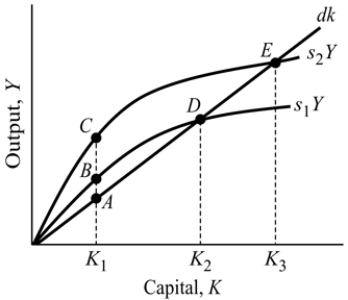 Figure 8.1
-Refer to Figure 8.1. If the saving rate were s1 and the economy's level of K is at K1, then:
Figure 8.1
-Refer to Figure 8.1. If the saving rate were s1 and the economy's level of K is at K1, then: (Multiple Choice)
4.9/5 (79)
(79) 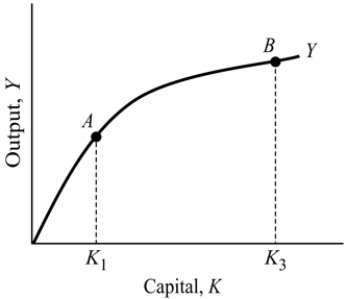 Figure 8.3
-Refer to Figure 8.3. Which of the following will not move the economy from K1 to K3?
Figure 8.3
-Refer to Figure 8.3. Which of the following will not move the economy from K1 to K3? (Multiple Choice)
4.9/5 (81)
(81) In the 20 years from 1980- 2000, evidence suggests that there existed a high rate of convergence across countries.
(True/False)
4.9/5 (83)
(83) Using a production possibility curve, a shifting of the curve outward illustrates:
(Multiple Choice)
4.8/5 (76)
(76) In an economy with no government or foreign sector, the stock of capital depends on:
(Multiple Choice)
4.8/5 (78)
(78) Recall Application 5, "The Role of Political Factors in Economic Growth," to answer the following questions:
-According to the application, China's political institution is considered:
(Multiple Choice)
5.0/5 (84)
(84) A method used to determine the contribution to economic growth from increased capital, labor and technological progress is called:
(Multiple Choice)
4.8/5 (77)
(77) 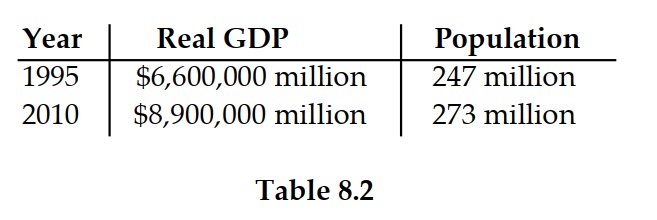 -Refer to Table 8.2. Calculate the growth of real GDP per capita from 1995 to 2001.
 (Essay)
4.8/5 (89)
(89) Based on growth accounting, which of the following would not cause an increase in output?
(Multiple Choice)
4.8/5 (85)
(85) Increased investments in infrastructure or public capital would:
(Multiple Choice)
4.8/5 (86)
(86) If firms in the economy utilize more efficient ways of organizing economic affairs that allow the economy to increase output without increasing inputs, then we say that the economy is experiencing:
(Multiple Choice)
4.8/5 (74)
(74) Governments in developing countries can promote economic growth by:
(Multiple Choice)
4.8/5 (72)
(72) 
Filters
- Essay(0)
- Multiple Choice(0)
- Short Answer(0)
- True False(0)
- Matching(0)