



 Chat with AI
Exam 8: Why Do Economies Grow

Exam 1: Introduction: What Is Economics144 Questions
Exam 2: The Key Principles of Economics195 Questions
Exam 3: Exchange and Markets135 Questions
Exam 4: Demand, Supply, and Market Equilibrium279 Questions
Exam 5: Measuring a Nations Production and Income161 Questions
Exam 6: Unemployment and Inflation206 Questions
Exam 7: The Economy at Full Employment165 Questions
Exam 8: Why Do Economies Grow203 Questions
Exam 9: Aggregate Demand and Aggregate Supply189 Questions
Exam 10: Fiscal Policy166 Questions
Exam 11: The Income-Expenditure Model265 Questions
Exam 12: Investment and Financial Markets179 Questions
Exam 13: Money and the Banking System184 Questions
Exam 14: The Federal Reserve and Monetary Policy203 Questions
Exam 15: Modern Macroeconomics: From the Short Run to the Long Run176 Questions
Exam 16: The Dynamics of Inflation and Unemployment186 Questions
Exam 17: Macroeconomic Policy Debates143 Questions
Exam 18: International Trade and Public Policy226 Questions
Exam 19: The World of International Finance189 Questions
Select questions type


If Julie expects that her salary will increase by 10 percent per year, how many years will it take for her salary to double?
(Multiple Choice)
5.0/5  (72)
(72) Describe how new growth theory explains the impact of comprehensive education in a developing country.
(Essay)
4.9/5 (77)
(77) If the population of Country A is 400 and the real GDP per capita of Country A is $200,000 , then the GDP in country A is:
(Multiple Choice)
4.8/5 (88)
(88) 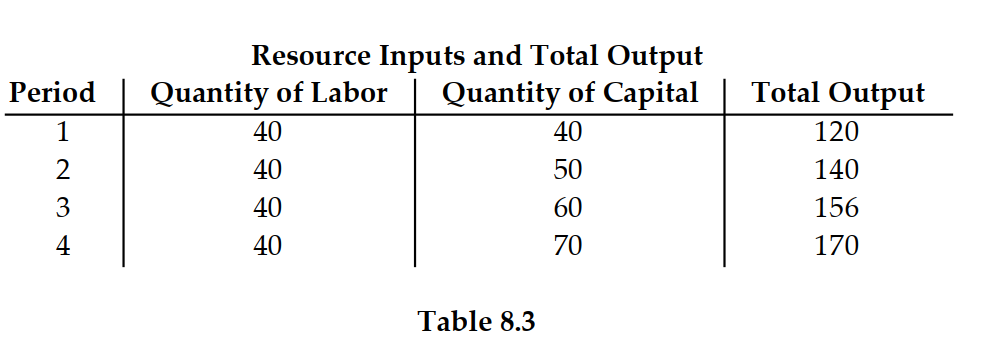 -Refer to Table 8.3. Diminishing returns to capital most obviously occur between periods _______ and _______.
 (Multiple Choice)
4.9/5 (72)
(72) If total output grows at 4 percent per year while labor and capital grow at 1.5 percent and 2.1 percent pre year, respectively, then:
(Multiple Choice)
4.8/5 (70)
(70) Innovations that come about through inventive activity designed specifically to reduce costs is known as:
(Multiple Choice)
4.7/5 (77)
(77) According to the Solow Model, a higher depreciation rate will always result in a decrease in output.
(True/False)
5.0/5 (76)
(76) In order to increase the size of markets, and so promote faster technological innovation, countries could:
(Multiple Choice)
4.7/5 (93)
(93) Explain why policymakers would want to increase the saving rate if they are concerned about economic growth.
(Essay)
4.8/5 (73)
(73) Recall Application 4, "Growth Accounting and Information Technology," to answer the following questions:
-According to the application, the increased productivity due to higher investment in computer technology is
(Multiple Choice)
4.8/5 (78)
(78) 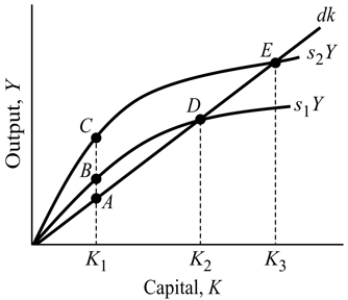 Figure 8.1
-Refer to Figure 8.1. If the saving rate is s2, the economy reaches the long run equilibrium at:
Figure 8.1
-Refer to Figure 8.1. If the saving rate is s2, the economy reaches the long run equilibrium at: (Multiple Choice)
4.9/5 (79)
(79) 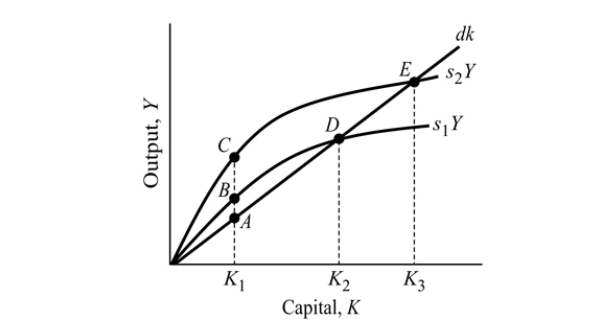 Figure 8.1
-Refer to Figure 8.1 If the saving rate is s1, and the economy currently has K3 level of capital. Which of the following is true?
Figure 8.1
-Refer to Figure 8.1 If the saving rate is s1, and the economy currently has K3 level of capital. Which of the following is true? (Multiple Choice)
4.8/5 (102)
(102) 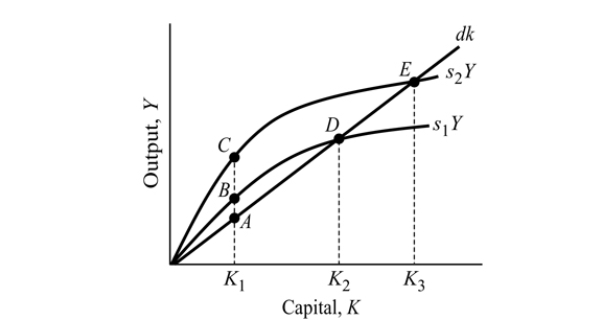 Figure 8.1
-Refer to Figure 8.1. What will happen to the long run equilibrium if the economy changes saving rates from s1 to s2?
Figure 8.1
-Refer to Figure 8.1. What will happen to the long run equilibrium if the economy changes saving rates from s1 to s2? (Multiple Choice)
4.9/5 (67)
(67) According to the Solow Model, a country with a higher level of income always has a higher consumption level.
(True/False)
4.9/5 (67)
(67) If the capital stock remains fixed while the supply of labor increases, it is likely that:
(Multiple Choice)
4.8/5 (74)
(74) In growth accounting, the three sources of growth for a country are:
(Multiple Choice)
5.0/5 (79)
(79) If a county has a growth rate of approximately 0.7 percent each year, it will take about:
(Multiple Choice)
4.8/5 (82)
(82) Human capital increases when the economy experiences a higher birth rate.
(True/False)
4.9/5 (73)
(73) If Canadian income grows at a rate of 2 percent per year and French income grows at a rate of 3 percent each year, it will take about 35 years for Canadian income to double, but only 23 years for French income to double.
(True/False)
4.9/5 (73)
(73) 
Filters
- Essay(0)
- Multiple Choice(0)
- Short Answer(0)
- True False(0)
- Matching(0)