



 Chat with AI
Exam 8: Why Do Economies Grow

Exam 1: Introduction: What Is Economics144 Questions
Exam 2: The Key Principles of Economics195 Questions
Exam 3: Exchange and Markets135 Questions
Exam 4: Demand, Supply, and Market Equilibrium279 Questions
Exam 5: Measuring a Nations Production and Income161 Questions
Exam 6: Unemployment and Inflation206 Questions
Exam 7: The Economy at Full Employment165 Questions
Exam 8: Why Do Economies Grow203 Questions
Exam 9: Aggregate Demand and Aggregate Supply189 Questions
Exam 10: Fiscal Policy166 Questions
Exam 11: The Income-Expenditure Model265 Questions
Exam 12: Investment and Financial Markets179 Questions
Exam 13: Money and the Banking System184 Questions
Exam 14: The Federal Reserve and Monetary Policy203 Questions
Exam 15: Modern Macroeconomics: From the Short Run to the Long Run176 Questions
Exam 16: The Dynamics of Inflation and Unemployment186 Questions
Exam 17: Macroeconomic Policy Debates143 Questions
Exam 18: International Trade and Public Policy226 Questions
Exam 19: The World of International Finance189 Questions
Select questions type


You have just been appointed to a special Presidential Task Force on Economic Growth. You are responsible for proposing three policies that the government can enact to increase the growth rate. What policies would you recommend and why?
(Essay)
4.9/5  (76)
(76) During recessions, the full utilization of the capital stock raises labor productivity.
(True/False)
4.9/5 (82)
(82) According to the rule of 70, if a variable grows at x% per year, then that variable will double in approximately 70/(1- x) years.
(True/False)
4.7/5 (72)
(72) For the United States, explain why the amount of output that each worker can produce per hour has risen in the last half century.
(Essay)
4.9/5 (90)
(90) Based on what you learned from the application, which industries are negatively affected by global warming?
(Multiple Choice)
4.7/5 (87)
(87) Recall Application 5, "The Role of Political Factors in Economic Growth," to answer the following questions:
-According to the application, which of the following is an example of authoritarian institutions?
(Multiple Choice)
4.8/5 (77)
(77) 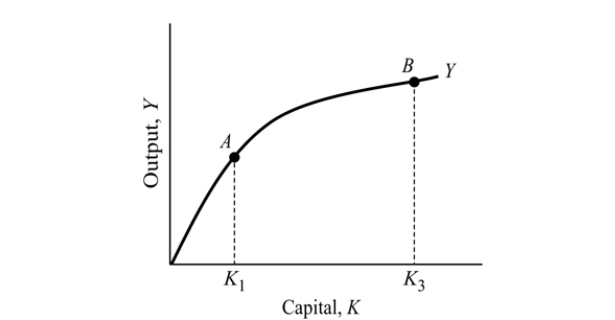 Figure 8.3
-Refer to Figure 8.3. Compared to point A, being at point B implies:
Figure 8.3
-Refer to Figure 8.3. Compared to point A, being at point B implies: (Multiple Choice)
4.8/5 (85)
(85) Recall Application 7, "Lack of Property Rights Hinders Growth in Peru," to answer the following questions:
-According to the application, the inability of households to switch production to highly profitable goods such as palm oil is made difficult by the:
(Multiple Choice)
4.8/5 (97)
(97) Both real GDP and real GDP per capita vary widely from country to country.
(True/False)
4.8/5 (75)
(75) Which of the following countries ran trade deficits in the 19th century to build vast railroad systems?
(Multiple Choice)
4.7/5 (79)
(79) Governments in developing countries can promote economic growth by:
(Multiple Choice)
4.7/5 (83)
(83) 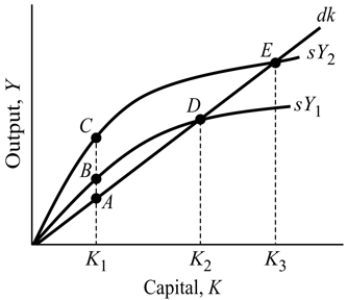 Figure 8.2
-Refer to Figure 8.2 The increase in the equilibrium capital stock from K2 to K3 was brought about by:
Figure 8.2
-Refer to Figure 8.2 The increase in the equilibrium capital stock from K2 to K3 was brought about by: (Multiple Choice)
4.8/5 (80)
(80) Suppose country A has a per capita income of $1000. If country A's GDP grows at 7 percent per year, how long will it take for country A's income per capita equal $4000?
(Essay)
4.9/5 (71)
(71) Developing countries can benefit from the vast accumulated knowledge of developed economies if they invest in:
(Multiple Choice)
4.9/5 (87)
(87) Of the four countries with the highest level of GNP per capita (the United States, Japan, Italy, and the United Kingdom), during the 1960- 2008 period, the fastest growing country was:
(Multiple Choice)
4.8/5 (83)
(83) Recall Application 7, "Lack of Property Rights Hinders Growth in Peru," to answer the following questions:
-According to the application, the houses in urban slums lack:
(Multiple Choice)
4.8/5 (75)
(75) 
Filters
- Essay(0)
- Multiple Choice(0)
- Short Answer(0)
- True False(0)
- Matching(0)