



 Chat with AI
Exam 8: Why Do Economies Grow

Exam 1: Introduction: What Is Economics144 Questions
Exam 2: The Key Principles of Economics195 Questions
Exam 3: Exchange and Markets135 Questions
Exam 4: Demand, Supply, and Market Equilibrium279 Questions
Exam 5: Measuring a Nations Production and Income161 Questions
Exam 6: Unemployment and Inflation206 Questions
Exam 7: The Economy at Full Employment165 Questions
Exam 8: Why Do Economies Grow203 Questions
Exam 9: Aggregate Demand and Aggregate Supply189 Questions
Exam 10: Fiscal Policy166 Questions
Exam 11: The Income-Expenditure Model265 Questions
Exam 12: Investment and Financial Markets179 Questions
Exam 13: Money and the Banking System184 Questions
Exam 14: The Federal Reserve and Monetary Policy203 Questions
Exam 15: Modern Macroeconomics: From the Short Run to the Long Run176 Questions
Exam 16: The Dynamics of Inflation and Unemployment186 Questions
Exam 17: Macroeconomic Policy Debates143 Questions
Exam 18: International Trade and Public Policy226 Questions
Exam 19: The World of International Finance189 Questions
Select questions type


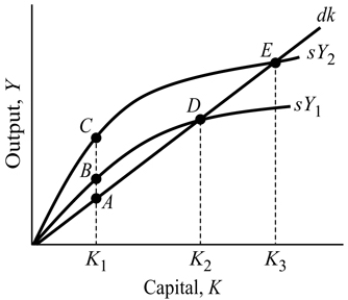 Figure 8.2
-Refer to Figure 8.2 If the economy currently has K1 level of capital, which of the following is true?
Figure 8.2
-Refer to Figure 8.2 If the economy currently has K1 level of capital, which of the following is true? (Multiple Choice)
4.8/5  (74)
(74) Recall Application 6, "Culture, Evolution, and Economic Growth," to answer the following questions:
-According to the application, the research of Galor and Moav concluded that the sources of evolution was genetic because:
(Multiple Choice)
5.0/5 (81)
(81) Larger markets are likely to promote faster technological innovation because:
(Multiple Choice)
4.9/5 (70)
(70) Growth that cannot be explained by increases in capital and labor must be caused by technological progress.
(True/False)
4.7/5 (78)
(78) Recall Application 7, "Lack of Property Rights Hinders Growth in Peru," to answer the following questions:
-Explain how the lack of clear ownership of urban dwellings prevent firms from investing in businesses that are highly profitable.
(Essay)
4.7/5 (75)
(75) Using the rule of 70, how many years would it take for David's income to double if he was to experience a 4 percent increase in income each year?
(Multiple Choice)
4.9/5 (85)
(85) Many economists believe that technological progress in the U.S. would be accelerated if:
(Multiple Choice)
4.9/5 (84)
(84) Recall Application 1 , "Global Warming, Rich Countries and Poor Countries," to answer the following questions:
-Based on what you learned from the application, a one degree Celsius increase in temperatures:
(Multiple Choice)
4.9/5 (78)
(78) In the Solow Model, an increase in the capital stock (K) by 10 percent, (holding L constant) will result in an
(Multiple Choice)
4.9/5 (74)
(74) Because of the principle of diminishing returns, growth promotion through capital deepening works better in countries that:
(Multiple Choice)
4.7/5 (77)
(77) When relative prices are taken into consideration, the country with the highest level of real GDP per capita in 2008 was:
(Multiple Choice)
4.8/5 (74)
(74) Which of the following is an assumption in the Solow Model?
(Multiple Choice)
4.8/5 (75)
(75) In the Solow Model, a higher depreciation rate is illustrated as:
(Multiple Choice)
4.7/5 (75)
(75) Explain how each of the following is related to the rates of productivity and economic growth in an economy:
(a) the level of investment spending
(b) the extent of government regulation
(c) the level of spending on research and development
(d) the saving rate
(Essay)
4.8/5 (86)
(86) In addition to saving and investment, what other public policies might a country adopt to increase labor productivity?
(Essay)
4.9/5 (80)
(80) Recall Application 1 , "Global Warming, Rich Countries and Poor Countries," to answer the following questions:
-Based on what you learned from the application, in what way can we improve the standard of living in poor countries?
(Multiple Choice)
4.8/5 (70)
(70) According to growth accounting, which of the following helps explain why the growth rate in the United States has been positive during the 1900s?
(Multiple Choice)
4.9/5 (80)
(80) In growth accounting, the three sources of growth for a country are capital, labor and:
(Multiple Choice)
4.7/5 (99)
(99) Other things equal, relatively poor countries tend to grow _______ than relatively rich countries and this is known as _______.
(Multiple Choice)
4.8/5 (67)
(67) Real GDP was 120 in year 1 and 140 in year 2. In this case, the growth rate of real GDP would be:
(Multiple Choice)
5.0/5 (88)
(88) 
Filters
- Essay(0)
- Multiple Choice(0)
- Short Answer(0)
- True False(0)
- Matching(0)