



 Chat with AI
Exam 10: Fiscal Policy

Exam 1: Introduction: What Is Economics144 Questions
Exam 2: The Key Principles of Economics195 Questions
Exam 3: Exchange and Markets135 Questions
Exam 4: Demand, Supply, and Market Equilibrium279 Questions
Exam 5: Measuring a Nations Production and Income161 Questions
Exam 6: Unemployment and Inflation206 Questions
Exam 7: The Economy at Full Employment165 Questions
Exam 8: Why Do Economies Grow203 Questions
Exam 9: Aggregate Demand and Aggregate Supply189 Questions
Exam 10: Fiscal Policy166 Questions
Exam 11: The Income-Expenditure Model265 Questions
Exam 12: Investment and Financial Markets179 Questions
Exam 13: Money and the Banking System184 Questions
Exam 14: The Federal Reserve and Monetary Policy203 Questions
Exam 15: Modern Macroeconomics: From the Short Run to the Long Run176 Questions
Exam 16: The Dynamics of Inflation and Unemployment186 Questions
Exam 17: Macroeconomic Policy Debates143 Questions
Exam 18: International Trade and Public Policy226 Questions
Exam 19: The World of International Finance189 Questions
Select questions type


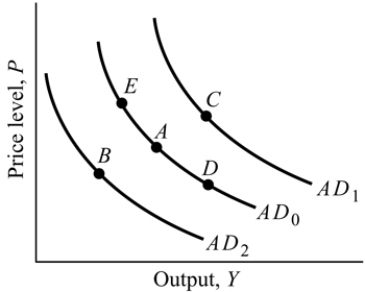 Figure 10.1
-Refer to Figure 10.1 to answer this question. Suppose that the economy were at point A, and the government decreases government spending. In the short run , the economy will move to point:
Figure 10.1
-Refer to Figure 10.1 to answer this question. Suppose that the economy were at point A, and the government decreases government spending. In the short run , the economy will move to point: (Multiple Choice)
4.9/5  (87)
(87) Long- term budget deficits are bad for the economy for all the following reasons except:
(Multiple Choice)
4.9/5 (86)
(86) The fiscal expansion during the Kennedy administration was successful because the economy was already operating above full employment.
(True/False)
4.9/5 (79)
(79) One reason why the US government experienced a surplus during Clinton's era was that the U.S. economy was growing.
(True/False)
4.8/5 (80)
(80) Which of the following is an example of an expansionary fiscal policy?
(Multiple Choice)
4.8/5 (72)
(72) The federal budget acts as an automatic economic stabilizer because the President has the power to authorize additional discretionary spending.
(True/False)
4.9/5 (98)
(98) The corporate tax rate during the Kennedy Administration was lower than the corporate tax rate today.
(True/False)
4.8/5 (76)
(76) In fiscal policy, the outside lag usually takes longer than the inside lag.
(True/False)
4.8/5 (86)
(86) Recall Application 1, "Increasing Life Expectancy and Aging Populations Spur Costs of Entitlement Programs," to answer
the following questions:
-According to the application, estimates of the size of spending for Social Security, Medicare and Medicaid is approximately _______ percent of GDP by 2075.
(Multiple Choice)
4.7/5 (74)
(74) According to the textbook, the Great Depression was prolonged due to the lack of net fiscal expansion.
(True/False)
4.9/5 (85)
(85) The tax cuts of the first Reagan administration were intended to stimulate aggregate supply, rather than to stimulate aggregate demand.
(True/False)
4.8/5 (92)
(92) As a large proportion of the population retire in the next few years, what would happen to the federal revenue?
(Multiple Choice)
4.7/5 (91)
(91) The budget deficit was about _______ percent of GDP in 2009.
(Multiple Choice)
4.8/5 (82)
(82) 
Filters
- Essay(0)
- Multiple Choice(0)
- Short Answer(0)
- True False(0)
- Matching(0)