



 Chat with AI
Exam 10: Fiscal Policy

Exam 1: Introduction: What Is Economics144 Questions
Exam 2: The Key Principles of Economics195 Questions
Exam 3: Exchange and Markets135 Questions
Exam 4: Demand, Supply, and Market Equilibrium279 Questions
Exam 5: Measuring a Nations Production and Income161 Questions
Exam 6: Unemployment and Inflation206 Questions
Exam 7: The Economy at Full Employment165 Questions
Exam 8: Why Do Economies Grow203 Questions
Exam 9: Aggregate Demand and Aggregate Supply189 Questions
Exam 10: Fiscal Policy166 Questions
Exam 11: The Income-Expenditure Model265 Questions
Exam 12: Investment and Financial Markets179 Questions
Exam 13: Money and the Banking System184 Questions
Exam 14: The Federal Reserve and Monetary Policy203 Questions
Exam 15: Modern Macroeconomics: From the Short Run to the Long Run176 Questions
Exam 16: The Dynamics of Inflation and Unemployment186 Questions
Exam 17: Macroeconomic Policy Debates143 Questions
Exam 18: International Trade and Public Policy226 Questions
Exam 19: The World of International Finance189 Questions
Select questions type


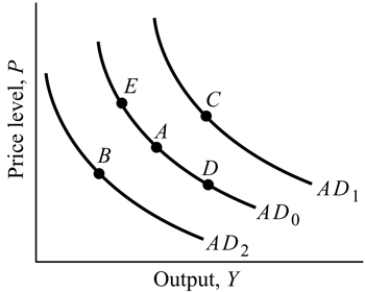 Figure 10.1
-Refer to Figure 10.1 to answer this question. Suppose that the economy were at point A, and the government increases taxes. In the short run , the economy will move to point:
Figure 10.1
-Refer to Figure 10.1 to answer this question. Suppose that the economy were at point A, and the government increases taxes. In the short run , the economy will move to point: (Multiple Choice)
4.8/5  (78)
(78) Rank (from 1 to 4) the following categories of federal revenue from larger (1) to smaller (4):
( ) Corporate income taxes
( ) Social Security taxes
( ) Individual income taxes
( ) Estate and gift taxes
(Essay)
4.9/5 (77)
(77) Which of the following is included in "Entitlement and mandatory spending?"
(Multiple Choice)
4.9/5 (84)
(84) As the national debt of the United States becomes larger, which component of the Federal Spending would increase the most?
(Multiple Choice)
4.9/5 (90)
(90) 
Filters
- Essay(0)
- Multiple Choice(0)
- Short Answer(0)
- True False(0)
- Matching(0)