



 Chat with AI
Exam 17: A: International Trade

Exam 1: B: Limits, Alternatives, and Choices265 Questions
Exam 1: A: - Limits, Alternatives, and Choices60 Questions
Exam 2: B: The Market System and the Circular Flow119 Questions
Exam 2: A: - The Market System and the Circular Flow42 Questions
Exam 3: B: Demand, Supply, and Market Equilibrium291 Questions
Exam 3: A: - Demand, Supply, and Market Equilibrium51 Questions
Exam 4: B: Market Failures: Public Goods and Externalities133 Questions
Exam 4: A: - Market Failures: Public Goods and Externalities36 Questions
Exam 5: B: Governments Role and Government Failure121 Questions
Exam 5: A: Governments Role and Government Failure1 Questions
Exam 6: B: an Introduction to Macroeconomics65 Questions
Exam 6: A: an Introduction to Macroeconomics31 Questions
Exam 7: B: Measuring the Economys Output191 Questions
Exam 7: A: Measuring the Economys Output30 Questions
Exam 8: B: Economic Growth122 Questions
Exam 8: A: Economic Growth35 Questions
Exam 9: B: Business Cycles, Unemployment, and Inflation193 Questions
Exam 9: A: Business Cycles, Unemployment, and Inflation40 Questions
Exam 10: B: Basic Macroeconomic Relationships200 Questions
Exam 10: A: Basic Macroeconomic Relationships26 Questions
Exam 11: B: The Aggregate Expenditures Model238 Questions
Exam 11: A: The Aggregate Expenditures Model47 Questions
Exam 12: B: Aggregate Demand and Aggregate Supply203 Questions
Exam 12: A: Aggregate Demand and Aggregate Supply35 Questions
Exam 13: B: Fiscal Policy, Deficits, Surpluses, and Debt234 Questions
Exam 13: A: Fiscal Policy, Deficits, Surpluses, and Debt53 Questions
Exam 14: B: Money, Banking, and Money Creation206 Questions
Exam 14: A: Money, Banking, and Money Creation56 Questions
Exam 15: B: Interest Rates and Monetary Policy239 Questions
Exam 15: A: Interest Rates and Monetary Policy47 Questions
Exam 17: C: Financial Economics323 Questions
Exam 16: A: Long-Run Macroeconomic Adjustments28 Questions
Exam 16: B: Long-Run Macroeconomic Adjustments122 Questions
Exam 17: A: International Trade40 Questions
Exam 17: B: International Trade188 Questions
Exam 18: A: The Balance of Payments and Exchange Rates30 Questions
Exam 18: B: The Balance of Payments and Exchange Rates133 Questions
Exam 22: The Economics of Developing Countries254 Questions
Select questions type


The table below shows the maximum amounts of food and clothing that two nations, A and B, can produce.Draw the production possibilities curve for A and B using the below graphs.Assume constant costs. 
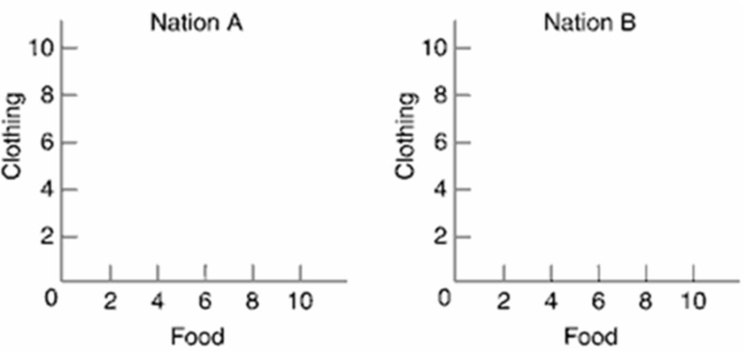 (a) What is the cost ratio for the two products?(b) If each nation specializes according to comparative advantage, who should produce and trade each product? Why?(c) What will be the range for the terms of trade? If the terms are set at 1 food = 2 clothing, show how the trading possibilities lines will change in the graph.Explain.
 (Essay)
4.8/5  (76)
(76) How do protectionist policies affect consumers, workers, producers, and the government? Explain.
(Essay)
4.9/5 (77)
(77) Of all the reason for protests against the WTO, which are most substantive?
(Essay)
4.8/5 (88)
(88) The following table shows the domestic quantity demanded (QD) and quantity supplied (QS) of soybeans in Canada and Brazil at various prices (in Canadian dollars). 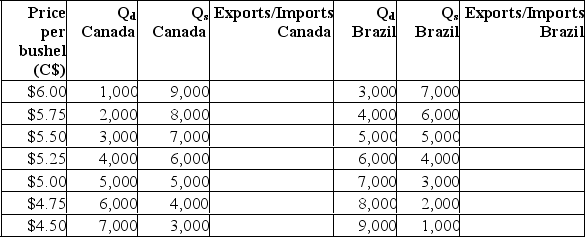 (a) Complete the above table by indicating the size of exports or imports for each country at each price.(b) Suppose Canada and Brazil are closed economies.What is the domestic price of soybeans in Canada? What is the domestic price of soybeans in Brazil?(c) Suppose Canada and Brazil are the only countries in a two-nation world.What is the world price of soybeans? Is Canada an exporter or an importer at the world price? Is Brazil an exporter or an importer at the world price?

(a) Complete the above table by indicating the size of exports or imports for each country at each price.(b) Suppose Canada and Brazil are closed economies.What is the domestic price of soybeans in Canada? What is the domestic price of soybeans in Brazil?(c) Suppose Canada and Brazil are the only countries in a two-nation world.What is the world price of soybeans? Is Canada an exporter or an importer at the world price? Is Brazil an exporter or an importer at the world price?
(Essay)
4.8/5 (89)
(89) Given the data in the graph below, which nation should specialize in steel production and which nation in wheat production? Why? 
(Essay)
4.9/5 (81)
(81) Evaluate the statement: "Tariffs and quotas are needed to protect Canadian products from dumping."
(Essay)
4.9/5 (95)
(95) Evaluate the validity of the argument that a new industry in a nation needs protection from foreign competition if it is to prosper.
(Essay)
4.9/5 (91)
(91) How can Canada compete successfully with relatively low-wage nations such as India and China?
(Essay)
5.0/5 (73)
(73) What are the similarities and differences in the economic effects of tariffs and quotas?
(Essay)
4.8/5 (79)
(79) Answer the next three questions on the basis of the following production possibilities data for Narnia and Somosa.All figures are in thousands of units. 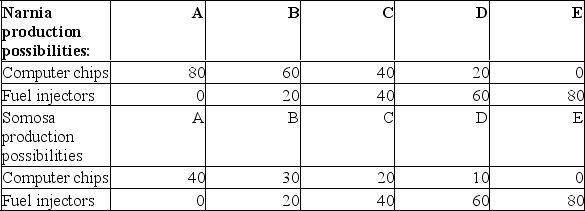 (a) If trade occurs between Narnia and Somosa, which nation should export what product? Why?(b) What are the limits of the terms of trade between Narnia and Somosa?(c) Assume that prior to specialization and trade, Narnia and Somosa chose production possibility "C." Now each specializes according to comparative advantage.What will be the resulting gains from trade? Explain your answer.
 (Essay)
4.7/5 (77)
(77) How can supply and demand analysis be used to explain the equilibrium price and quantity of exports and imports for aluminum when there is trade between two nations (e.g., the United States and Canada)?
(Essay)
4.9/5 (83)
(83) Why might trade barriers be a highly ineffective technique for increasing domestic employment?
(Essay)
4.8/5 (85)
(85) What are the net costs of tariffs and quotas on consumption and income distribution?
(Essay)
4.8/5 (75)
(75) What are the limitations to the diversification for stability argument for trade protection?
(Essay)
4.7/5 (88)
(88) 
Filters
- Essay(0)
- Multiple Choice(0)
- Short Answer(0)
- True False(0)
- Matching(0)