



 Chat with AI
Exam 9: B: Business Cycles, Unemployment, and Inflation

Exam 1: B: Limits, Alternatives, and Choices265 Questions
Exam 1: A: - Limits, Alternatives, and Choices60 Questions
Exam 2: B: The Market System and the Circular Flow119 Questions
Exam 2: A: - The Market System and the Circular Flow42 Questions
Exam 3: B: Demand, Supply, and Market Equilibrium291 Questions
Exam 3: A: - Demand, Supply, and Market Equilibrium51 Questions
Exam 4: B: Market Failures: Public Goods and Externalities133 Questions
Exam 4: A: - Market Failures: Public Goods and Externalities36 Questions
Exam 5: B: Governments Role and Government Failure121 Questions
Exam 5: A: Governments Role and Government Failure1 Questions
Exam 6: B: an Introduction to Macroeconomics65 Questions
Exam 6: A: an Introduction to Macroeconomics31 Questions
Exam 7: B: Measuring the Economys Output191 Questions
Exam 7: A: Measuring the Economys Output30 Questions
Exam 8: B: Economic Growth122 Questions
Exam 8: A: Economic Growth35 Questions
Exam 9: B: Business Cycles, Unemployment, and Inflation193 Questions
Exam 9: A: Business Cycles, Unemployment, and Inflation40 Questions
Exam 10: B: Basic Macroeconomic Relationships200 Questions
Exam 10: A: Basic Macroeconomic Relationships26 Questions
Exam 11: B: The Aggregate Expenditures Model238 Questions
Exam 11: A: The Aggregate Expenditures Model47 Questions
Exam 12: B: Aggregate Demand and Aggregate Supply203 Questions
Exam 12: A: Aggregate Demand and Aggregate Supply35 Questions
Exam 13: B: Fiscal Policy, Deficits, Surpluses, and Debt234 Questions
Exam 13: A: Fiscal Policy, Deficits, Surpluses, and Debt53 Questions
Exam 14: B: Money, Banking, and Money Creation206 Questions
Exam 14: A: Money, Banking, and Money Creation56 Questions
Exam 15: B: Interest Rates and Monetary Policy239 Questions
Exam 15: A: Interest Rates and Monetary Policy47 Questions
Exam 17: C: Financial Economics323 Questions
Exam 16: A: Long-Run Macroeconomic Adjustments28 Questions
Exam 16: B: Long-Run Macroeconomic Adjustments122 Questions
Exam 17: A: International Trade40 Questions
Exam 17: B: International Trade188 Questions
Exam 18: A: The Balance of Payments and Exchange Rates30 Questions
Exam 18: B: The Balance of Payments and Exchange Rates133 Questions
Exam 22: The Economics of Developing Countries254 Questions
Select questions type


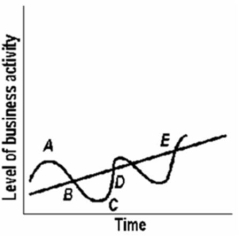 The above diagram shows different phases of the:

During the past ten years the average annual rate of inflation in Canada has been less than 1 percent.
(True/False)
4.7/5  (88)
(88) The price level has doubled in 35 years.The approximate annual percentage rate of increase in the price level over this period has been:
(Multiple Choice)
4.9/5 (91)
(91) A nation has a population of 260 million people.Of these, 60 million are retired, in the military, in institutions, or under 15 years old.There are 188 million who are employed.What is the unemployment rate?
(Multiple Choice)
4.9/5 (83)
(83) Suppose rate of inflation for some specific year was 10 percent.If the CPI for that year was 139.7, the previous year's CPI must have been:
(Multiple Choice)
4.9/5 (84)
(84) If the consumer price index falls from 120 to 116 in a particular year, the economy has experienced:
(Multiple Choice)
4.8/5 (75)
(75) If the CPI was 160 in 2008 and 40 in 2005, the cost of living was:
(Multiple Choice)
4.8/5 (84)
(84) If the nominal interest rate is 12 percent and the real interest rate is 8 percent, then the inflation premium is:
(Multiple Choice)
4.7/5 (84)
(84) Kevin has lost his job in an automobile plant because of the use of robots for welding on the assembly line.Kevin plans to go to technical school to learn how to repair microcomputers.The type of unemployment Kevin is faced with is:
(Multiple Choice)
4.9/5 (88)
(88) For every 1 percent that the actual unemployment rate exceeds the natural rate, there is generated a 2 percent GDP gap.This is a statement of:
(Multiple Choice)
4.8/5 (86)
(86) Working as an elevator operator used to be a common job in the workforce four decades ago, but today few jobs remain.The unemployment created by introduction of automatic elevators would be considered:
(Multiple Choice)
5.0/5 (86)
(86) If average nominal income was about $15,000 and the price level index was 118, then average real income would be about:
(Multiple Choice)
4.9/5 (75)
(75) An annual rate of inflation of 7 percent will double the price level in about 15 years.
(True/False)
4.9/5 (85)
(85) The aggregate cost of unemployment can be measured by the:
(Multiple Choice)
4.8/5 (76)
(76) A cumulative wage-price spiral which produces a rapid and huge increase in the price level can be characterized as:
(Multiple Choice)
4.9/5 (74)
(74) If the total population is 175 million, the labour force is 100 million, and 89 million workers are employed, then the unemployment rate is 11 percent.
(True/False)
5.0/5 (73)
(73) 
Filters
- Essay(0)
- Multiple Choice(0)
- Short Answer(0)
- True False(0)
- Matching(0)