



 Chat with AI
Exam 11: B: The Aggregate Expenditures Model

Exam 1: B: Limits, Alternatives, and Choices265 Questions
Exam 1: A: - Limits, Alternatives, and Choices60 Questions
Exam 2: B: The Market System and the Circular Flow119 Questions
Exam 2: A: - The Market System and the Circular Flow42 Questions
Exam 3: B: Demand, Supply, and Market Equilibrium291 Questions
Exam 3: A: - Demand, Supply, and Market Equilibrium51 Questions
Exam 4: B: Market Failures: Public Goods and Externalities133 Questions
Exam 4: A: - Market Failures: Public Goods and Externalities36 Questions
Exam 5: B: Governments Role and Government Failure121 Questions
Exam 5: A: Governments Role and Government Failure1 Questions
Exam 6: B: an Introduction to Macroeconomics65 Questions
Exam 6: A: an Introduction to Macroeconomics31 Questions
Exam 7: B: Measuring the Economys Output191 Questions
Exam 7: A: Measuring the Economys Output30 Questions
Exam 8: B: Economic Growth122 Questions
Exam 8: A: Economic Growth35 Questions
Exam 9: B: Business Cycles, Unemployment, and Inflation193 Questions
Exam 9: A: Business Cycles, Unemployment, and Inflation40 Questions
Exam 10: B: Basic Macroeconomic Relationships200 Questions
Exam 10: A: Basic Macroeconomic Relationships26 Questions
Exam 11: B: The Aggregate Expenditures Model238 Questions
Exam 11: A: The Aggregate Expenditures Model47 Questions
Exam 12: B: Aggregate Demand and Aggregate Supply203 Questions
Exam 12: A: Aggregate Demand and Aggregate Supply35 Questions
Exam 13: B: Fiscal Policy, Deficits, Surpluses, and Debt234 Questions
Exam 13: A: Fiscal Policy, Deficits, Surpluses, and Debt53 Questions
Exam 14: B: Money, Banking, and Money Creation206 Questions
Exam 14: A: Money, Banking, and Money Creation56 Questions
Exam 15: B: Interest Rates and Monetary Policy239 Questions
Exam 15: A: Interest Rates and Monetary Policy47 Questions
Exam 17: C: Financial Economics323 Questions
Exam 16: A: Long-Run Macroeconomic Adjustments28 Questions
Exam 16: B: Long-Run Macroeconomic Adjustments122 Questions
Exam 17: A: International Trade40 Questions
Exam 17: B: International Trade188 Questions
Exam 18: A: The Balance of Payments and Exchange Rates30 Questions
Exam 18: B: The Balance of Payments and Exchange Rates133 Questions
Exam 22: The Economics of Developing Countries254 Questions
Select questions type


In a mixed open economy, where aggregate expenditures exceed GDP:
(Multiple Choice)
4.8/5  (81)
(81) If Canada wants to increase its net exports, other things equal, it might take steps to:
(Multiple Choice)
4.9/5 (69)
(69) Complete the following table and answer the next question(s) on the basis of the resulting data.All figures are in billions of dollars. 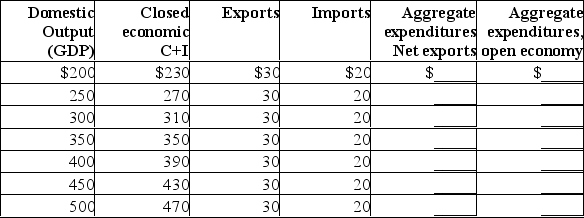 If the above economy was closed to international trade, the equilibrium GDP and the multiplier would be:
 (Multiple Choice)
4.9/5 (71)
(71) If an unplanned increase in business inventories occurs at some level of GDP, then GDP:
(Multiple Choice)
4.7/5 (92)
(92) All else equal, a large decline in the real interest rate will shift the:
(Multiple Choice)
4.9/5 (85)
(85) For given data the aggregate expenditures-domestic output and the saving-investment approaches will yield the same equilibrium level of GDP.
(True/False)
4.8/5 (84)
(84) In a mixed open economy, which of the following affect the equilibrium GDP in the same direction?
(Multiple Choice)
4.7/5 (77)
(77) An increase in government expenditures will shift the aggregate expenditures schedule ____ and ____ the equilibrium GDP.
(Multiple Choice)
4.9/5 (81)
(81) 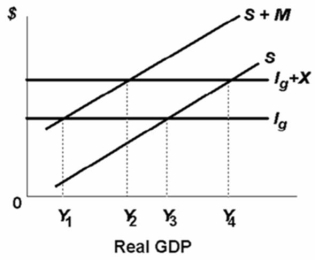 In the above private open economy exports are __________ and imports are __________ domestic GDP:
 (Multiple Choice)
4.7/5 (76)
(76) In a mixed open economy the equilibrium level of GDP exists where:
(Multiple Choice)
4.8/5 (79)
(79) Which of the following would reduce GDP by the greatest amount?
(Multiple Choice)
4.9/5 (89)
(89) The letters Y, Ca, Ig, Xn, G, and T stand for GDP, consumption, gross investment, net exports, government purchases, and net taxes respectively.Figures are in billions of dollars.Ca = 25 + .75(Y - T ) Ig = Ig0 = 50
Xn = Xn0 = 10
G = G0 = 70
T = T0 = 30
Refer to the above information.The equilibrium level of GDP for this economy is:
(Multiple Choice)
4.8/5 (95)
(95)  Refer to the above diagram which applies to a private closed economy.If gross investment is Ig1, the equilibrium GDP and the level of consumption will be:
 (Multiple Choice)
4.8/5 (62)
(62) The following information is consumption and investment data for a private closed economy.Figures are in billions of dollars.C = 60 + .6Y I = I0 = 30
Refer to the above data.The equilibrium level of income (Y ) is:
(Multiple Choice)
4.9/5 (74)
(74)  Refer to the above diagram for a private closed economy.At the $300 level of GDP:
 (Multiple Choice)
4.8/5 (73)
(73) Refer to the below diagram, which aggregate expenditure (AE) schedule for a private closed economy implies the largest MPC? 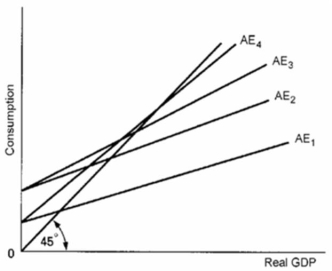
(Multiple Choice)
4.9/5 (85)
(85) 
Filters
- Essay(0)
- Multiple Choice(0)
- Short Answer(0)
- True False(0)
- Matching(0)