



 Chat with AI
Exam 18: B: The Balance of Payments and Exchange Rates

Exam 1: B: Limits, Alternatives, and Choices265 Questions
Exam 1: A: - Limits, Alternatives, and Choices60 Questions
Exam 2: B: The Market System and the Circular Flow119 Questions
Exam 2: A: - The Market System and the Circular Flow42 Questions
Exam 3: B: Demand, Supply, and Market Equilibrium291 Questions
Exam 3: A: - Demand, Supply, and Market Equilibrium51 Questions
Exam 4: B: Market Failures: Public Goods and Externalities133 Questions
Exam 4: A: - Market Failures: Public Goods and Externalities36 Questions
Exam 5: B: Governments Role and Government Failure121 Questions
Exam 5: A: Governments Role and Government Failure1 Questions
Exam 6: B: an Introduction to Macroeconomics65 Questions
Exam 6: A: an Introduction to Macroeconomics31 Questions
Exam 7: B: Measuring the Economys Output191 Questions
Exam 7: A: Measuring the Economys Output30 Questions
Exam 8: B: Economic Growth122 Questions
Exam 8: A: Economic Growth35 Questions
Exam 9: B: Business Cycles, Unemployment, and Inflation193 Questions
Exam 9: A: Business Cycles, Unemployment, and Inflation40 Questions
Exam 10: B: Basic Macroeconomic Relationships200 Questions
Exam 10: A: Basic Macroeconomic Relationships26 Questions
Exam 11: B: The Aggregate Expenditures Model238 Questions
Exam 11: A: The Aggregate Expenditures Model47 Questions
Exam 12: B: Aggregate Demand and Aggregate Supply203 Questions
Exam 12: A: Aggregate Demand and Aggregate Supply35 Questions
Exam 13: B: Fiscal Policy, Deficits, Surpluses, and Debt234 Questions
Exam 13: A: Fiscal Policy, Deficits, Surpluses, and Debt53 Questions
Exam 14: B: Money, Banking, and Money Creation206 Questions
Exam 14: A: Money, Banking, and Money Creation56 Questions
Exam 15: B: Interest Rates and Monetary Policy239 Questions
Exam 15: A: Interest Rates and Monetary Policy47 Questions
Exam 17: C: Financial Economics323 Questions
Exam 16: A: Long-Run Macroeconomic Adjustments28 Questions
Exam 16: B: Long-Run Macroeconomic Adjustments122 Questions
Exam 17: A: International Trade40 Questions
Exam 17: B: International Trade188 Questions
Exam 18: A: The Balance of Payments and Exchange Rates30 Questions
Exam 18: B: The Balance of Payments and Exchange Rates133 Questions
Exam 22: The Economics of Developing Countries254 Questions
Select questions type


The following table shows the balance of payments statement of Transylvania in 2013.All the figures are in billions of dollars.  Refer to the above data.In 2013, Transylvania imported more products than it exported.
 (True/False)
4.9/5  (79)
(79) The following table shows the balance of payments statement of Transylvania for 2013.All the figures are in billions of dollars.  Refer to the above data.In 2013, Transylvania was a net recipient of transfers from the rest of the world.
 (True/False)
4.8/5 (75)
(75) 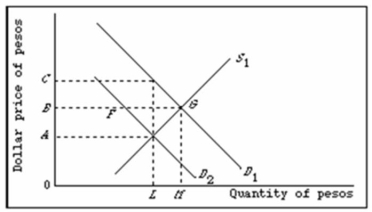 Refer to the above diagram.The initial demand for and supply of pesos are shown by D1 and S1.If the decline in Canadian imports from Mexico described in the previous question occurred under a system of flexible exchange rates:
 (Multiple Choice)
4.9/5 (72)
(72) In a nation's balance of payments, which one of the following items is always recorded as a positive entry?
(Multiple Choice)
4.7/5 (87)
(87) Using Image 18.2 Global Perspective, In October 2017, one Canadian dollar bought:
(Multiple Choice)
4.8/5 (81)
(81) A system of fixed exchange rates is more likely to give rise to exchange controls than is a system of flexible exchange rates.
(True/False)
4.9/5 (82)
(82) The following table shows the trade between Canada and Transylvania for the year 2012.All figures are in billions of dollars.  Refer to the information above.Canada had a merchandise trade:
 (Multiple Choice)
4.8/5 (70)
(70) The purchasing-power-parity theory holds that exchange rates equate the purchasing power of various currencies.
(True/False)
4.8/5 (70)
(70) According to the purchasing power parity theory of exchange rates:
(Multiple Choice)
4.9/5 (82)
(82) Refer to the diagram below.The initial demand for and supply of pesos are shown by D1 and S1.Suppose Canada reduces its imports of Mexican goods, shifting its demand for pesos from D1 and D2.If Canada was operating under a system of exchange controls that maintains the exchange rate at E, the Canadian government would: 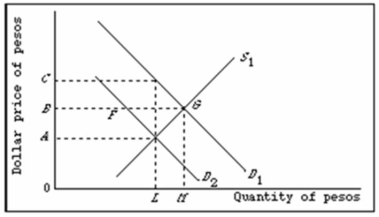
(Multiple Choice)
4.7/5 (75)
(75) Assume that Switzerland and Britain have flexible exchange rates.Other things unchanged, if economic growth is more rapid in Switzerland than in Britain:
(Multiple Choice)
4.9/5 (83)
(83) International financial transactions mostly fall into two broad categories:
(Multiple Choice)
4.8/5 (80)
(80) The exchange rate system currently used by the industrially advanced nations is:
(Multiple Choice)
4.7/5 (84)
(84) Under a system of fixed exchange rates, a nation which experiences chronic balance of payments deficits may:
(Multiple Choice)
4.8/5 (89)
(89) The foreign demand curve for a nation's currency is considered to be a derived demand because:
(Multiple Choice)
4.8/5 (73)
(73) Which one of the following will not directly affect Canada's balance on current account?
(Multiple Choice)
4.9/5 (85)
(85) The current exchange-rate system is an "almost" flexible exchange-rate system.
(True/False)
4.8/5 (74)
(74) Which one of the following will directly affect Canada's balance on goods and services, but not affect its balance of trade?
(Multiple Choice)
4.8/5 (72)
(72) Which one of the following, other things equal, will directly alter Canada's balance of trade?
(Multiple Choice)
4.8/5 (72)
(72) 
Filters
- Essay(0)
- Multiple Choice(0)
- Short Answer(0)
- True False(0)
- Matching(0)