



 Chat with AI
Exam 19: Metabolic Integration

Exam 1: Principles of Biochemistry100 Questions
Exam 2: Physical Biochemistry: Energy Conversion, Water, and Membranes100 Questions
Exam 3: Nucleic Acid Structure and Function100 Questions
Exam 4: Protein Structure100 Questions
Exam 5: Methods in Protein Biochemistry100 Questions
Exam 6: Protein Function114 Questions
Exam 7: Enzyme Mechanisms106 Questions
Exam 8: Cell Signaling Systems102 Questions
Exam 9: Glycolysis: a Paradigm of Metabolic Regulation100 Questions
Exam 10: The Citrate Cycle100 Questions
Exam 11: Oxidative Phosphorylation99 Questions
Exam 12: Photosynthesis100 Questions
Exam 13: Carbohydrate Structure and Function100 Questions
Exam 14: Carbohydrate Metabolism100 Questions
Exam 15: Lipid Structure and Function100 Questions
Exam 16: Lipid Metabolism100 Questions
Exam 17: Amino Acid Metabolism100 Questions
Exam 18: Nucleotide Metabolism99 Questions
Exam 19: Metabolic Integration101 Questions
Exam 20: DNA Replication, Repair, and Recombination99 Questions
Exam 21: RNA Synthesis, Processing, and Gene Silencing100 Questions
Exam 22: Protein Synthesis, Posttranslational Modification, and Transport100 Questions
Exam 23: Gene Regulation100 Questions
Select questions type


Which of the following functions by specifically targeting neuronal control of food consumption?
(Multiple Choice)
5.0/5  (79)
(79) Compare the activation levels of AMPK signaling in a normal-weight versus an obese person in response to adiponectin exposure.
(Essay)
4.7/5 (77)
(77) Glucagon stimulates glucose export by increasing metabolic flux through gluconeogenesis in the
(Multiple Choice)
4.7/5 (89)
(89) PPARs have a variety of functions in lipid metabolism that include all EXCEPT
(Multiple Choice)
4.8/5 (71)
(71) Which of the following changes in metabolic flux would be expected to occur during long periods without food?
(Multiple Choice)
4.8/5 (81)
(81) Whipple surgery, sometimes carried out on patients battling pancreatic cancer, is one of the most demanding surgeries to perform. It involves removing parts of the pancreas and rerouting aspects of the digestive track. A complication of the surgery can be the development of diabetes. Why could this complication develop? Include the types of cells and hormones that are involved.
(Essay)
4.8/5 (73)
(73) A physician believes her patient has metabolic syndrome. In her examining room, she checks the patient's visceral fat levels and blood pressure. She then writes out a prescription for the patient to obtain bloodwork. The bloodwork includes a glucose tolerance test. What additional bloodwork should the physician order for the patient?
(Essay)
4.7/5 (93)
(93) Which of the following is unlikely to affect metabolic homeostasis?
(Multiple Choice)
4.7/5 (83)
(83) The numerical value of a food that indicates how quickly glucose is released into the blood is called the
(Multiple Choice)
4.9/5 (87)
(87) Analysis of phosphorylated proteins in a cell with a fully active AMPK would reveal that is phosphorylated.
(Multiple Choice)
4.8/5 (76)
(76) A patient presents with insulin resistance, hypertension, and hyperlipidemia. What condition would you diagnose this patient as having?
(Short Answer)
4.8/5 (85)
(85) Orlistat and olestra can both lead to undigested lipids in the colon, yet they do so by contrasting mechanisms. Orlistat __________, whereas olestra _.
(Multiple Choice)
5.0/5 (85)
(85) The blood-brain barrier results from , which allow glucose and to enter the brain.
(Multiple Choice)
5.0/5 (73)
(73) Neuronal samples from wild-type mice were monitored in the absence and presence of leptin via Western blotting. The data are shown below. Choose the answer that correctly identifies the NPY/AGRP neuronal samples obtained in the absence and then the presence of leptin. 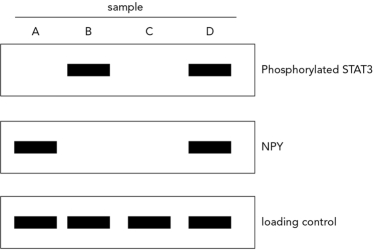
(Multiple Choice)
4.9/5 (80)
(80) Which of the following drugs stimulate adrenergic receptor signaling?
(Multiple Choice)
4.7/5 (79)
(79) Which organ is responsible for regulating physiological levels of glucose?
(Multiple Choice)
4.9/5 (80)
(80) What is the process of maintaining optimal metabolic concentrations and managing chemical energy reserves in tissues? Describe the three primary factors that influence this process.
(Essay)
4.9/5 (82)
(82) Liver and skeletal muscle both respond to insulin by exhibiting an increased metabolic flux through glycolytic and glycogen synthesis pathways. Yet the tissues also exhibit different responses in how glucose is transported into the cells on insulin stimulation. What are these differences?
(Essay)
4.8/5 (73)
(73) 
Filters
- Essay(0)
- Multiple Choice(0)
- Short Answer(0)
- True False(0)
- Matching(0)