



 Chat with AI
Exam 12: Photosynthesis

Exam 1: Principles of Biochemistry100 Questions
Exam 2: Physical Biochemistry: Energy Conversion, Water, and Membranes100 Questions
Exam 3: Nucleic Acid Structure and Function100 Questions
Exam 4: Protein Structure100 Questions
Exam 5: Methods in Protein Biochemistry100 Questions
Exam 6: Protein Function114 Questions
Exam 7: Enzyme Mechanisms106 Questions
Exam 8: Cell Signaling Systems102 Questions
Exam 9: Glycolysis: a Paradigm of Metabolic Regulation100 Questions
Exam 10: The Citrate Cycle100 Questions
Exam 11: Oxidative Phosphorylation99 Questions
Exam 12: Photosynthesis100 Questions
Exam 13: Carbohydrate Structure and Function100 Questions
Exam 14: Carbohydrate Metabolism100 Questions
Exam 15: Lipid Structure and Function100 Questions
Exam 16: Lipid Metabolism100 Questions
Exam 17: Amino Acid Metabolism100 Questions
Exam 18: Nucleotide Metabolism99 Questions
Exam 19: Metabolic Integration101 Questions
Exam 20: DNA Replication, Repair, and Recombination99 Questions
Exam 21: RNA Synthesis, Processing, and Gene Silencing100 Questions
Exam 22: Protein Synthesis, Posttranslational Modification, and Transport100 Questions
Exam 23: Gene Regulation100 Questions
Select questions type


Which of the following is a photosynthetic light harvesting pigment?

Free
(Multiple Choice)
5.0/5  (92)
(92) Correct Answer: Verified
D
Why are Calvin cycle reactions also referred to as the dark reactions?
Free
(Multiple Choice)
4.8/5 (74)
(74) Correct Answer:Verified
VerifiedC
In the five steps used by photosynthetic organisms to convert solar energy into chemical energy, which molecules store the solar energy before sugar synthesis?
Free
(Multiple Choice)
5.0/5 (68)
(68) Correct Answer:Verified
VerifiedD
Trace the electron from plastocyanin to NADPH in the photosynthetic electron transport system.
(Essay)
4.7/5 (65)
(65) Which enzyme in the photosynthesis light reactions does NOT transfer electrons?
(Multiple Choice)
4.8/5 (76)
(76) Which species from the light reactions keeps thioredoxin reduced so that it can activate enzymes in the Calvin cycle?
(Multiple Choice)
4.9/5 (72)
(72) Write out the overall net Calvin cycle reaction assuming three CO2 molecules are the starting reactant.
(Essay)
4.8/5 (78)
(78) During photophosphorylation, the protons are pumped into the __________, and the ATP is made in the _.
(Multiple Choice)
4.7/5 (77)
(77) In the chloroplasts, photosystem I (PSI) and photosystem II (PSII) are known to localize in different regions. PSI generally localizes in the , whereas PSII localizes in the __________.
(Multiple Choice)
4.9/5 (88)
(88) Approximately how many light-harvesting chromophores are found per photosystem enzyme, such as in PSI or PSII?
(Multiple Choice)
4.9/5 (80)
(80) Heme and chlorophyll have similar overall structures. What is common between the two molecules?
(Multiple Choice)
4.7/5 (82)
(82) Describe the arrangement of light-harvesting complexes relative to the reaction center in a plant's photosystem enzymes.
(Essay)
4.8/5 (79)
(79) What group in photosystem II (PSII) directly reacts with H2O during its light-driven oxidation?
(Multiple Choice)
4.9/5 (76)
(76) At what stage of plant growth is the glyoxylate cycle most common, and why?
(Essay)
4.7/5 (75)
(75) The five-step mechanism of ribulose bisphosphate carboxylase (rubisco)
(Multiple Choice)
4.8/5 (68)
(68) Which enzyme in the photosynthetic Z scheme catalyzes the PQ cycle, which is analogous to Complex III and the Q cycle in the mitochondrial electron transport chain?
(Multiple Choice)
4.8/5 (81)
(81) Regulation of photosystem II (PSII) enzyme activity is accomplished by phosphorylation. Higher levels of stimulates the phosphorylation and tuning down of PSII activity.
(Multiple Choice)
5.0/5 (79)
(79) Identify the cell types of cells A and B below, and then identify the plant type in which the cell arrangements are found.
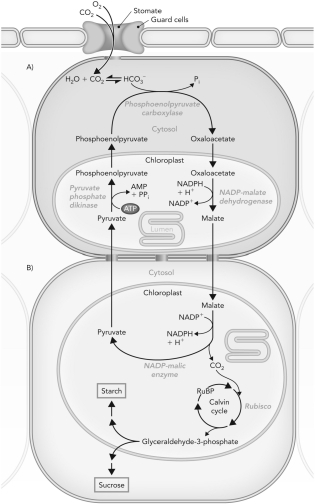
(Essay)
4.8/5 (74)
(74) 
Filters
- Essay(0)
- Multiple Choice(0)
- Short Answer(0)
- True False(0)
- Matching(0)