



 Chat with AI
Exam 11: Oxidative Phosphorylation

Exam 1: Principles of Biochemistry100 Questions
Exam 2: Physical Biochemistry: Energy Conversion, Water, and Membranes100 Questions
Exam 3: Nucleic Acid Structure and Function100 Questions
Exam 4: Protein Structure100 Questions
Exam 5: Methods in Protein Biochemistry100 Questions
Exam 6: Protein Function114 Questions
Exam 7: Enzyme Mechanisms106 Questions
Exam 8: Cell Signaling Systems102 Questions
Exam 9: Glycolysis: a Paradigm of Metabolic Regulation100 Questions
Exam 10: The Citrate Cycle100 Questions
Exam 11: Oxidative Phosphorylation99 Questions
Exam 12: Photosynthesis100 Questions
Exam 13: Carbohydrate Structure and Function100 Questions
Exam 14: Carbohydrate Metabolism100 Questions
Exam 15: Lipid Structure and Function100 Questions
Exam 16: Lipid Metabolism100 Questions
Exam 17: Amino Acid Metabolism100 Questions
Exam 18: Nucleotide Metabolism99 Questions
Exam 19: Metabolic Integration101 Questions
Exam 20: DNA Replication, Repair, and Recombination99 Questions
Exam 21: RNA Synthesis, Processing, and Gene Silencing100 Questions
Exam 22: Protein Synthesis, Posttranslational Modification, and Transport100 Questions
Exam 23: Gene Regulation100 Questions
Select questions type


An ATP synthase enzyme with more than 10 c subunits in the F0 stalk would

Free
(Multiple Choice)
4.9/5  (84)
(84) Correct Answer: Verified
A
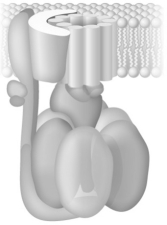
On the figure below label the clearly identify the positions of the three functional units of ATP synthase: the rotor, the catalytic headpiece, and the stator.
Free
(Essay)
4.8/5 (75)
(75) Correct Answer:Verified
Verified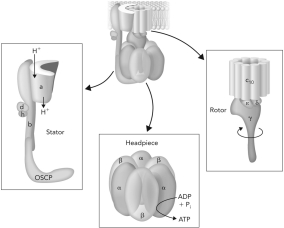
For each molecule below, list the number of ATP obtained assuming that the electron transport chain and oxidative phosphorylation are active. 
(Essay)
4.9/5 (98)
(98) For the metabolism of one glucose to two pyruvate molecules, set up a table showing the differences in the number of ATP obtained in the muscle and the liver assuming that the NADH and FADH2 is used by the electron transport chain and oxidative phosphorylation to make ATP. 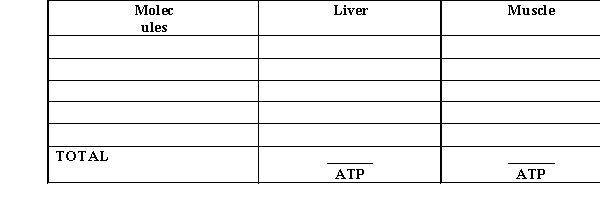
(Essay)
4.9/5 (87)
(87) Use the table below to answer the question. 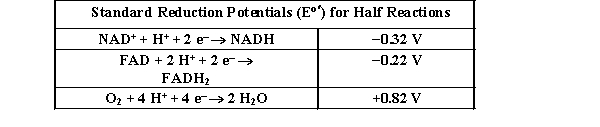 In the direction indicated, which of the following reactions are thermodynamically favored?
I. NAD+ + H2O O2 + NADH
II. FADH2 + H2O O2 + FAD
III. NADH + O2 H2O + NAD+
In the direction indicated, which of the following reactions are thermodynamically favored?
I. NAD+ + H2O O2 + NADH
II. FADH2 + H2O O2 + FAD
III. NADH + O2 H2O + NAD+ (Multiple Choice)
4.9/5 (91)
(91) Which reaction does the concept of oxidative phosphorylation refer to?
(Multiple Choice)
4.9/5 (84)
(84) Which one of the following correctly designates the number of ATPs generated by the reducing molecules shown below?
(Multiple Choice)
4.8/5 (87)
(87) Approximately how many more ATPs are made from one glucose molecule under aerobic conditions with oxidative phosphorylation than under anaerobic conditions?
(Multiple Choice)
4.8/5 (80)
(80) The ATP synthase enzyme contains a central stalk embedded in the mitochondrial membrane. What part of this stalk rotates?
(Multiple Choice)
4.9/5 (87)
(87) During transfer of ATP, ADP, and Pi, some of the proton gradient is lost in the
(Multiple Choice)
4.8/5 (78)
(78) What is the location of the electron transport system protein called cytochrome c?
(Multiple Choice)
4.9/5 (86)
(86) Which directions across the mitochondria must H+, ATP, ADP, and Pi travel during active mitochondrial ATP synthesis?
(Essay)
4.9/5 (70)
(70) The main activator molecule of the ATP synthesis and the electron transport system is
(Multiple Choice)
4.9/5 (65)
(65) If the mitochondrial ATP synthase were inhibited, but the electron transport chain was allowed to run continuously, the pH of the cytoplasm would
(Multiple Choice)
4.8/5 (75)
(75) What would happen to the ETC and oxidative phosphorylation pathway in the presence of excess NADH if the mitochondrial matrix were not closed, but opened up to the cytoplasm?
(Multiple Choice)
4.9/5 (72)
(72) Use the table below to (A) write out the balanced reaction between NADH and O2 that drives the electron transport system and (B) compute the standard reduction potential. 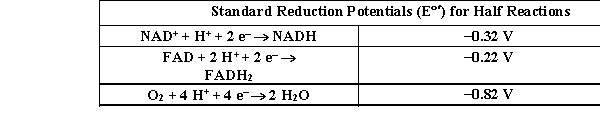
(Essay)
4.9/5 (81)
(81) The free energy released from the electron transport system reaction NADH + 1/2 O2 + H+ H2O + NAD+ is G '= -220 kJ/mol. How many moles of ATP could theoretically be made assuming 100% efficiency in energy coupling through the chemiosmotic theory, and that
ADP+Pi ATP G '= 30.5 kJ/mol?
(Essay)
4.8/5 (75)
(75) The catalytic headpiece of the ATP synthase enzyme is primarily composed of which subunits?
(Multiple Choice)
4.8/5 (75)
(75) The structure of the electron transport system protein called cytochrome c is highly conserved in nature because the
(Multiple Choice)
4.7/5 (67)
(67) 
Filters
- Essay(0)
- Multiple Choice(0)
- Short Answer(0)
- True False(0)
- Matching(0)