



 Chat with AI
Exam 11: Oxidative Phosphorylation

Exam 1: Principles of Biochemistry100 Questions
Exam 2: Physical Biochemistry: Energy Conversion, Water, and Membranes100 Questions
Exam 3: Nucleic Acid Structure and Function100 Questions
Exam 4: Protein Structure100 Questions
Exam 5: Methods in Protein Biochemistry100 Questions
Exam 6: Protein Function114 Questions
Exam 7: Enzyme Mechanisms106 Questions
Exam 8: Cell Signaling Systems102 Questions
Exam 9: Glycolysis: a Paradigm of Metabolic Regulation100 Questions
Exam 10: The Citrate Cycle100 Questions
Exam 11: Oxidative Phosphorylation99 Questions
Exam 12: Photosynthesis100 Questions
Exam 13: Carbohydrate Structure and Function100 Questions
Exam 14: Carbohydrate Metabolism100 Questions
Exam 15: Lipid Structure and Function100 Questions
Exam 16: Lipid Metabolism100 Questions
Exam 17: Amino Acid Metabolism100 Questions
Exam 18: Nucleotide Metabolism99 Questions
Exam 19: Metabolic Integration101 Questions
Exam 20: DNA Replication, Repair, and Recombination99 Questions
Exam 21: RNA Synthesis, Processing, and Gene Silencing100 Questions
Exam 22: Protein Synthesis, Posttranslational Modification, and Transport100 Questions
Exam 23: Gene Regulation100 Questions
Select questions type


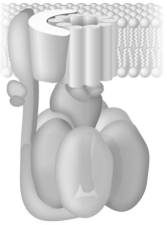
Label the locations of , , , and c, and the F0 and F1 subunits on the following ATP synthase enzyme.
(Essay)
4.9/5  (73)
(73) Which of the following is NOT a part of oxidative phosphorylation?
(Multiple Choice)
4.8/5 (68)
(68) Studies of the inner mitochondrial membrane reveal its composition to be approximately 20% lipid bilayer and 80% protein. What is true of these proteins?
(Multiple Choice)
4.8/5 (86)
(86) Inhibitors of the electron transport system, such as cyanide (CN - ) and carbon monoxide (CO), inhibit complex IV by binding to the heme iron cofactor. What is the resulting effect on oxidative phosphorylation?
(Multiple Choice)
4.9/5 (75)
(75) Describe the process by which proton flow through the c subunits forces the rotation of the ATP synthase spindle in the mitochondrial membrane. Please include the roles of aspartic acid residues and the half-channels in your description.
(Essay)
4.7/5 (79)
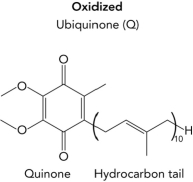
(79) Use the structure of the oxidized coenzyme Q (ubiquinone) shown below and draw the two-electron reduced form.
(Essay)
5.0/5 (86)
(86) Which one of the following is involved in the flow of electrons from NADH through the electron transport system to molecular oxygen (O2)?
(Multiple Choice)
4.9/5 (88)
(88) The first enzyme in the electron transport system is referred to as complex I, otherwise known as
(Multiple Choice)
4.8/5 (78)
(78) Which is the only electron carrier in the electron transport system that is not embedded in a membrane?
(Multiple Choice)
4.8/5 (76)
(76) Which one of the following statements about the glycerol phosphate shuttle is true?
(Multiple Choice)
4.7/5 (90)
(90) The electron transport complexes found in the electron transport system
(Multiple Choice)
4.8/5 (71)
(71) What active site cofactor is found in the electron transport system protein called cytochrome c?
(Multiple Choice)
4.7/5 (89)
(89) What is the fate of NADH after it donates its electrons to the electron transport system?
(Multiple Choice)
4.8/5 (89)
(89) What happens to patients given the proton gradient uncoupler 2,4-dinitrophenol?
(Multiple Choice)
4.8/5 (83)
(83) Draw a diagram of the mitochondrion and indicate which side of the organelle has a net positive charge and which side has a net negative charge as a result of proton pumping.
(Essay)
4.9/5 (96)
(96) Which mechanism is the most efficient at moving NADH equivalents from the cytoplasm into the mitochondria?
(Multiple Choice)
4.7/5 (84)
(84) Submitochondrial particles are inside-out pieces of the inner mitochondrial membrane formed through the sonication of mitochondria. Draw a diagram of these inside-out particles clearly showing (A) where electron transport from NADH occurs, (B) the direction of proton pumping, (C) the location of ATP synthesis, and (D) where O2 reacts.
(Essay)
4.8/5 (95)
(95) 
Filters
- Essay(0)
- Multiple Choice(0)
- Short Answer(0)
- True False(0)
- Matching(0)