



 Chat with AI
Exam 11: Oxidative Phosphorylation

Exam 1: Principles of Biochemistry100 Questions
Exam 2: Physical Biochemistry: Energy Conversion, Water, and Membranes100 Questions
Exam 3: Nucleic Acid Structure and Function100 Questions
Exam 4: Protein Structure100 Questions
Exam 5: Methods in Protein Biochemistry100 Questions
Exam 6: Protein Function114 Questions
Exam 7: Enzyme Mechanisms106 Questions
Exam 8: Cell Signaling Systems102 Questions
Exam 9: Glycolysis: a Paradigm of Metabolic Regulation100 Questions
Exam 10: The Citrate Cycle100 Questions
Exam 11: Oxidative Phosphorylation99 Questions
Exam 12: Photosynthesis100 Questions
Exam 13: Carbohydrate Structure and Function100 Questions
Exam 14: Carbohydrate Metabolism100 Questions
Exam 15: Lipid Structure and Function100 Questions
Exam 16: Lipid Metabolism100 Questions
Exam 17: Amino Acid Metabolism100 Questions
Exam 18: Nucleotide Metabolism99 Questions
Exam 19: Metabolic Integration101 Questions
Exam 20: DNA Replication, Repair, and Recombination99 Questions
Exam 21: RNA Synthesis, Processing, and Gene Silencing100 Questions
Exam 22: Protein Synthesis, Posttranslational Modification, and Transport100 Questions
Exam 23: Gene Regulation100 Questions
Select questions type


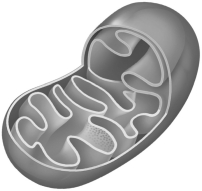
Use the following picture of a mitochondrion and label the (A) matrix, (B) crista, (c) inner membrane space, (D) cytoplasm, (E) inner membrane, (F) outer membrane, (G) location of the ATP synthesis, (H) location of elevated pH, and (I) the location of the electron transport system complexes.
(Essay)
4.9/5  (77)
(77) The electron transport chain component that transfers electrons directly to oxygen is
(Multiple Choice)
4.8/5 (71)
(71) Explain why many mitochondrial diseases are inherited from the mother only.
(Essay)
4.9/5 (84)
(84) Protons are pumped by mitochondria during active electron transport
(Multiple Choice)
4.8/5 (74)
(74) Thermogenin (or uncoupling protein) is not toxic like 2,4-dinitrophenol because the protein
(Multiple Choice)
4.8/5 (99)
(99) Complex IV in the mitochondrial electron transport chain belongs to which enzyme class?
(Multiple Choice)
4.8/5 (75)
(75) Which of the following statements about the chemiosmotic theory is true?
(Multiple Choice)
4.9/5 (80)
(80) List the order of enzymes, enzyme complexes, and membrane soluble electron carriers that an electron is passed through on its way from NADH to O2 in the electron transport system.
(Essay)
5.0/5 (91)
(91) Which statement is true of the mitochondrial electron transport system?
(Multiple Choice)
4.9/5 (84)
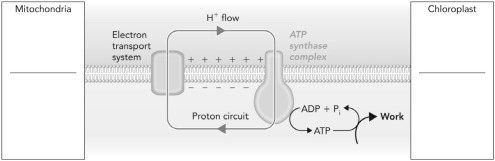
(84) On the left hand side of the figure, label the regions above and below the lipid membrane assuming the process occurs in mitochondria. On the right hand side, label the regions assuming the process occurs in chloroplasts.
(Essay)
4.9/5 (80)
(80) Explain how ATP synthase can be used as primary active transporter of H+ and pump protons.
(Essay)
4.8/5 (86)
(86) What is the reaction catalyzed by complex III in the electron transport system?
(Multiple Choice)
4.8/5 (79)
(79) A decrease in would be LEAST likely to affect the processes of the electron transport system.
(Multiple Choice)
4.8/5 (84)
(84) The __________ causes the catalytic headpiece of ATP synthase to change conformation.
(Multiple Choice)
4.9/5 (72)
(72) How are many mitochondrial diseases passed on from parents to offspring?
(Multiple Choice)
4.8/5 (86)
(86) Which statement comparing chloroplasts and mitochondria is true?
(Multiple Choice)
4.8/5 (76)
(76) For one electron entering the electron transport chain at complex I, how many times is it handed off between redox active cofactors on its way through the enzyme complexes to end up on O2?
(Multiple Choice)
4.8/5 (94)
(94) 
Filters
- Essay(0)
- Multiple Choice(0)
- Short Answer(0)
- True False(0)
- Matching(0)