



 Chat with AI
Exam 14: Carbohydrate Metabolism

Exam 1: Principles of Biochemistry100 Questions
Exam 2: Physical Biochemistry: Energy Conversion, Water, and Membranes100 Questions
Exam 3: Nucleic Acid Structure and Function100 Questions
Exam 4: Protein Structure100 Questions
Exam 5: Methods in Protein Biochemistry100 Questions
Exam 6: Protein Function114 Questions
Exam 7: Enzyme Mechanisms106 Questions
Exam 8: Cell Signaling Systems102 Questions
Exam 9: Glycolysis: a Paradigm of Metabolic Regulation100 Questions
Exam 10: The Citrate Cycle100 Questions
Exam 11: Oxidative Phosphorylation99 Questions
Exam 12: Photosynthesis100 Questions
Exam 13: Carbohydrate Structure and Function100 Questions
Exam 14: Carbohydrate Metabolism100 Questions
Exam 15: Lipid Structure and Function100 Questions
Exam 16: Lipid Metabolism100 Questions
Exam 17: Amino Acid Metabolism100 Questions
Exam 18: Nucleotide Metabolism99 Questions
Exam 19: Metabolic Integration101 Questions
Exam 20: DNA Replication, Repair, and Recombination99 Questions
Exam 21: RNA Synthesis, Processing, and Gene Silencing100 Questions
Exam 22: Protein Synthesis, Posttranslational Modification, and Transport100 Questions
Exam 23: Gene Regulation100 Questions
Select questions type


State whether enzymes are phosphorylated or dephosphorylated in the glycogen metabolism pathways on the binding of adrenaline to liver or muscle cell receptors and state how this affects their activity.

Free
(Essay)
4.7/5  (81)
(81) Correct Answer: Verified
Adrenaline leads to the phosphorylation of glycogen synthase and its inactivity while leading to phosphorylation of glycogen phosphorylase and its activation.
A patient is found to have a mutated enzyme that results in fewer branch points in glycogen. Which one of the following would best characterize the way in which the patient's glycogen is altered relative to normal glycogen?
Free
(Multiple Choice)
4.8/5 (70)
(70) Correct Answer:Verified
VerifiedD
Which is the substrate or product of the reactions that comprise the oxidative branch of the pentose phosphate pathway?
Free
(Multiple Choice)
4.8/5 (71)
(71) Correct Answer:Verified
VerifiedC
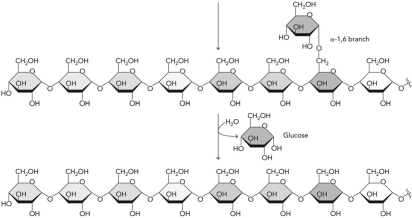
How many high-energy NTP molecules are hydrolyzed for each glucose monomer added to a growing glycogen polymer?
(Multiple Choice)
4.9/5 (75)
(75) 
The hormone insulin stimulates __________ and inhibits __________, leading to a(n) __________ in the glucose levels.
(Multiple Choice)
5.0/5 (92)
(92) What would happen to cellular glucose-6-phosphate if the pentose phosphate pathway is inhibited?
(Essay)
4.8/5 (91)
(91) Which of the following metabolites has carbon atoms that can end up in glucose via the gluconeogenesis pathway in humans?
(Multiple Choice)
4.8/5 (72)
(72) The enzymes that catalyze the regulated steps in glycolysis are
(Multiple Choice)
4.9/5 (85)
(85) The hormone insulin activates phosphofructokinase 2 (2PFK2). This leads to a(n) __________ in concentration of fructose 2,6 bisphosphate, which favors the __________
Pathway.
(Multiple Choice)
4.8/5 (79)
(79) State the role of the liver and the role of the muscles and explain their need for different glycogen metabolism regulation.
(Essay)
4.9/5 (61)
(61) Because muscles lack receptors for glucagon, what hormone activates muscle glycogen phosphorylase?
(Multiple Choice)
4.9/5 (92)
(92) In the breakdown of glycogen by glycogen phosphorylase, the immediate predominant product is
(Multiple Choice)
4.7/5 (90)
(90) Which of the following molecules is found in the nonoxidative phase of the pentose phosphate pathway?
(Multiple Choice)
4.8/5 (78)
(78) List the three metabolic molecules that regulate the activity of the pentose phosphate pathway.
(Essay)
4.9/5 (72)
(72) McArdle disease is due to a deficiency in muscle glycogen phosphorylase activity. The result of this deficiency is an inability to
(Multiple Choice)
4.8/5 (83)
(83) Which of the following molecules would inhibit the last reaction of glycolysis?
(Multiple Choice)
4.8/5 (81)
(81) 
Filters
- Essay(0)
- Multiple Choice(0)
- Short Answer(0)
- True False(0)
- Matching(0)