



 Chat with AI
Exam 14: Carbohydrate Metabolism

Exam 1: Principles of Biochemistry100 Questions
Exam 2: Physical Biochemistry: Energy Conversion, Water, and Membranes100 Questions
Exam 3: Nucleic Acid Structure and Function100 Questions
Exam 4: Protein Structure100 Questions
Exam 5: Methods in Protein Biochemistry100 Questions
Exam 6: Protein Function114 Questions
Exam 7: Enzyme Mechanisms106 Questions
Exam 8: Cell Signaling Systems102 Questions
Exam 9: Glycolysis: a Paradigm of Metabolic Regulation100 Questions
Exam 10: The Citrate Cycle100 Questions
Exam 11: Oxidative Phosphorylation99 Questions
Exam 12: Photosynthesis100 Questions
Exam 13: Carbohydrate Structure and Function100 Questions
Exam 14: Carbohydrate Metabolism100 Questions
Exam 15: Lipid Structure and Function100 Questions
Exam 16: Lipid Metabolism100 Questions
Exam 17: Amino Acid Metabolism100 Questions
Exam 18: Nucleotide Metabolism99 Questions
Exam 19: Metabolic Integration101 Questions
Exam 20: DNA Replication, Repair, and Recombination99 Questions
Exam 21: RNA Synthesis, Processing, and Gene Silencing100 Questions
Exam 22: Protein Synthesis, Posttranslational Modification, and Transport100 Questions
Exam 23: Gene Regulation100 Questions
Select questions type


Why is it important that muscle cells are unresponsive to glucagon?
(Multiple Choice)
4.8/5  (84)
(84) Draw a diagram indicating the organs, metabolic pathways, and key molecules involved in the circular Cori cycle.
(Essay)
4.9/5 (77)
(77) Which enzyme class catalyzes the following pentose phosphate pathway reaction (note that there may be some missing reactants and products)? 
(Multiple Choice)
4.7/5 (76)
(76) What molecules are missing from boxes in the gluconeogenesis reaction shown below? 
(Multiple Choice)
4.8/5 (77)
(77) Which correctly describes the role of the transport system shown below? 
(Multiple Choice)
5.0/5 (84)
(84) Which of the following metabolites is NOT a gluconeogenesis substrate in humans?
(Multiple Choice)
4.8/5 (71)
(71) Starting from the oxidative phase of the pentose phosphate pathway, how many ATP and high-energy reduced molecules, respectively, are made in going from one glucose molecule to glyceraldehyde-3-phosphate and fructose-6-phosphate?
(Multiple Choice)
4.9/5 (78)
(78) What controls the activity of the opposing enzymes hexokinase and glucose-6-phosphatase from the glycolysis and gluconeogenesis pathways?
(Multiple Choice)
5.0/5 (99)
(99) Of the four molecules listed below, three of them reciprocally regulate phosphofructokinase 1 (PFK1) and fructose-1,6-bisphosphatase. Which molecule does NOT fit?
(Multiple Choice)
4.8/5 (63)
(63) In the glycogenesis pathway, which enzyme catalyzes the formation of (1,6) linkages?
(Multiple Choice)
4.9/5 (87)
(87) Cytoplasmic levels of NADH must be maintained in order for gluconeogenesis to occur. What generates NADH for this pathway?
(Multiple Choice)
4.8/5 (69)
(69) von Gierke disease is a common glycogen storage disease caused by a deficiency in glucose-6-phosphatase. Explain how a deficiency in this gluconeogenesis enzyme leads to glycogen storage issues.
(Essay)
4.8/5 (94)
(94) Fill in the names of the enzymes involved in the important cellular glutathione detoxification system shown below.
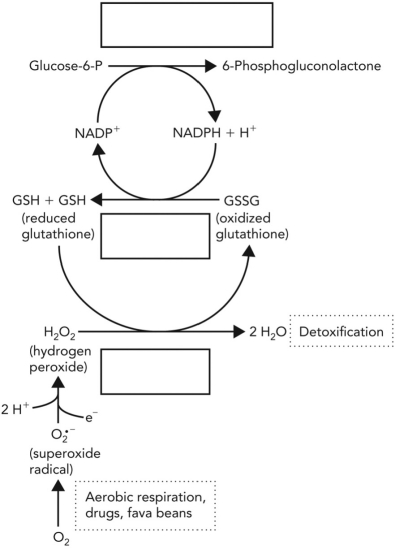
(Essay)
4.8/5 (83)
(83) Draw a glucose molecule and indicate which atom is linked to glycogen during the glycogen synthesis process.
(Essay)
4.8/5 (74)
(74) 
Filters
- Essay(0)
- Multiple Choice(0)
- Short Answer(0)
- True False(0)
- Matching(0)