



 Chat with AI
Exam 19: Metabolic Integration

Exam 1: Principles of Biochemistry100 Questions
Exam 2: Physical Biochemistry: Energy Conversion, Water, and Membranes100 Questions
Exam 3: Nucleic Acid Structure and Function100 Questions
Exam 4: Protein Structure100 Questions
Exam 5: Methods in Protein Biochemistry100 Questions
Exam 6: Protein Function114 Questions
Exam 7: Enzyme Mechanisms106 Questions
Exam 8: Cell Signaling Systems102 Questions
Exam 9: Glycolysis: a Paradigm of Metabolic Regulation100 Questions
Exam 10: The Citrate Cycle100 Questions
Exam 11: Oxidative Phosphorylation99 Questions
Exam 12: Photosynthesis100 Questions
Exam 13: Carbohydrate Structure and Function100 Questions
Exam 14: Carbohydrate Metabolism100 Questions
Exam 15: Lipid Structure and Function100 Questions
Exam 16: Lipid Metabolism100 Questions
Exam 17: Amino Acid Metabolism100 Questions
Exam 18: Nucleotide Metabolism99 Questions
Exam 19: Metabolic Integration101 Questions
Exam 20: DNA Replication, Repair, and Recombination99 Questions
Exam 21: RNA Synthesis, Processing, and Gene Silencing100 Questions
Exam 22: Protein Synthesis, Posttranslational Modification, and Transport100 Questions
Exam 23: Gene Regulation100 Questions
Select questions type


Serum levels of high-molecular-weight adiponectin are in obese individuals, in part because of __________ suppression of adiponectin expression.
(Multiple Choice)
4.9/5  (79)
(79) The average amount of adipose tissue the body maintains at physiological homeostasis is known as the
(Multiple Choice)
4.8/5 (79)
(79) A patient has been diagnosed with metabolic syndrome. To establish the diagnosis, the doctor likely performed several tests. A test that the doctor was UNLIKELY to perform would be
(Multiple Choice)
4.9/5 (75)
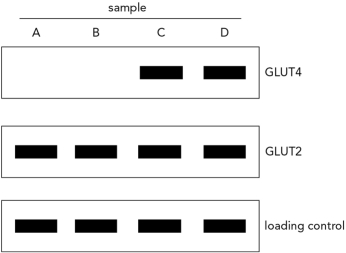
(75) Membrane fractions of skeletal muscle and adipose tissue were purified. Before purification the samples were exposed to insulin or glucagon. The samples were then analyzed via Western blotting using antibodies against GLUT4 and GLUT2. A loading control was included in the analysis. The results are shown below. Assume that sample A is skeletal muscle. Which sample corresponds to skeletal muscle that has been exposed to insulin? Explain your choice.
(Essay)
5.0/5 (62)
(62) During starvation, acetyl-CoA generated by fatty acid oxidation is used to generate ketone bodies. Relate how rates of fatty acid oxidation and flux through the citric acid cycle can lead to increased ketogenesis in this situation.
(Essay)
4.9/5 (80)
(80) The pancreatic cell type that is responsible for the production of somatostatin is the cells.
(Multiple Choice)
4.8/5 (79)
(79) What might occur if a mutation in the leptin receptor causes it to be always activated, even in the absence of leptin?
(Multiple Choice)
4.9/5 (58)
(58) Predict the metabolic outcome of a partial inhibition of lipoprotein lipase.
(Multiple Choice)
4.9/5 (70)
(70) Skeletal muscle can use all of the following as metabolic fuel EXCEPT
(Multiple Choice)
4.7/5 (73)
(73) When AMPK is bound by AMP and is phosphorylated at Thr172, activity will .
(Multiple Choice)
5.0/5 (83)
(83) Propose an experimental design using identical twins that would support the thrifty gene hypothesis.
(Essay)
4.8/5 (86)
(86) Humans have evolved to utilize ketone bodies as a partial replacement for glucose during times of starvation before moving toward muscle protein as an energy source. Why is this beneficial?
(Essay)
4.7/5 (88)
(88) Monitoring fatty acid metabolism in a patient before and after administration of metformin would show a decrease of fatty acid synthesis in and an increase in fatty acid oxidation in .
(Multiple Choice)
4.7/5 (71)
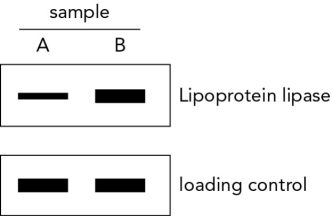
(71) Samples of adipose tissue from a patient were analyzed by Western blot. Samples were obtained before and after treatment with a drug aimed to treat type 2 diabetes. Given the data shown, determine which sample (A or B) was obtained after drug administration. Discuss your reasoning and include the name of the drug that was used in the study.
(Essay)
4.8/5 (94)
(94) The exchange of fatty acids and triacylglycerols between the liver and adipose tissue is an ongoing process that helps maintain metabolic homeostasis. What is the name of this process?
(Short Answer)
4.8/5 (78)
(78) Differentiate the roles of the two different phosphorylation sites of insulin receptor substrate 1 (IRS1). Include the specific amino acids that are phosphorylated as well as the signaling pathway involved in your answer.
(Essay)
4.7/5 (87)
(87) Glucagon-like peptide-1 (GLP-1) is a hormone peptide secreted by intestinal L cells. It is secreted in response to the nutrient detection in the small intestine. The resulting physiological response is the lowering of blood glucose levels. Which of the following is a potential mechanism for how GLP-1 causes this physiological response?
(Multiple Choice)
4.9/5 (61)
(61) What are the concentrations of glucose that would be expected of a healthy individual after an 8-hour fast and after consuming a large soft pretzel?
(Multiple Choice)
4.9/5 (72)
(72) During periods of starvation, gluconeogenesis increases in the liver. Which of the following is a major substrate for glucose biosynthesis under these conditions?
(Multiple Choice)
5.0/5 (84)
(84) 
Filters
- Essay(0)
- Multiple Choice(0)
- Short Answer(0)
- True False(0)
- Matching(0)