



 Chat with AI
Exam 10: The Blood Vessels and Blood Pressure

Exam 1: Introduction to Physiology and Homeostasis81 Questions
Exam 2: Cell Physiology135 Questions
Exam 3: The Plasma Membrane and Membrane Potential182 Questions
Exam 4: Principles of Neural and Hormonal Communication169 Questions
Exam 5: A--The Central Nervous System202 Questions
Exam 5: B--The Central Nervous System14 Questions
Exam 6: A--The Peripheral Nervous System: Afferent Division; Special Senses196 Questions
Exam 6: B--The Peripheral Nervous System: Afferent Division; Special Senses20 Questions
Exam 7: The Peripheral Nervous System: Efferent Division104 Questions
Exam 8: A--Muscle Physiology199 Questions
Exam 8: B--Muscle Physiology13 Questions
Exam 9: A--Cardiac Physiology159 Questions
Exam 9: B--Cardiac Physiology20 Questions
Exam 10: The Blood Vessels and Blood Pressure213 Questions
Exam 11: The Blood175 Questions
Exam 12: Body Defenses188 Questions
Exam 13: A--The Respiratory System198 Questions
Exam 13: B--The Respiratory System12 Questions
Exam 14: A--The Urinary System217 Questions
Exam 14: B--The Urinary System19 Questions
Exam 15: A--Fluid and Acid-Base Balance190 Questions
Exam 15: B--Fluid and Acid-Base Balance9 Questions
Exam 16: A--The Digestive System236 Questions
Exam 16: B--The Digestive System12 Questions
Exam 17: Energy Balance and Temperature Regulation139 Questions
Exam 18: A--Principles of Endocrinology: the Central Endocrine Glands204 Questions
Exam 18: B--Principles of Endocrinology: the Central Endocrine Glands6 Questions
Exam 19: A--The Peripheral Endocrine Glands196 Questions
Exam 19: B--The Peripheral Endocrine Glands6 Questions
Exam 20: A--The Reproductive System235 Questions
Exam 20: B--The Reproductive System5 Questions
Select questions type


For the following questions, choose the appropriate letter from the answer code below to make the statement true. a. increases b. inhibits or decreases: c. has no effect on
Decreased O2, increased CO2, increased acid, and increased K+ concentrations in a skeletal muscle ____ the radius of the arterioles supplying this skeletal muscle.
(Short Answer)
4.9/5  (75)
(75) The larger arteries assist with systemic blood flow to tissues by
(Multiple Choice)
4.8/5 (75)
(75) If driving pressure is constant, flow will double when the radius increases by two-fold.
(True/False)
4.9/5 (78)
(78) The carotid sinuses and aorta contain receptors that are sensitive to changes in
(Multiple Choice)
5.0/5 (84)
(84) Which of the following factors would produce the greatest change in blood flow?
(Multiple Choice)
4.8/5 (86)
(86) Given the following forces acting at a given point across the capillary wall, what type of fluid movement will be taking place at that point? - cagill wy blood premane = 32 man Hg
- blood armotic prense
- intarstitial fluid hydrastedic pratre = Hg
- intarstitial fluid osmotic grange 0
(Multiple Choice)
4.9/5 (94)
(94) Complete each of the following statments. Assume a person has a blood pressure recording of 125/77.
(a) What is the systolicpressure?___________
b) What is the diastolic pressure?___________
c) What is the pulse pressure?___________
(d) What is the mean arterial pressure?___________
(e) Would any sound be heard when the pressure in an external cuff around the arm was 130 mm Hg?___________
(f) Would any sound be heard when cuff pressure was 118 mm Hg ?___________
(g) Would any sound be heard when cuff pressure was 75 mm Hg ?___________
(Short Answer)
4.9/5 (86)
(86) The capillary vessel walls are more permeable than the lymphatic vessel walls.
(True/False)
4.9/5 (84)
(84) Varicose veins develop mainly from the incompetent function of the
(Multiple Choice)
4.9/5 (74)
(74) For the following questions, choose the appropriate letter from the answer code below to make the statement true. a. increases b. inhibits or decreases: c. has no effect on
Decreased arteriolar radii ____ the blood flow through arterioles.
(Short Answer)
4.9/5 (81)
(81) Use this figure to answer the corresponding questions.
Letter ____ identifies the linear velocity of flow in mm/sec, while letter ____ identifies the blood flow rate in liters/min.
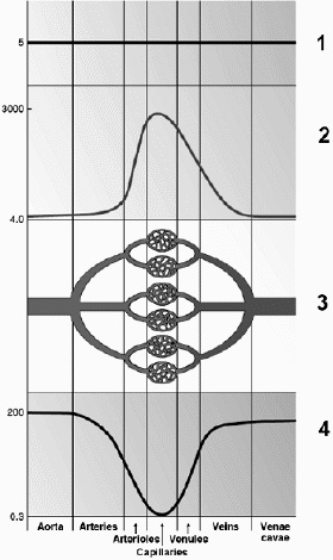 a. 1,2 b. 2,1 c. 3,1 d. 4,1 e. 2,4
 (Short Answer)
4.9/5 (74)
(74) Which of the following does not occur as a compensation for hemorrhage?
(Multiple Choice)
4.9/5 (90)
(90) Bulk flow refers to the volume of blood ejected by each ventricle each minute.
(True/False)
4.9/5 (84)
(84) The greatest pressure drop in the vascular system occurs within the capillaries due to fluid leaving the capillaries by the process of ultrafiltration.
(True/False)
4.9/5 (89)
(89) Edema, venous pooling, and a reduction in cardiac output are consequences of standing still for a long time.
(True/False)
4.9/5 (80)
(80) For the following questions, choose the appropriate letter from the answer code below to make the statement true. a. increases b. inhibits or decreases: c. has no effect on
Increasing sympathetic nerve activity ____ vein radii, and decreasing vein radii ____ venous return.
(Short Answer)
4.9/5 (90)
(90) 
Filters
- Essay(0)
- Multiple Choice(0)
- Short Answer(0)
- True False(0)
- Matching(0)