



 Chat with AI
Exam 10: The Blood Vessels and Blood Pressure

Exam 1: Introduction to Physiology and Homeostasis81 Questions
Exam 2: Cell Physiology135 Questions
Exam 3: The Plasma Membrane and Membrane Potential182 Questions
Exam 4: Principles of Neural and Hormonal Communication169 Questions
Exam 5: A--The Central Nervous System202 Questions
Exam 5: B--The Central Nervous System14 Questions
Exam 6: A--The Peripheral Nervous System: Afferent Division; Special Senses196 Questions
Exam 6: B--The Peripheral Nervous System: Afferent Division; Special Senses20 Questions
Exam 7: The Peripheral Nervous System: Efferent Division104 Questions
Exam 8: A--Muscle Physiology199 Questions
Exam 8: B--Muscle Physiology13 Questions
Exam 9: A--Cardiac Physiology159 Questions
Exam 9: B--Cardiac Physiology20 Questions
Exam 10: The Blood Vessels and Blood Pressure213 Questions
Exam 11: The Blood175 Questions
Exam 12: Body Defenses188 Questions
Exam 13: A--The Respiratory System198 Questions
Exam 13: B--The Respiratory System12 Questions
Exam 14: A--The Urinary System217 Questions
Exam 14: B--The Urinary System19 Questions
Exam 15: A--Fluid and Acid-Base Balance190 Questions
Exam 15: B--Fluid and Acid-Base Balance9 Questions
Exam 16: A--The Digestive System236 Questions
Exam 16: B--The Digestive System12 Questions
Exam 17: Energy Balance and Temperature Regulation139 Questions
Exam 18: A--Principles of Endocrinology: the Central Endocrine Glands204 Questions
Exam 18: B--Principles of Endocrinology: the Central Endocrine Glands6 Questions
Exam 19: A--The Peripheral Endocrine Glands196 Questions
Exam 19: B--The Peripheral Endocrine Glands6 Questions
Exam 20: A--The Reproductive System235 Questions
Exam 20: B--The Reproductive System5 Questions
Select questions type


Which local chemical changes do not occur during a period of increased cell activity?
(Multiple Choice)
4.7/5  (67)
(67) Which of the following factors aids venous return to the heart?
(Multiple Choice)
4.8/5 (68)
(68) What force continues to drive blood through the vasculature during ventricular diastole?
(Multiple Choice)
5.0/5 (89)
(89) For the following questions, choose the appropriate letter from the answer code below to make the statement true. a. increases b. inhibits or decreases: c. has no effect on
Increased venous radii ____ the blood flow through veins.
(Short Answer)
4.9/5 (87)
(87) What are the four roles of the lymphatic system in relation to the cardiovascular system?
(Essay)
5.0/5 (85)
(85) Indicate whether the following would a. increase BP b. decrease BP c. increase heat rate only d. have on effect on BP or heat rate ____ Increased vasomotor center activity
____ Barore ceptors inhibited
____ Chemoreceptors activated
____ Stress
____ Increased release of aldosterone
____ Increased release of vasopressin
____ Release of renin
____ Water reabsorption
____ Epinephrine release
____ Venous vaso dilation
(Short Answer)
4.9/5 (76)
(76) Which statement regarding sympathetic stimulation effects on blood pressure is incorrect?
(Multiple Choice)
4.9/5 (93)
(93) Blood flow is driven by osmotic pressure, while blood pressure is driven by hydrostatic forces.
(True/False)
4.9/5 (78)
(78) There is a constant flow of blood through the capillaries even though the heart is forcing blood out into the arterial system only part of the time.
(True/False)
4.8/5 (73)
(73) Velocity of blood flow is the slowest in the veins because the blood must move uphill against gravity in these vessels.
(True/False)
4.8/5 (91)
(91) Receptors that detect changes in the blood pressure are located in the
(Multiple Choice)
4.9/5 (85)
(85) What is the most important factor that increases blood flow through a specific tissue to meet the tissues needs?
(Multiple Choice)
5.0/5 (81)
(81) Use this figure to answer the corresponding questions.
Which vessel contains blood with the highest concentration of oxygen?
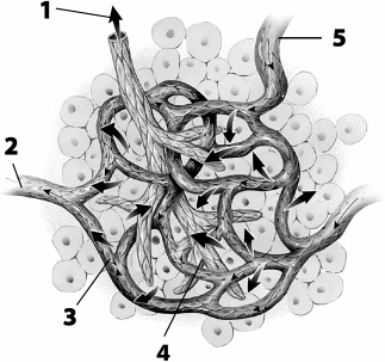 a. vessel 1 b. vessel 2 c. vessel 3 d. vessel 4 e. vessel 5
(Short Answer)
4.9/5 (77)
(77) Regulation of arterial pressure is mediated by reflex mechanisms. One important pressure receptor, a(n) ____, is located in the ____.
(Multiple Choice)
4.9/5 (69)
(69) During exercise, a larger percentage of the cardiac output travels to the skin and skeletal muscles.
(True/False)
4.7/5 (83)
(83) The primary means by which individual substances are exchanged between the blood and surrounding tissues is by bulk flow.
(True/False)
4.8/5 (71)
(71) Heart and venous valves serve a similar function. They prevent a ____ flow of blood.
(Multiple Choice)
4.8/5 (81)
(81) 
Filters
- Essay(0)
- Multiple Choice(0)
- Short Answer(0)
- True False(0)
- Matching(0)