



 Chat with AI
Exam 10: The Blood Vessels and Blood Pressure

Exam 1: Introduction to Physiology and Homeostasis81 Questions
Exam 2: Cell Physiology135 Questions
Exam 3: The Plasma Membrane and Membrane Potential182 Questions
Exam 4: Principles of Neural and Hormonal Communication169 Questions
Exam 5: A--The Central Nervous System202 Questions
Exam 5: B--The Central Nervous System14 Questions
Exam 6: A--The Peripheral Nervous System: Afferent Division; Special Senses196 Questions
Exam 6: B--The Peripheral Nervous System: Afferent Division; Special Senses20 Questions
Exam 7: The Peripheral Nervous System: Efferent Division104 Questions
Exam 8: A--Muscle Physiology199 Questions
Exam 8: B--Muscle Physiology13 Questions
Exam 9: A--Cardiac Physiology159 Questions
Exam 9: B--Cardiac Physiology20 Questions
Exam 10: The Blood Vessels and Blood Pressure213 Questions
Exam 11: The Blood175 Questions
Exam 12: Body Defenses188 Questions
Exam 13: A--The Respiratory System198 Questions
Exam 13: B--The Respiratory System12 Questions
Exam 14: A--The Urinary System217 Questions
Exam 14: B--The Urinary System19 Questions
Exam 15: A--Fluid and Acid-Base Balance190 Questions
Exam 15: B--Fluid and Acid-Base Balance9 Questions
Exam 16: A--The Digestive System236 Questions
Exam 16: B--The Digestive System12 Questions
Exam 17: Energy Balance and Temperature Regulation139 Questions
Exam 18: A--Principles of Endocrinology: the Central Endocrine Glands204 Questions
Exam 18: B--Principles of Endocrinology: the Central Endocrine Glands6 Questions
Exam 19: A--The Peripheral Endocrine Glands196 Questions
Exam 19: B--The Peripheral Endocrine Glands6 Questions
Exam 20: A--The Reproductive System235 Questions
Exam 20: B--The Reproductive System5 Questions
Select questions type


Complete each of the following statments.
Two functions of arteries include being a(n) ____________________ and a(n) ____________________.
(Short Answer)
4.9/5  (98)
(98) If the pulse pressure is 44 mm Hg and the diastolic pressure is 68 mm Hg, the systolic pressure is ____ mm Hg.
(Multiple Choice)
4.7/5 (88)
(88) Complete each of the following statments.
____________________ controls are primarily responsible for matching tissue blood flow with the metabolic needs of the tissue involved.
(Short Answer)
4.9/5 (78)
(78) As metabolic activity of an organ or tissue increases, blood flow to that organ increases. This phenomenon is known as
(Multiple Choice)
4.8/5 (72)
(72) ____ refers to a chronic state of increased arterial pressure.
(Multiple Choice)
4.9/5 (76)
(76) The pulse pressure is the maximum pressure exerted in the arteries.
(True/False)
4.9/5 (76)
(76) For the following questions, choose the appropriate letter from the answer code below to make the statement true. a. increases b. inhibits or decreases: c. has no effect on
Decreased rate of firing in afferent nerves reaching the cardiovascular control center ____ the sympathetic nerve stimulation of the cardiovascular system.
(Short Answer)
4.8/5 (75)
(75) Indicate the relative comparison of each of the paired items by writing the appropriate letter in the blank using the following answer code: a. A is greater than B b. B is greater than A c. A and B are equal
____ A. Blood flow through an arteriole upon increased sympathetic activity
B. Blood flow through an arteriole upon decreased sympathetic activity
____ A. Venous return upon increased sympathetic stimulation of veins
B. Blood flow through a vein upon decreased sympathetic activity
____ A. Velocity of blood flow through the veins
B. Velocity of blood flow through the capillaries
____ A. Local arteriolar radius in the presence of local decreased and increased concentrations
B. Local arteriolar rachus with nomal local concentrations of and
____ A. Circulation through the skin during exercise
B. Circulation through the skin at rest
____ A. Circulation to the brain at rest
B. Circulation to the brain during an examination
____ A. Net reabsorption pressure at the venula end of the capillary
B. Net ultrafiltration pressure at the arteriolar end of the capillary
(Short Answer)
4.8/5 (88)
(88) Use this figure to answer the corresponding questions.
Which vessel(s) contains overlapping endothelial cells?
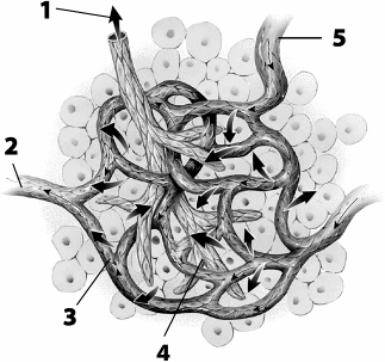 a. vessels 1 and 2 b. vessel 2 only c. vessels 2 and 4 d. vessel 4 only e. vessels 2,3 , and 5
(Short Answer)
4.8/5 (77)
(77) Complete each of the following statments.
Vasogenic shock is triggered by widespread ____________________ of blood vessels.
(Short Answer)
4.9/5 (80)
(80) At any point in time, most of the blood flow in the body is contained in the capillaries.
(True/False)
4.9/5 (74)
(74) Use this figure to answer the corresponding questions.
Letter ____ identifies the total cross-sectional area in cm2.
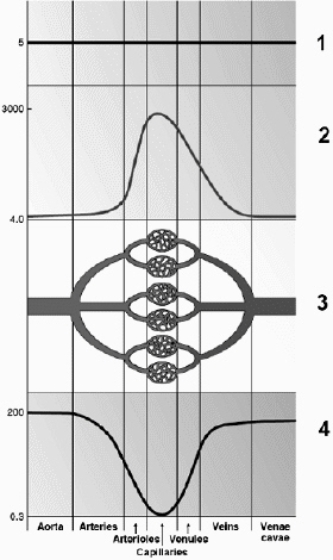 a. 1
b. 2
c. 3
d. 4
e. none of these
a. 1
b. 2
c. 3
d. 4
e. none of these (Short Answer)
4.8/5 (78)
(78) For the following questions, choose the appropriate letter from the answer code below to make the statement true. a. increases b. inhibits or decreases: c. has no effect on
Increased arteriolar radius ____ the total peripheral resistance, and increased total peripheral resistance ____ the mean systemic arterial blood pressure.
(Short Answer)
4.8/5 (87)
(87) Complete each of the following statments.
Movement of fluid from the interstitial fluid into the plasma is known as ____________________.
(Short Answer)
4.9/5 (77)
(77) During exercise, there is not an increased blood flow to the
(Multiple Choice)
4.9/5 (68)
(68) 
Filters
- Essay(0)
- Multiple Choice(0)
- Short Answer(0)
- True False(0)
- Matching(0)