



 Chat with AI
Exam 29: International Trade

Exam 1: The Central Idea156 Questions
Exam 2: Observing and Explaining the Economy143 Questions
Exam 3: The Supply and Demand Model166 Questions
Exam 4: Subtleties of the Supply and Demand Model176 Questions
Exam 5: The Demand Curve and the Behavior of Consumers176 Questions
Exam 6: The Supply Curve and the Behavior of Firms179 Questions
Exam 7: The Efficiency of Markets163 Questions
Exam 8: Costs and the Changes at Firms Over Time191 Questions
Exam 9: The Rise and Fall of Industries139 Questions
Exam 10: Monopoly184 Questions
Exam 11: Product Differentiation, Monopolistic Competition, and Oligopoly169 Questions
Exam 12: Antitrust Policy and Regulation152 Questions
Exam 13: Labor Markets179 Questions
Exam 14: Taxes, Transfers, and Income Distribution179 Questions
Exam 15: Public Goods, Externalities, and Government Behavior197 Questions
Exam 16: Capital and Financial Markets188 Questions
Exam 17: Macroeconomics: the Big Picture159 Questions
Exam 18: Measuring the Production, Income, and Spending of Nations177 Questions
Exam 19: The Spending Allocation Model166 Questions
Exam 20: Unemployment and Employment212 Questions
Exam 21: Productivity and Economic Growth162 Questions
Exam 22: Money and Inflation153 Questions
Exam 23: The Nature and Causes of Economic Fluctuations185 Questions
Exam 24: The Economic Fluctuations Model205 Questions
Exam 25: Using the Economic Fluctuations Model176 Questions
Exam 26: Fiscal Policy138 Questions
Exam 27: Monetary Policy180 Questions
Exam 28: Economic Growth Around the World157 Questions
Exam 29: International Trade242 Questions
Exam 30: International Finance125 Questions
Select questions type


An area that has no trade barriers between the countries in the area is called a
(Multiple Choice)
4.8/5  (76)
(76) If country A has a lower opportunity cost of producing cars than country B, then country A has
(Multiple Choice)
4.9/5 (95)
(95) Consider an industry in which, for each individual firm in the industry, cost per unit of output declines as the individual firm's output increases. If there is an increase in the number of firms in this industry whereas the market size stays the same, then the
(Multiple Choice)
4.7/5 (78)
(78) Production that uses a relatively low level of capital per worker is called
(Multiple Choice)
4.8/5 (73)
(73) The effect the Smoot-Hawley tariff had on international trade was small.
(True/False)
4.8/5 (76)
(76) Exhibit 29-1  -According to the data in Exhibit 29-1, which of the following statements is true?
 (Multiple Choice)
4.9/5 (88)
(88) Exhibit 29-2  -According to the data in Exhibit 29-2, the relative price of computers and rice for Korea is
 (Multiple Choice)
4.8/5 (77)
(77) A free trade area with a common external tariff is called a(n)
(Multiple Choice)
4.7/5 (65)
(65) Exhibit 29-3 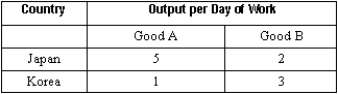 -Referring to Exhibit 29-3, suppose the posttrade relative price between Japan and Korea is 1 computer per unit of rice. If Japan takes 10 workers out of rice production, puts the 10 workers in computer production, and sells the resulting computers to Korea in exchange for rice, the net gain from trade for Japan is
 (Multiple Choice)
4.9/5 (69)
(69) Exhibit 29-1
-According to the data in Exhibit 29-1, the opportunity cost of producing one more unit of good B in China is
-According to the data in Exhibit 29-1, the opportunity cost of producing one more unit of good B in China is (Multiple Choice)
4.8/5 (76)
(76) Was the rationale for the North American Free Trade Agreement (NAFTA) based solely on the concept of comparative advantage? Explain.
(Essay)
4.8/5 (84)
(84) Using the price/cost per unit analysis diagram presented in this section, show how a free trade agreement between countries with identical technology and resources can lead to gains from trade.
(Essay)
4.8/5 (73)
(73) Simultaneous tariff reduction on the part of many countries is called
(Multiple Choice)
4.9/5 (76)
(76) The cost to consumers of imposing antidumping duties on steel has been up to more than $700,000 per job protected.
(True/False)
4.8/5 (78)
(78) A country is willing to export a positive quantity of a good if the quantity demanded domestically at the world price is greater than the quantity produced at the world price.
(True/False)
4.9/5 (89)
(89) If a country's opportunity costs increase when it trades one product for another,
(Multiple Choice)
4.8/5 (94)
(94) Exhibit 29-1
-According to the data in Exhibit 29-1, China has a(n)
-According to the data in Exhibit 29-1, China has a(n) (Multiple Choice)
4.9/5 (74)
(74) It takes Gail two hours to mow the lawn and one hour to clean up the house on weekends. It takes Gail's husband two hours to clean up the house. Gail's husband is responsible for cleaning up the house. Use the concept of comparative advantage to explain why.
(Essay)
4.8/5 (76)
(76) Suppose the Russian government decides it needs to protect its aircraft industry for reasons of national security. Name two ways it can achieve this goal. Which policy would you recommend? Why?
(Essay)
5.0/5 (90)
(90) 
Filters
- Essay(0)
- Multiple Choice(0)
- Short Answer(0)
- True False(0)
- Matching(0)