



 Chat with AI
Exam 29: International Trade

Exam 1: The Central Idea156 Questions
Exam 2: Observing and Explaining the Economy143 Questions
Exam 3: The Supply and Demand Model166 Questions
Exam 4: Subtleties of the Supply and Demand Model176 Questions
Exam 5: The Demand Curve and the Behavior of Consumers176 Questions
Exam 6: The Supply Curve and the Behavior of Firms179 Questions
Exam 7: The Efficiency of Markets163 Questions
Exam 8: Costs and the Changes at Firms Over Time191 Questions
Exam 9: The Rise and Fall of Industries139 Questions
Exam 10: Monopoly184 Questions
Exam 11: Product Differentiation, Monopolistic Competition, and Oligopoly169 Questions
Exam 12: Antitrust Policy and Regulation152 Questions
Exam 13: Labor Markets179 Questions
Exam 14: Taxes, Transfers, and Income Distribution179 Questions
Exam 15: Public Goods, Externalities, and Government Behavior197 Questions
Exam 16: Capital and Financial Markets188 Questions
Exam 17: Macroeconomics: the Big Picture159 Questions
Exam 18: Measuring the Production, Income, and Spending of Nations177 Questions
Exam 19: The Spending Allocation Model166 Questions
Exam 20: Unemployment and Employment212 Questions
Exam 21: Productivity and Economic Growth162 Questions
Exam 22: Money and Inflation153 Questions
Exam 23: The Nature and Causes of Economic Fluctuations185 Questions
Exam 24: The Economic Fluctuations Model205 Questions
Exam 25: Using the Economic Fluctuations Model176 Questions
Exam 26: Fiscal Policy138 Questions
Exam 27: Monetary Policy180 Questions
Exam 28: Economic Growth Around the World157 Questions
Exam 29: International Trade242 Questions
Exam 30: International Finance125 Questions
Select questions type


Country A has a comparative advantage over country B in the production of a good if the opportunity cost of producing the good in country A is less than in country B.
(True/False)
4.9/5  (82)
(82) The recommendation of early economists such as Smith and Ricardo to the British government was to
(Multiple Choice)
4.7/5 (62)
(62) A country should specialize in the production of those goods that use its most abundant factor most intensively.
(True/False)
4.8/5 (75)
(75) As tariffs were being reduced in the post-World War II period,
(Multiple Choice)
4.9/5 (84)
(84) The commerce clause of the U.S. Constitution is a clause that
(Multiple Choice)
5.0/5 (86)
(86) The average tariff level reached a high of ____ percent in the nineteenth century.
(Multiple Choice)
4.8/5 (85)
(85) If consumers as a whole benefit from the reduction of trade barriers, then why are businesses able to successfully lobby Congress to impose trade barriers?
(Essay)
4.8/5 (84)
(84) Production that uses a relatively high level of capital per worker is called
(Multiple Choice)
4.8/5 (82)
(82) Revenue tariffs are still common in less-developed countries because
(Multiple Choice)
4.7/5 (70)
(70) In trade policy, the removal of trade barriers by one country without reciprocal action on the part of other countries is called
(Multiple Choice)
4.9/5 (77)
(77) What is the difference between the effect of a tariff and the effect of a quota?
(Essay)
4.9/5 (90)
(90) Currently, unilateral disarmament is seldom used by developed countries.
(True/False)
4.9/5 (76)
(76) What problems do quality and performance standards create in terms of foreign trade?
(Essay)
4.9/5 (87)
(87) Suppose country X imposes a tariff on imported shoes. The table below shows the import demand and export supply before and after the tariff. Quantities are in thousands. 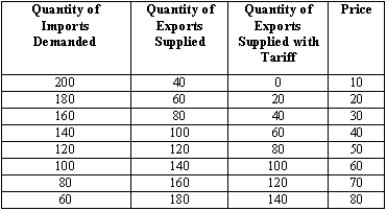

(Essay)
4.8/5 (90)
(90) Linear production possibilities curves explain why a country
(Multiple Choice)
4.8/5 (76)
(76) The shifting of trade away from the low-cost producer toward a higher-cost producer because of a reduction in trade barriers with the country of the higher-cost producer is called
(Multiple Choice)
4.8/5 (91)
(91) Trade restrictions imposed on a country with poor environmental and/or labor standards in order to get the country to improve these standards are often counterproductive.
(True/False)
4.9/5 (72)
(72) A curve showing the quantity of exports supplied at various prices is called a(n)
(Multiple Choice)
4.8/5 (76)
(76) Which of the following is not a reason why international trade has increased as a proportion of the world GDP in the last 50 years?
(Multiple Choice)
4.7/5 (71)
(71) 
Filters
- Essay(0)
- Multiple Choice(0)
- Short Answer(0)
- True False(0)
- Matching(0)