



 Chat with AI
Exam 29: International Trade

Exam 1: The Central Idea156 Questions
Exam 2: Observing and Explaining the Economy143 Questions
Exam 3: The Supply and Demand Model166 Questions
Exam 4: Subtleties of the Supply and Demand Model176 Questions
Exam 5: The Demand Curve and the Behavior of Consumers176 Questions
Exam 6: The Supply Curve and the Behavior of Firms179 Questions
Exam 7: The Efficiency of Markets163 Questions
Exam 8: Costs and the Changes at Firms Over Time191 Questions
Exam 9: The Rise and Fall of Industries139 Questions
Exam 10: Monopoly184 Questions
Exam 11: Product Differentiation, Monopolistic Competition, and Oligopoly169 Questions
Exam 12: Antitrust Policy and Regulation152 Questions
Exam 13: Labor Markets179 Questions
Exam 14: Taxes, Transfers, and Income Distribution179 Questions
Exam 15: Public Goods, Externalities, and Government Behavior197 Questions
Exam 16: Capital and Financial Markets188 Questions
Exam 17: Macroeconomics: the Big Picture159 Questions
Exam 18: Measuring the Production, Income, and Spending of Nations177 Questions
Exam 19: The Spending Allocation Model166 Questions
Exam 20: Unemployment and Employment212 Questions
Exam 21: Productivity and Economic Growth162 Questions
Exam 22: Money and Inflation153 Questions
Exam 23: The Nature and Causes of Economic Fluctuations185 Questions
Exam 24: The Economic Fluctuations Model205 Questions
Exam 25: Using the Economic Fluctuations Model176 Questions
Exam 26: Fiscal Policy138 Questions
Exam 27: Monetary Policy180 Questions
Exam 28: Economic Growth Around the World157 Questions
Exam 29: International Trade242 Questions
Exam 30: International Finance125 Questions
Select questions type


Which of the following do Japanese rice farmers and the U.S. textile industry have in common?
(Multiple Choice)
4.9/5  (74)
(74) Which of the following is least likely to explain a country's comparative advantage?
(Multiple Choice)
4.9/5 (75)
(75) Trade will tend to increase the cost of capital in a labor-abundant country.
(True/False)
4.8/5 (69)
(69) What are the two arguments made to justify not lowering trade barriers against countries with poor environmental protection laws and poor labor standards? According to the text, what is the problem with these arguments?
(Essay)
4.8/5 (87)
(87) Revenue tariffs, whose main purpose is raising revenue, were by far the most significant source of federal revenue in the United States before the income tax was made constitutional by the Sixteenth Amendment to the U.S. Constitution in 1913.
(True/False)
4.8/5 (77)
(77) Which of the following statements about nontariff barriers is true?
(Multiple Choice)
4.7/5 (81)
(81) When countries create a free trade area and increase market size, there will be
(Multiple Choice)
4.7/5 (85)
(85) Suppose there are two countries that are about to begin trading goods; one is labor abundant and one is capital abundant.

(Essay)
4.9/5 (82)
(82) A tariff will increase the price of imported goods and have no effect on the price of the same good produced domestically.
(True/False)
4.8/5 (81)
(81) Transfer payments to workers who lose jobs as a result of removing trade restrictions are called
(Multiple Choice)
4.8/5 (73)
(73) Suppose two countries have similar resources, capital, and skilled labor. If they produce more, the cost per unit of production for both goods declines as more goods are produced. The most efficient method to produce the products is for each country to
(Multiple Choice)
4.8/5 (75)
(75) If reducing trade barriers is supposed to improve consumer surplus and reduce deadweight loss, why is it so difficult to reduce trade barriers?
(Essay)
4.9/5 (71)
(71) Which of the following is the best definition of opportunity cost?
(Multiple Choice)
4.7/5 (70)
(70) After the Uruguay round of trade talks, the newest attempt on reducing trade barriers around the world has come to be known as the
(Multiple Choice)
4.8/5 (88)
(88) When the size of the market increases, the relationship between the number of firms in the market and the average total cost shifts upward.
(True/False)
4.7/5 (71)
(71) Exhibit 30-1 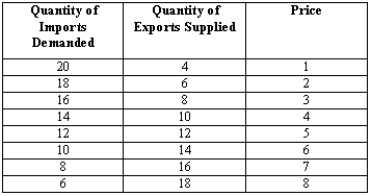 -A quota set below the free market equilibrium quantity of imports will mean that
 (Multiple Choice)
4.9/5 (81)
(81) 
Filters
- Essay(0)
- Multiple Choice(0)
- Short Answer(0)
- True False(0)
- Matching(0)