



 Chat with AI
Exam 29: International Trade

Exam 1: The Central Idea156 Questions
Exam 2: Observing and Explaining the Economy143 Questions
Exam 3: The Supply and Demand Model166 Questions
Exam 4: Subtleties of the Supply and Demand Model176 Questions
Exam 5: The Demand Curve and the Behavior of Consumers176 Questions
Exam 6: The Supply Curve and the Behavior of Firms179 Questions
Exam 7: The Efficiency of Markets163 Questions
Exam 8: Costs and the Changes at Firms Over Time191 Questions
Exam 9: The Rise and Fall of Industries139 Questions
Exam 10: Monopoly184 Questions
Exam 11: Product Differentiation, Monopolistic Competition, and Oligopoly169 Questions
Exam 12: Antitrust Policy and Regulation152 Questions
Exam 13: Labor Markets179 Questions
Exam 14: Taxes, Transfers, and Income Distribution179 Questions
Exam 15: Public Goods, Externalities, and Government Behavior197 Questions
Exam 16: Capital and Financial Markets188 Questions
Exam 17: Macroeconomics: the Big Picture159 Questions
Exam 18: Measuring the Production, Income, and Spending of Nations177 Questions
Exam 19: The Spending Allocation Model166 Questions
Exam 20: Unemployment and Employment212 Questions
Exam 21: Productivity and Economic Growth162 Questions
Exam 22: Money and Inflation153 Questions
Exam 23: The Nature and Causes of Economic Fluctuations185 Questions
Exam 24: The Economic Fluctuations Model205 Questions
Exam 25: Using the Economic Fluctuations Model176 Questions
Exam 26: Fiscal Policy138 Questions
Exam 27: Monetary Policy180 Questions
Exam 28: Economic Growth Around the World157 Questions
Exam 29: International Trade242 Questions
Exam 30: International Finance125 Questions
Select questions type


According to the text, the most important reason international trade has grown so rapidly during the past 40 years is the reduction in the cost of transportation and communication.
(True/False)
4.9/5  (89)
(89) Exhibit 30-1 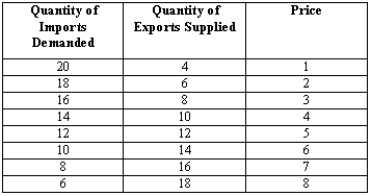 -An upper limit on the quantity of a good that may be imported or sold is called a(n)
 (Multiple Choice)
4.8/5 (92)
(92) A country can have an absolute advantage in the production of all goods.
(True/False)
4.9/5 (80)
(80) A new industry that may be encouraged by protectionist policies is called a(n)
(Multiple Choice)
4.9/5 (76)
(76) When Canada and the United States permitted free trade in cars, Canadian automobile
(Multiple Choice)
4.8/5 (62)
(62) Throughout much of U.S. history, tariffs had the purpose of
(Multiple Choice)
4.9/5 (76)
(76) Multilateral approaches have more advantages than regional trading areas have.
(True/False)
4.8/5 (79)
(79) Explain the connection between the relative price and opportunity cost.
(Essay)
4.7/5 (74)
(74) When economies of scale exist over wide production ranges for two products,
(Multiple Choice)
4.7/5 (77)
(77) Often the benefit an individual consumer receives from the elimination of trade barriers is much less than the benefit a domestic firm or industry receives from keeping such a barrier in place.
(True/False)
4.9/5 (82)
(82) The selling of goods by foreign firms at a price below average cost or below the price in the domestic country is called
(Multiple Choice)
4.8/5 (80)
(80) Exhibit 29-2  -Suppose two countries trade two goods without government restrictions. If transportation costs are negligible and markets are competitive, then the price of the goods
 (Multiple Choice)
4.7/5 (74)
(74) Countries with low labor productivity will not have a comparative advantage in the production of any good.
(True/False)
4.9/5 (86)
(86) The slope of a linear production possibilities curve with trade is given by the
(Multiple Choice)
4.9/5 (77)
(77) An international treaty and organization that until 1993 promoted mutual reduction in tariffs and other trade barriers among countries was called the
(Multiple Choice)
4.9/5 (83)
(83) 
Exhibit 29-2
-According to the data in Exhibit 29-2, the relative price of computers and rice for Japan is
-According to the data in Exhibit 29-2, the relative price of computers and rice for Japan is (Multiple Choice)
4.9/5 (80)
(80) 
Filters
- Essay(0)
- Multiple Choice(0)
- Short Answer(0)
- True False(0)
- Matching(0)