



 Chat with AI
Exam 29: International Trade

Exam 1: The Central Idea156 Questions
Exam 2: Observing and Explaining the Economy143 Questions
Exam 3: The Supply and Demand Model166 Questions
Exam 4: Subtleties of the Supply and Demand Model176 Questions
Exam 5: The Demand Curve and the Behavior of Consumers176 Questions
Exam 6: The Supply Curve and the Behavior of Firms179 Questions
Exam 7: The Efficiency of Markets163 Questions
Exam 8: Costs and the Changes at Firms Over Time191 Questions
Exam 9: The Rise and Fall of Industries139 Questions
Exam 10: Monopoly184 Questions
Exam 11: Product Differentiation, Monopolistic Competition, and Oligopoly169 Questions
Exam 12: Antitrust Policy and Regulation152 Questions
Exam 13: Labor Markets179 Questions
Exam 14: Taxes, Transfers, and Income Distribution179 Questions
Exam 15: Public Goods, Externalities, and Government Behavior197 Questions
Exam 16: Capital and Financial Markets188 Questions
Exam 17: Macroeconomics: the Big Picture159 Questions
Exam 18: Measuring the Production, Income, and Spending of Nations177 Questions
Exam 19: The Spending Allocation Model166 Questions
Exam 20: Unemployment and Employment212 Questions
Exam 21: Productivity and Economic Growth162 Questions
Exam 22: Money and Inflation153 Questions
Exam 23: The Nature and Causes of Economic Fluctuations185 Questions
Exam 24: The Economic Fluctuations Model205 Questions
Exam 25: Using the Economic Fluctuations Model176 Questions
Exam 26: Fiscal Policy138 Questions
Exam 27: Monetary Policy180 Questions
Exam 28: Economic Growth Around the World157 Questions
Exam 29: International Trade242 Questions
Exam 30: International Finance125 Questions
Select questions type


A country would have a comparative advantage in a good if its production is
(Multiple Choice)
4.8/5  (95)
(95) The reduction of trade barriers is a concept that was first recognized by most mainstream economists during the twentieth century.
(True/False)
4.9/5 (85)
(85) The United States may have a comparative advantage in pharmaceuticals because of
(Multiple Choice)
5.0/5 (97)
(97) Exhibit 29-5  -Suppose that instead of constant costs of production, the United States and Mexico both had increasing costs of production.

-Suppose that instead of constant costs of production, the United States and Mexico both had increasing costs of production.
(Essay)
4.9/5 (79)
(79) Trade between countries in goods from the same or similar industries is called
(Multiple Choice)
5.0/5 (82)
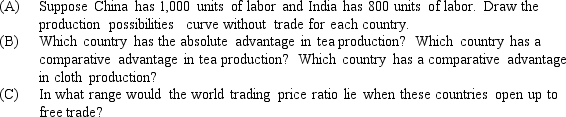
(82) Suppose China and India are both able to produce tea and cloth by only using labor. In China, it takes 1 unit of labor to produce 1 kilogram of tea and 2 units of labor to produce 1 meter of cloth. In India, it takes 2 units of labor to produce 1 kilogram of tea and 2 units of labor to produce 1 meter of cloth.
(Essay)
4.7/5 (82)
(82) Rose has an absolute advantage over Sam in both computer programming and sales. Rose will hire Sam to sell her software if her efficiency at programming
(Multiple Choice)
5.0/5 (73)
(73) The relative price of two goods (units of A per unit of B) is the same as the opportunity cost of producing good B.
(True/False)
4.7/5 (79)
(79) Why is multilateral negotiation a viable alternative to unilateral disarmament?
(Essay)
4.9/5 (78)
(78) If country A can produce computers more efficiently than cars relative to country B, then trade theory tells us that
(Multiple Choice)
4.9/5 (72)
(72) To measure the gains from trade, we need to consider the relative prices in the two countries.
(True/False)
5.0/5 (63)
(63) When countries specialize in producing products in which they have a comparative advantage, they
(Multiple Choice)
4.8/5 (73)
(73) When a firm dumps a product in another country, it sells it at
(Multiple Choice)
4.9/5 (76)
(76) If adjustment costs associated with removing trade restrictions are high, then
(Multiple Choice)
5.0/5 (70)
(70) The oldest and most common method for a government to restrict trade is by using quotas.
(True/False)
4.8/5 (68)
(68) Trade will tend to increase wages in a labor-abundant country because the
(Multiple Choice)
4.9/5 (78)
(78) When countries create a free trade area and increase market size, the schedule relating
(Multiple Choice)
4.9/5 (82)
(82) 
Filters
- Essay(0)
- Multiple Choice(0)
- Short Answer(0)
- True False(0)
- Matching(0)