



 Chat with AI
Exam 29: International Trade

Exam 1: The Central Idea156 Questions
Exam 2: Observing and Explaining the Economy143 Questions
Exam 3: The Supply and Demand Model166 Questions
Exam 4: Subtleties of the Supply and Demand Model176 Questions
Exam 5: The Demand Curve and the Behavior of Consumers176 Questions
Exam 6: The Supply Curve and the Behavior of Firms179 Questions
Exam 7: The Efficiency of Markets163 Questions
Exam 8: Costs and the Changes at Firms Over Time191 Questions
Exam 9: The Rise and Fall of Industries139 Questions
Exam 10: Monopoly184 Questions
Exam 11: Product Differentiation, Monopolistic Competition, and Oligopoly169 Questions
Exam 12: Antitrust Policy and Regulation152 Questions
Exam 13: Labor Markets179 Questions
Exam 14: Taxes, Transfers, and Income Distribution179 Questions
Exam 15: Public Goods, Externalities, and Government Behavior197 Questions
Exam 16: Capital and Financial Markets188 Questions
Exam 17: Macroeconomics: the Big Picture159 Questions
Exam 18: Measuring the Production, Income, and Spending of Nations177 Questions
Exam 19: The Spending Allocation Model166 Questions
Exam 20: Unemployment and Employment212 Questions
Exam 21: Productivity and Economic Growth162 Questions
Exam 22: Money and Inflation153 Questions
Exam 23: The Nature and Causes of Economic Fluctuations185 Questions
Exam 24: The Economic Fluctuations Model205 Questions
Exam 25: Using the Economic Fluctuations Model176 Questions
Exam 26: Fiscal Policy138 Questions
Exam 27: Monetary Policy180 Questions
Exam 28: Economic Growth Around the World157 Questions
Exam 29: International Trade242 Questions
Exam 30: International Finance125 Questions
Select questions type


In the United States, those who are the most vocal about retaliation against other countries are those who want to protect an industry.
(True/False)
4.8/5  (85)
(85) Unlike in developed countries, revenue tariffs are not common in developing countries.
(True/False)
4.9/5 (73)
(73) Exhibit 29-1  -According to the data in Exhibit 29-1, the opportunity cost of producing one more unit of good A in China is
 (Multiple Choice)
4.8/5 (91)
(91) Exhibit 29-4 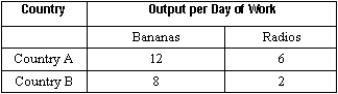 -Referring to Exhibit 29-4, suppose you are given the following information about the production of two goods in two countries.

-Referring to Exhibit 29-4, suppose you are given the following information about the production of two goods in two countries.
(Essay)
4.8/5 (66)
(66) A country cannot have a comparative advantage in the production of all goods.
(True/False)
4.9/5 (80)
(80) What was the purpose of the Smoot-Hawley tariff of 1930? Did it work? Explain.
(Essay)
4.8/5 (79)
(79) The principle by which all countries involved in GATT negotiations receive the same tariff rates as the country with the lowest negotiated tariff rates is called
(Multiple Choice)
5.0/5 (90)
(90) Suppose the United States decides to grant most-favored-nation status to Ukraine. What does this status mean? How will it affect the price and quantity of U.S. imports from Ukraine? Is this an increase or decrease in deadweight loss? Is this an increase or decrease in tariff revenue?
(Essay)
4.8/5 (79)
(79) Consider an industry in which, for each individual firm in the industry, cost per unit of output declines as the individual firm's output increases. As the size of the market increases, the average total cost at each firm
(Multiple Choice)
4.9/5 (85)
(85) Rose has an absolute advantage over Sam in computer programming and sales. Her efficiency at programming compared to Sam's is greater than her efficiency at sales compared to Sam's.
(Multiple Choice)
4.9/5 (77)
(77) If one country has a lower level of capital per worker than another country, it is relatively
(Multiple Choice)
4.9/5 (82)
(82) Suppose Rose has a comparative advantage over Sam in programming rather than in sales. If Rose sold programs rather than write them, then she would
(Multiple Choice)
4.8/5 (83)
(83) If there are increasing opportunity costs of production, the production possibilities curve will bow inward.
(True/False)
4.8/5 (81)
(81) Suppose Canada has 400 units of labor and the United States has 800 units of labor. In Canada, 1 unit of labor can produce 10 bushels of wheat or 5 pounds of fish. In the United States, 1 unit of labor can produce 12 bushels of wheat or 6 pounds of fish. Draw the production possibilities curve for each country. Who has a comparative advantage in the production of wheat? Explain.
(Essay)
4.9/5 (77)
(77) The corn laws were laws that pertained to restricting imports of the vegetable corn into England.
(True/False)
4.8/5 (81)
(81) If the price U.S. consumers pay with a quota on an imported good exceeds the price they pay without a quota, then the quota was set
(Multiple Choice)
4.9/5 (75)
(75) 
Filters
- Essay(0)
- Multiple Choice(0)
- Short Answer(0)
- True False(0)
- Matching(0)