



 Chat with AI
Exam 29: International Trade

Exam 1: The Central Idea156 Questions
Exam 2: Observing and Explaining the Economy143 Questions
Exam 3: The Supply and Demand Model166 Questions
Exam 4: Subtleties of the Supply and Demand Model176 Questions
Exam 5: The Demand Curve and the Behavior of Consumers176 Questions
Exam 6: The Supply Curve and the Behavior of Firms179 Questions
Exam 7: The Efficiency of Markets163 Questions
Exam 8: Costs and the Changes at Firms Over Time191 Questions
Exam 9: The Rise and Fall of Industries139 Questions
Exam 10: Monopoly184 Questions
Exam 11: Product Differentiation, Monopolistic Competition, and Oligopoly169 Questions
Exam 12: Antitrust Policy and Regulation152 Questions
Exam 13: Labor Markets179 Questions
Exam 14: Taxes, Transfers, and Income Distribution179 Questions
Exam 15: Public Goods, Externalities, and Government Behavior197 Questions
Exam 16: Capital and Financial Markets188 Questions
Exam 17: Macroeconomics: the Big Picture159 Questions
Exam 18: Measuring the Production, Income, and Spending of Nations177 Questions
Exam 19: The Spending Allocation Model166 Questions
Exam 20: Unemployment and Employment212 Questions
Exam 21: Productivity and Economic Growth162 Questions
Exam 22: Money and Inflation153 Questions
Exam 23: The Nature and Causes of Economic Fluctuations185 Questions
Exam 24: The Economic Fluctuations Model205 Questions
Exam 25: Using the Economic Fluctuations Model176 Questions
Exam 26: Fiscal Policy138 Questions
Exam 27: Monetary Policy180 Questions
Exam 28: Economic Growth Around the World157 Questions
Exam 29: International Trade242 Questions
Exam 30: International Finance125 Questions
Select questions type


A tax on an import evaluated as a percentage of the value of the import is called a(n)
(Multiple Choice)
4.8/5  (79)
(79) Consumption can only occur along the pre-trade production possibilities frontier.
(True/False)
4.9/5 (87)
(87) A person with a lower opportunity cost of producing a good than another person
(Multiple Choice)
4.8/5 (74)
(74) Exhibit 29-1  -According to Exhibit 29-1, which of the following is true?
 (Multiple Choice)
4.7/5 (93)
(93) Explain the difference between an export subsidy and an import tariff. Under what circumstances would a country use one versus the other? Who gains and who loses under each policy?
(Essay)
4.7/5 (66)
(66) How does trade due to comparative advantage differ from trade due to expanded markets?
(Essay)
4.9/5 (78)
(78) The share of 2015 world GDP accounted for by international trade was
(Multiple Choice)
4.9/5 (73)
(73) When the government imposes an import tariff, the price received by suppliers equals the price
(Multiple Choice)
4.9/5 (81)
(81) An import tax whose main purpose is to provide revenue to the government is called a(n)
(Multiple Choice)
4.9/5 (78)
(78) Exhibit 29-2  -Suppose the pretrade relative price of two goods in country X is 2 and the pretrade relative price of two goods in country Y is 4. The posttrade relative price will settle somewhere between 2 and 4 depending on
 (Multiple Choice)
4.9/5 (66)
(66) When cost per unit of production for two goods declines as more are produced, a country that trades can
(Multiple Choice)
4.9/5 (74)
(74) Rose has a comparative advantage in computer programming whereas Sam has a comparative advantage in sales. Therefore,
(Multiple Choice)
4.7/5 (88)
(88) When the United States imposes a tariff on imported cars, U.S. consumers pay
(Multiple Choice)
4.9/5 (83)
(83) Compared to production possibilities curves without trade, those with trade are
(Multiple Choice)
4.9/5 (78)
(78) A policy that restricts trade to protect domestic producers is called a(n)
(Multiple Choice)
4.8/5 (68)
(68) The increase in trade due to a decrease in trade barriers is called
(Multiple Choice)
4.9/5 (77)
(77) Exhibit 30-1 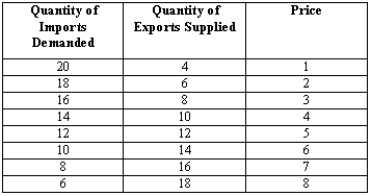 -If the world price of the good is $4, according to the data in Exhibit 30-1,
 (Multiple Choice)
4.8/5 (79)
(79) The most significant source of federal revenue in the United States before the income tax was enacted in 1913 was
(Multiple Choice)
4.7/5 (92)
(92) 
Filters
- Essay(0)
- Multiple Choice(0)
- Short Answer(0)
- True False(0)
- Matching(0)