



 Chat with AI
Exam 29: International Trade

Exam 1: The Central Idea156 Questions
Exam 2: Observing and Explaining the Economy143 Questions
Exam 3: The Supply and Demand Model166 Questions
Exam 4: Subtleties of the Supply and Demand Model176 Questions
Exam 5: The Demand Curve and the Behavior of Consumers176 Questions
Exam 6: The Supply Curve and the Behavior of Firms179 Questions
Exam 7: The Efficiency of Markets163 Questions
Exam 8: Costs and the Changes at Firms Over Time191 Questions
Exam 9: The Rise and Fall of Industries139 Questions
Exam 10: Monopoly184 Questions
Exam 11: Product Differentiation, Monopolistic Competition, and Oligopoly169 Questions
Exam 12: Antitrust Policy and Regulation152 Questions
Exam 13: Labor Markets179 Questions
Exam 14: Taxes, Transfers, and Income Distribution179 Questions
Exam 15: Public Goods, Externalities, and Government Behavior197 Questions
Exam 16: Capital and Financial Markets188 Questions
Exam 17: Macroeconomics: the Big Picture159 Questions
Exam 18: Measuring the Production, Income, and Spending of Nations177 Questions
Exam 19: The Spending Allocation Model166 Questions
Exam 20: Unemployment and Employment212 Questions
Exam 21: Productivity and Economic Growth162 Questions
Exam 22: Money and Inflation153 Questions
Exam 23: The Nature and Causes of Economic Fluctuations185 Questions
Exam 24: The Economic Fluctuations Model205 Questions
Exam 25: Using the Economic Fluctuations Model176 Questions
Exam 26: Fiscal Policy138 Questions
Exam 27: Monetary Policy180 Questions
Exam 28: Economic Growth Around the World157 Questions
Exam 29: International Trade242 Questions
Exam 30: International Finance125 Questions
Select questions type


The difference between production possibilities curves with and without trade represents the
(Multiple Choice)
4.7/5  (85)
(85) Exhibit 30-1  -According to the data in Exhibit 30-1, the equilibrium price for the good is
 (Multiple Choice)
4.8/5 (77)
(77) As a market increases in size, average total cost declines at each firm if the number of firms does not change.
(True/False)
4.7/5 (85)
(85) A tariff imposed on a country as a penalty for dumping goods is called a(n)
(Multiple Choice)
5.0/5 (83)
(83) Trade will tend to equalize the price of goods, but not the price of factors of production.
(True/False)
4.8/5 (68)
(68) 
The intersection of the export supply curve and import demand curve gives the amount
(Multiple Choice)
4.7/5 (90)
(90) What is unilateral disarmament? Why is unilateral disarmament not a viable way to reduce trade barriers in developed countries?
(Essay)
4.9/5 (83)
(83) If the comparative advantage between Japan and Korea was due only to differences in relative capital and labor abundance, then trade would tend to
(Multiple Choice)
4.8/5 (81)
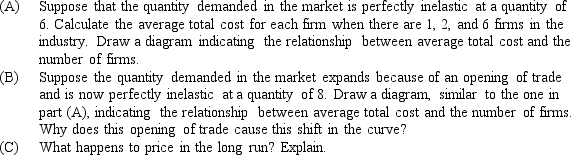
(81) Suppose that each firm in an industry has total costs as shown in the following table. 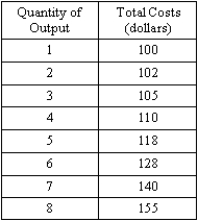
(Essay)
4.9/5 (79)
(79) Changes in comparative advantage over time from investment in physical and human capital and in technology are called
(Multiple Choice)
4.8/5 (94)
(94) The oldest and most common method for a government to restrict trade is the
(Multiple Choice)
4.8/5 (77)
(77) Country A and country B both produce only two goods, cars and computers. If country A has a lower opportunity cost of producing cars, then
(Multiple Choice)
4.9/5 (72)
(72) Exhibit 29-3 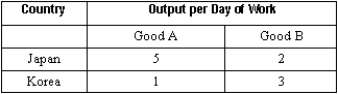 -Referring to Exhibit 29-3, suppose the posttrade relative price between Japan and Korea is 1 computer per unit of rice. If Korea takes 10 workers out of rice production, puts the 10 workers in computer production, and sells the resulting computers to Japan in exchange for rice, Korea will
 (Multiple Choice)
4.9/5 (73)
(73) The Smoot-Hawley tariff demonstrated to the whole world how
(Multiple Choice)
4.8/5 (70)
(70) U.S. tariffs, measured as a percentage of the import price,
(Multiple Choice)
4.9/5 (71)
(71) There are winners and losers as a result of protectionist policies, but economic theory can show that the gains from the winners are larger than the losses of the losers.
(True/False)
5.0/5 (79)
(79) Why might it not be a good idea for the government to use trade policy to protect newly emerging industries?
(Essay)
4.8/5 (83)
(83) 
Filters
- Essay(0)
- Multiple Choice(0)
- Short Answer(0)
- True False(0)
- Matching(0)