



 Chat with AI
Exam 29: International Trade

Exam 1: The Central Idea156 Questions
Exam 2: Observing and Explaining the Economy143 Questions
Exam 3: The Supply and Demand Model166 Questions
Exam 4: Subtleties of the Supply and Demand Model176 Questions
Exam 5: The Demand Curve and the Behavior of Consumers176 Questions
Exam 6: The Supply Curve and the Behavior of Firms179 Questions
Exam 7: The Efficiency of Markets163 Questions
Exam 8: Costs and the Changes at Firms Over Time191 Questions
Exam 9: The Rise and Fall of Industries139 Questions
Exam 10: Monopoly184 Questions
Exam 11: Product Differentiation, Monopolistic Competition, and Oligopoly169 Questions
Exam 12: Antitrust Policy and Regulation152 Questions
Exam 13: Labor Markets179 Questions
Exam 14: Taxes, Transfers, and Income Distribution179 Questions
Exam 15: Public Goods, Externalities, and Government Behavior197 Questions
Exam 16: Capital and Financial Markets188 Questions
Exam 17: Macroeconomics: the Big Picture159 Questions
Exam 18: Measuring the Production, Income, and Spending of Nations177 Questions
Exam 19: The Spending Allocation Model166 Questions
Exam 20: Unemployment and Employment212 Questions
Exam 21: Productivity and Economic Growth162 Questions
Exam 22: Money and Inflation153 Questions
Exam 23: The Nature and Causes of Economic Fluctuations185 Questions
Exam 24: The Economic Fluctuations Model205 Questions
Exam 25: Using the Economic Fluctuations Model176 Questions
Exam 26: Fiscal Policy138 Questions
Exam 27: Monetary Policy180 Questions
Exam 28: Economic Growth Around the World157 Questions
Exam 29: International Trade242 Questions
Exam 30: International Finance125 Questions
Select questions type


A requirement that a fraction of the product must be produced within the area to qualify for zero tariffs between the countries in the free trade area is called a(n)
(Multiple Choice)
4.9/5  (66)
(66) Exhibit 29-3 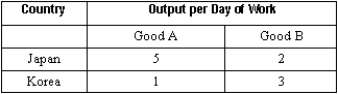 -Referring to Exhibit 29-3, suppose the posttrade relative price between Japan and Korea is 1 computer per unit of rice. If Korea takes 10 workers out of computer production, puts the 10 workers in rice production, and sells the resulting rice to Japan in exchange for computers, Korea will gain
 (Multiple Choice)
4.9/5 (86)
(86) Production can only occur along the pre-trade production possibilities frontier.
(True/False)
4.9/5 (83)
(83) Over the past 50 years, international trade, as a proportion of real GDP, has
(Multiple Choice)
4.8/5 (86)
(86) An increase in the number of firms entering a market causes the
(Multiple Choice)
4.9/5 (78)
(78) Explain how there can be gains from trade between countries even if there is no difference in the efficiency of production between each country.
(Essay)
4.9/5 (74)
(74) Most trade between countries is of the interindustry variety-that is, a country will trade one good for a different good. Is this statement true or false? Explain.
(True/False)
5.0/5 (73)
(73) The gains from trade are larger for a particular country if the post-trade relative price settles closer to the pre-trade relative price of the other country.
(True/False)
5.0/5 (76)
(76) A situation in which a person or a country can produce one good at a lower opportunity cost than another person or country is known as
(Multiple Choice)
4.8/5 (85)
(85) If a country has an absolute advantage in the production of both goods, then it is better off producing them both rather than producing only one good and trading with another country. True or False. Explain.
(True/False)
4.9/5 (77)
(77) One of the most common forms of trade restrictions is the ad valorem tariff, which represents a tax on imports evaluated as a percentage of the value of the import.
(True/False)
4.9/5 (81)
(81) An increase in the size of the market due to the creation of a free trade area
(Multiple Choice)
4.8/5 (77)
(77) A curve showing the quantity of imports demanded at various prices is called a(n)
(Multiple Choice)
4.8/5 (59)
(59) The negative slope of Korea's linear production possibilities curve between computers and rice means that
(Multiple Choice)
4.8/5 (74)
(74) 
Filters
- Essay(0)
- Multiple Choice(0)
- Short Answer(0)
- True False(0)
- Matching(0)