



 Chat with AI
Exam 13: Nuclear Magnetic Resonance Spectroscopy

Exam 1: Introduction and Review127 Questions
Exam 2: Structure and Properties of Organic Molecules129 Questions
Exam 3: Structure and Stereochemistry of Alkanes129 Questions
Exam 4: The Study of Chemical Reactions128 Questions
Exam 5: Stereochemistry128 Questions
Exam 6: Alkyl Halides: Nucleophilic Substitution and Elimination132 Questions
Exam 7: Structure and Synthesis of Alkenes128 Questions
Exam 8: Reactions of Alkenes132 Questions
Exam 9: Alkynes124 Questions
Exam 10: Structure and Synthesis of Alcohols132 Questions
Exam 11: Reactions of Alcohols124 Questions
Exam 12: Infrared Spectroscopy and Mass Spectrometry120 Questions
Exam 13: Nuclear Magnetic Resonance Spectroscopy130 Questions
Exam 14: Ethers, Epoxides, and Thioethers127 Questions
Exam 15: Conjugated Systems, Orbital Symmetry, and Ultraviolet Spectroscopy130 Questions
Exam 16: Aromatic Compounds128 Questions
Exam 17: Reactions of Aromatic Compounds129 Questions
Exam 18: Ketones and Aldehydes132 Questions
Exam 19: Amines129 Questions
Exam 20: Carboxylic Acids125 Questions
Exam 21: Carboxylic Acid Derivatives128 Questions
Exam 22: Condensations and Alpha Substitutions of Carboxyl Compounds125 Questions
Exam 23: Carbohydrates and Nucleic Acids125 Questions
Exam 24: Amino Acids, Peptides, and Proteins127 Questions
Exam 25: Lipids127 Questions
Exam 26: Synthetic Polymers128 Questions
Select questions type


How many peaks appear in the proton spin decoupled 13 C NMR spectrum of the compound below? 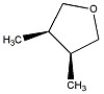
(Multiple Choice)
4.7/5  (68)
(68) Which of the structures shown below is consistent with the C-13 NMR (off resonance splitting for each peak is shown as a table within the figure) and H-NMR spectra? (formula = C9H11OBr) 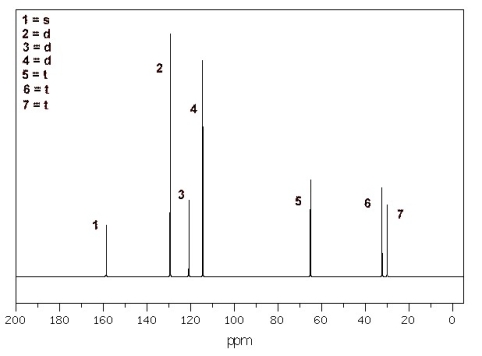
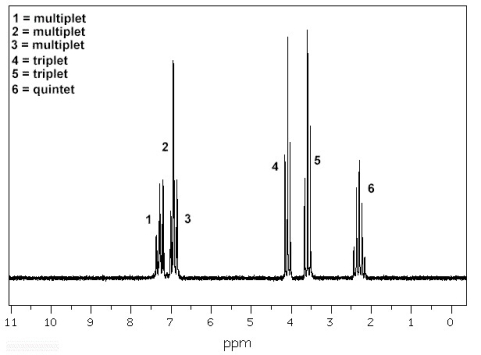
(Multiple Choice)
4.9/5 (81)
(81) What type of carbon environment does not generate a signal in the DEPT-90 spectrum and gives a negative signal in the DEPT-135 spectrum?
(Multiple Choice)
4.7/5 (86)
(86) Provide a structure that is consistent with the data below.
C7H16O
IR (cm-1): 3200-3600 (broad), 2950
1H NMR ( d): 2.8 (1H, broad s), 1.0 (6H, s), 0.9 (9H, s)
13C NMR (d ): 68 (s), 39 (s), 16 (q), 13 (q)
(Essay)
4.8/5 (59)
(59) Predict the number of distinct quartets expected in the off-resonance decoupled 13C NMR spectrum of the compound shown below. 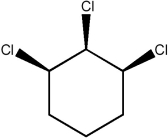
(Short Answer)
4.9/5 (75)
(75) How many peaks appear in the proton spin decoupled 13C NMR spectrum of the compound below? 
(Short Answer)
4.8/5 (84)
(84) What is the approximate chemical shift of an alkynyl carbon in 13C NMR spectroscopy?
(Multiple Choice)
4.8/5 (81)
(81) Predict the number of signals expected, their splitting, and their relative area in the 1H NMR spectrum of (CH3)3CCHO.
(Short Answer)
4.8/5 (79)
(79) How many peaks appear in the proton spin decoupled 13C NMR spectrum of the compound below? 
(Short Answer)
4.8/5 (71)
(71) A nucleus with an ________ atomic number or an ________ mass number has a nuclear spin that can be observed by the NMR spectrometer.
(Multiple Choice)
4.8/5 (80)
(80) Deduce the identity of the following compound from the spectral data given.
C5H10O: 1H NMR, δ 1.2 (6H, doublet), 2.1 (3H, singlet), 2.8 (1H, septet) (ppm); IR, 2980, 1710 cm-1; MS, m/z 71, 43
(Essay)
4.8/5 (72)
(72) Predict the number of distinct quartets expected in the off-resonance decoupled 13C NMR spectrum of the compound shown below. 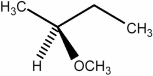
(Short Answer)
4.8/5 (81)
(81) The chair form of cyclohexane has protons in two distinct environments, axial and equatorial. When the proton NMR of cyclohexane is run on a 100-MHz instrument at 23°C, only one signal for the compound is observed. Explain this apparent contradiction.
(Essay)
4.8/5 (75)
(75) Provide a structure that is consistent with the data below.
C6H10
IR (cm-1): 2950, 2230
1H NMR ( d): 2.0 (1H, septet), 1.8 (3H, s), 0.9 (6H, d)
13C NMR (d ): 78 (s), 72 (s), 45 (d), 18 (q), 15 (q)
(Essay)
4.9/5 (75)
(75) How many peaks appear in the proton spin decoupled 13C NMR spectrum of the compound below? 
(Short Answer)
4.8/5 (82)
(82) Deduce the identity of the following compound from the 1H NMR data given.
C6H8O4: δ 3.9 (6H, singlet), 6.1 (2H, singlet) (ppm)
(Essay)
4.8/5 (75)
(75) An NMR spectrometer that operates at a frequency of 60 MHz for 13C NMR spectra, operates at what frequency for 1H NMR spectra?
(Multiple Choice)
4.8/5 (85)
(85) How might the two trimethylcyclohexane isomers shown below be most readily distinguished using NMR? 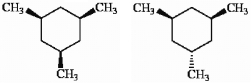
(Essay)
4.7/5 (79)
(79) Given that compound X has a molecular formula of C6H10O2, gave three peaks in its 13C NMR spectrum (14, 63 and 158 ppm) and two peaks in its 1H NMR spectrum (1.4, triplet and 4.3 ppm, quartet), provide a structure for compound X.
(Essay)
4.8/5 (78)
(78) Deduce the identity of the following compound from the 1H NMR data given.
C9H10O2: δ 2.2 (3H, singlet), 5.0 (2H, singlet), 7.2 (5H, singlet) (ppm)
(Essay)
4.8/5 (86)
(86) 
Filters
- Essay(0)
- Multiple Choice(0)
- Short Answer(0)
- True False(0)
- Matching(0)