



 Chat with AI
Exam 7: Structure and Synthesis of Alkenes

Exam 1: Introduction and Review127 Questions
Exam 2: Structure and Properties of Organic Molecules129 Questions
Exam 3: Structure and Stereochemistry of Alkanes129 Questions
Exam 4: The Study of Chemical Reactions128 Questions
Exam 5: Stereochemistry128 Questions
Exam 6: Alkyl Halides: Nucleophilic Substitution and Elimination132 Questions
Exam 7: Structure and Synthesis of Alkenes128 Questions
Exam 8: Reactions of Alkenes132 Questions
Exam 9: Alkynes124 Questions
Exam 10: Structure and Synthesis of Alcohols132 Questions
Exam 11: Reactions of Alcohols124 Questions
Exam 12: Infrared Spectroscopy and Mass Spectrometry120 Questions
Exam 13: Nuclear Magnetic Resonance Spectroscopy130 Questions
Exam 14: Ethers, Epoxides, and Thioethers127 Questions
Exam 15: Conjugated Systems, Orbital Symmetry, and Ultraviolet Spectroscopy130 Questions
Exam 16: Aromatic Compounds128 Questions
Exam 17: Reactions of Aromatic Compounds129 Questions
Exam 18: Ketones and Aldehydes132 Questions
Exam 19: Amines129 Questions
Exam 20: Carboxylic Acids125 Questions
Exam 21: Carboxylic Acid Derivatives128 Questions
Exam 22: Condensations and Alpha Substitutions of Carboxyl Compounds125 Questions
Exam 23: Carbohydrates and Nucleic Acids125 Questions
Exam 24: Amino Acids, Peptides, and Proteins127 Questions
Exam 25: Lipids127 Questions
Exam 26: Synthetic Polymers128 Questions
Select questions type


What kind of reactive intermediate is present in the mechanism of the following reaction? 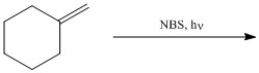

Free
(Multiple Choice)
4.7/5  (82)
(82) Correct Answer: Verified
D
Provide the reagents necessary for carrying out the transformation of cyclopentane to cyclopentene.
Free
(Short Answer)
4.8/5 (69)
(69) Correct Answer:Verified
Verified1. Br2, hν
2. NaOH, acetone
By what mechanism does cyclohexanol react when treated in sulfuric acid and what compound results?
Free
(Multiple Choice)
4.9/5 (63)
(63) Correct Answer:Verified
VerifiedE

Describe the major elimination products of the following reaction, including any stereochemistry, and indicate which structure will predominate. Explain and defend your answer. 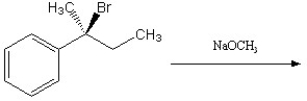
(Essay)
5.0/5 (82)
(82) Name the alkene shown. Be sure to include the appropriate E or Z label necessary. 
(Short Answer)
4.8/5 (82)
(82) Using Zaitsev's rule, choose the most stable alkene among the following.
(Multiple Choice)
5.0/5 (99)
(99) Name the alkene shown. Be sure to include the appropriate E or Z label necessary. 
(Short Answer)
4.9/5 (76)
(76) 
How many elements of unsaturation are implied by the molecular formula C7H11Cl?
(Multiple Choice)
4.9/5 (75)
(75) Draw all likely alkene products in the following reaction and circle the product you expect to predominate. 
(Short Answer)
4.9/5 (87)
(87) Which of the following alkenes has the largest molar heat of hydrogenation (ie, releases the most heat upon hydrogenation)?
(Multiple Choice)
4.8/5 (92)
(92) The steroid testosterone has the molecular formula C19H28O2. Given that there are two P -bond in a molecule of testosterone, how many rings are present in each molecule?
(Multiple Choice)
4.9/5 (72)
(72) Dehydrohalogenation of 2-bromobutane in the presence of a strong base proceeds via which of the following mechanistic pathways?
(Multiple Choice)
4.8/5 (78)
(78) Compare the relative heats of hydrogenation of cyclobutene and cyclopentene and explain the difference in magnitude.
(Essay)
4.7/5 (77)
(77) Which of the following alkenes is the major product when 2-bromo-2-methylpentane is treated with sodium ethoxide in ethanol?
(Multiple Choice)
5.0/5 (79)
(79) Propose a detailed, step-by-step mechanism for the reaction pathway shown below. 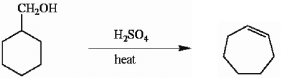
(Essay)
4.8/5 (90)
(90) Which of the alkyl chlorides listed below undergoes dehydrohalogenation in the presence of a strong base to give pent-2-ene as the only alkene product?
(Multiple Choice)
4.9/5 (72)
(72) 
Filters
- Essay(0)
- Multiple Choice(0)
- Short Answer(0)
- True False(0)
- Matching(0)