



 Chat with AI
Exam 7: Structure and Synthesis of Alkenes

Exam 1: Introduction and Review127 Questions
Exam 2: Structure and Properties of Organic Molecules129 Questions
Exam 3: Structure and Stereochemistry of Alkanes129 Questions
Exam 4: The Study of Chemical Reactions128 Questions
Exam 5: Stereochemistry128 Questions
Exam 6: Alkyl Halides: Nucleophilic Substitution and Elimination132 Questions
Exam 7: Structure and Synthesis of Alkenes128 Questions
Exam 8: Reactions of Alkenes132 Questions
Exam 9: Alkynes124 Questions
Exam 10: Structure and Synthesis of Alcohols132 Questions
Exam 11: Reactions of Alcohols124 Questions
Exam 12: Infrared Spectroscopy and Mass Spectrometry120 Questions
Exam 13: Nuclear Magnetic Resonance Spectroscopy130 Questions
Exam 14: Ethers, Epoxides, and Thioethers127 Questions
Exam 15: Conjugated Systems, Orbital Symmetry, and Ultraviolet Spectroscopy130 Questions
Exam 16: Aromatic Compounds128 Questions
Exam 17: Reactions of Aromatic Compounds129 Questions
Exam 18: Ketones and Aldehydes132 Questions
Exam 19: Amines129 Questions
Exam 20: Carboxylic Acids125 Questions
Exam 21: Carboxylic Acid Derivatives128 Questions
Exam 22: Condensations and Alpha Substitutions of Carboxyl Compounds125 Questions
Exam 23: Carbohydrates and Nucleic Acids125 Questions
Exam 24: Amino Acids, Peptides, and Proteins127 Questions
Exam 25: Lipids127 Questions
Exam 26: Synthetic Polymers128 Questions
Select questions type


A chemist has isolated a new natural product and determined its molecular formula to be C24H40O4. In hydrogenation experiments the chemist found that each mole of the natural product reacted with two moles of H2. How many rings are present in the structure of the new natural product?
(Multiple Choice)
4.9/5  (87)
(87) 
Why is rotation about the carbon-carbon double bond in alkenes prohibited while relatively free rotation can occur about the carbon-carbon single bond in alkanes?
(Essay)
4.9/5 (80)
(80) Provide the reagents necessary for carrying out the transformation of 2-methylheptane to 2-methylhept-1-ene
(Essay)
4.7/5 (64)
(64) Provide the name of the major alkene product that results when (2S,3R)-2-bromo-3-methylpentane is treated with sodium methoxide in methanol.
(Short Answer)
4.7/5 (93)
(93) How many elements of unsaturation are implied by the molecular formula C5H8O?
(Multiple Choice)
4.9/5 (76)
(76) A newly isolated natural product was found to have the molecular formula C15H28O2. By hydrogenating a sample of the compound, it was determined to possess one p bond. How many rings are present in the compound?
(Multiple Choice)
4.9/5 (80)
(80) Which of the following statements applies to the E2 mechanism?
(Multiple Choice)
4.9/5 (77)
(77) Which of the following cycloalkenes would be expected to be stable? 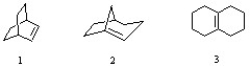
(Multiple Choice)
4.7/5 (79)
(79) 
Provide the name of the major alkene product that results when (2S,3R)-2,3-dibromopentane is treated with zinc in acetic acid.
(Short Answer)
4.9/5 (81)
(81) The prostaglandin precursor arachidonic acid has the molecular formula C20H32O2. Given that arachidonic acid is an acyclic carboxylic acid that contains no carbon-carbon triple bonds, how many carbon-carbon double bonds are present?
(Multiple Choice)
4.8/5 (63)
(63) Which sequence ranks the following compounds in order of increasing heat of hydrogenation, ΔHhyd?
1. cis-2-butene
2. 1-butene
3. cyclohexene
(Multiple Choice)
4.8/5 (71)
(71) 
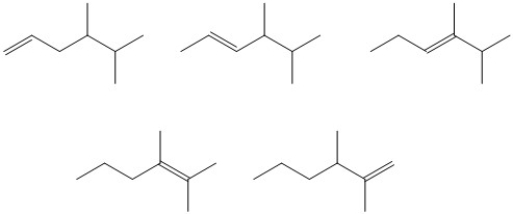
Using Zaitsev's rule, choose the most stable alkene among the following.
(Multiple Choice)
4.9/5 (77)
(77) How many elements of unsaturation are implied by the molecular formula C6H12?
(Multiple Choice)
4.8/5 (84)
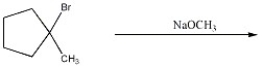
(84) Provide the structure of the major organic product of the reaction below. 
(Essay)
4.8/5 (69)
(69) 
Filters
- Essay(0)
- Multiple Choice(0)
- Short Answer(0)
- True False(0)
- Matching(0)