



 Chat with AI
Exam 7: Structure and Synthesis of Alkenes

Exam 1: Introduction and Review127 Questions
Exam 2: Structure and Properties of Organic Molecules129 Questions
Exam 3: Structure and Stereochemistry of Alkanes129 Questions
Exam 4: The Study of Chemical Reactions128 Questions
Exam 5: Stereochemistry128 Questions
Exam 6: Alkyl Halides: Nucleophilic Substitution and Elimination132 Questions
Exam 7: Structure and Synthesis of Alkenes128 Questions
Exam 8: Reactions of Alkenes132 Questions
Exam 9: Alkynes124 Questions
Exam 10: Structure and Synthesis of Alcohols132 Questions
Exam 11: Reactions of Alcohols124 Questions
Exam 12: Infrared Spectroscopy and Mass Spectrometry120 Questions
Exam 13: Nuclear Magnetic Resonance Spectroscopy130 Questions
Exam 14: Ethers, Epoxides, and Thioethers127 Questions
Exam 15: Conjugated Systems, Orbital Symmetry, and Ultraviolet Spectroscopy130 Questions
Exam 16: Aromatic Compounds128 Questions
Exam 17: Reactions of Aromatic Compounds129 Questions
Exam 18: Ketones and Aldehydes132 Questions
Exam 19: Amines129 Questions
Exam 20: Carboxylic Acids125 Questions
Exam 21: Carboxylic Acid Derivatives128 Questions
Exam 22: Condensations and Alpha Substitutions of Carboxyl Compounds125 Questions
Exam 23: Carbohydrates and Nucleic Acids125 Questions
Exam 24: Amino Acids, Peptides, and Proteins127 Questions
Exam 25: Lipids127 Questions
Exam 26: Synthetic Polymers128 Questions
Select questions type


Provide the proper IUPAC name for the alkene shown below.
CH2=CHCH2CH2CH2CH3
(Short Answer)
4.8/5  (87)
(87) Draw and name the six alkenes which have the molecular formula C5H10.
(Essay)
4.8/5 (82)
(82) Circle the alkene below which has the smallest heat of hydrogenation. 
(Essay)
4.8/5 (79)
(79) Provide the structure of the major organic product of the reaction below. 
(Essay)
4.8/5 (68)
(68) Dehydrohalogenation of an alkyl halide by treating it with a strong base to yield an alkene product typically occurs by what reaction mechanism?
(Multiple Choice)
4.8/5 (81)
(81) Draw all likely alkene products in the following reaction and circle the product you expect to predominate. 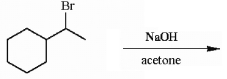
(Essay)
4.9/5 (75)
(75) Carbon-carbon single bonds tend to be ________ and ________ than carbon-carbon double bonds.
(Multiple Choice)
4.9/5 (62)
(62) Draw all likely alkene products in the following reaction and circle the product you expect to predominate. 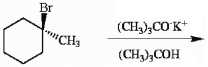
(Essay)
4.9/5 (64)
(64) In the group shown below, which of the following alcohols is (are) likely to yield a product where skeletal rearrangement has occurred when treated with sulfuric acid?
3-methyl-3-pentanol, 3,3-dimethyl-2-butanol, 2,2-dimethylcyclohexanol
(Multiple Choice)
4.8/5 (84)
(84) Consider molecules with the formula C10H16. Which of the following structural features are not possible within this set of molecules?
(Multiple Choice)
4.8/5 (82)
(82) Provide a series of steps through which 2-methylbutane is converted into 2-methylbut-1-ene? 
(Essay)
4.8/5 (100)
(100) Provide the reagents necessary for carrying out the transformation of 2-methylheptane to 2-methylhept-2-ene.
(Short Answer)
4.9/5 (84)
(84) Provide the structure of the major organic product of the reaction below. 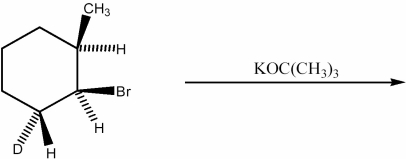
(Essay)
4.8/5 (90)
(90) Which has the smaller heat of hydrogenation, (E)-2-pentene or (Z)-2-pentene? What is the structural origin of this difference?
(Essay)
4.8/5 (78)
(78) 
What two atomic orbitals or hybrid atomic orbitals overlap to form the CC π bond in ethylene?
(Multiple Choice)
4.9/5 (91)
(91) Consider the constitutional isomers 2-methylbut-1-ene, 2-methylbut-2-ene, and 3-methylbut-1-ene. When each of these alkenes is subjected to catalytic hydrogenation (H2, Pt), a single product results. Which of the following best describes the structural relationship among these products?
(Multiple Choice)
4.8/5 (97)
(97) 

Filters
- Essay(0)
- Multiple Choice(0)
- Short Answer(0)
- True False(0)
- Matching(0)