



 Chat with AI
Exam 9: Alkynes

Exam 1: Introduction and Review127 Questions
Exam 2: Structure and Properties of Organic Molecules129 Questions
Exam 3: Structure and Stereochemistry of Alkanes129 Questions
Exam 4: The Study of Chemical Reactions128 Questions
Exam 5: Stereochemistry128 Questions
Exam 6: Alkyl Halides: Nucleophilic Substitution and Elimination132 Questions
Exam 7: Structure and Synthesis of Alkenes128 Questions
Exam 8: Reactions of Alkenes132 Questions
Exam 9: Alkynes124 Questions
Exam 10: Structure and Synthesis of Alcohols132 Questions
Exam 11: Reactions of Alcohols124 Questions
Exam 12: Infrared Spectroscopy and Mass Spectrometry120 Questions
Exam 13: Nuclear Magnetic Resonance Spectroscopy130 Questions
Exam 14: Ethers, Epoxides, and Thioethers127 Questions
Exam 15: Conjugated Systems, Orbital Symmetry, and Ultraviolet Spectroscopy130 Questions
Exam 16: Aromatic Compounds128 Questions
Exam 17: Reactions of Aromatic Compounds129 Questions
Exam 18: Ketones and Aldehydes132 Questions
Exam 19: Amines129 Questions
Exam 20: Carboxylic Acids125 Questions
Exam 21: Carboxylic Acid Derivatives128 Questions
Exam 22: Condensations and Alpha Substitutions of Carboxyl Compounds125 Questions
Exam 23: Carbohydrates and Nucleic Acids125 Questions
Exam 24: Amino Acids, Peptides, and Proteins127 Questions
Exam 25: Lipids127 Questions
Exam 26: Synthetic Polymers128 Questions
Select questions type


Describe a qualitative, nonspectroscopic means for distinguishing terminal alkynes from internal ones.

Free
(Essay)
4.9/5  (79)
(79) Correct Answer: Verified
Add a solution of Cu+ or Ag+. Terminal alkynes react to form insoluble metal acetylides which precipitate
cipate.
Give the IUPAC name for (CH3)2C(CH2CH3)C=CCH(CH3)2.
Free
(Short Answer)
5.0/5 (81)
(81) Correct Answer:Verified
Verified2,5,5-trimethylhept-3-yne
To a solution of propyne in diethyl ether, one molar equivalent of CH3Li was added and the resulting mixture was stirred for 0.5 hour. After this time, an excess of D2O was added. Describe the major organic product(s) of this reaction.
Free
(Multiple Choice)
4.9/5 (84)
(84) Correct Answer:Verified
VerifiedA


What is the major organic product that results when 1-heptyne is treated with 2 equivalents of HBr?
(Multiple Choice)
5.0/5 (99)
(99) 


What is the major product of the following acid/catalyzed hydration reaction? 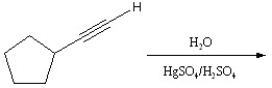
(Multiple Choice)
4.7/5 (84)
(84) How many distinct internal alkynes exist with a molecular formula of C6H10?
(Multiple Choice)
4.8/5 (67)
(67) Complete the following reaction sequences below by filling-in the missing reagents or structures. 
(Essay)
4.8/5 (79)
(79) Treatment of hex-2-yne with mercuric sulfate in dilute sulfuric acid yields a mixture of two ketones. Similar treatment of hex-3-yne produces a single ketone instead of a mixture. Explain.
(Essay)
4.9/5 (79)
(79) The pi bond of an alkyne is ________ and ________ than the pi bond of an alkene.
(Multiple Choice)
5.0/5 (79)
(79) Provide the structure of the major organic product(s) in the reaction below.
CH3CH2CH2CH2CH2C꓿CCH2CH3 
(Essay)
4.9/5 (72)
(72) A mixture of hept-1-yne, hept-2-yne, and hept-3-yne was hydrogenated in the presence of a platinum catalyst until hydrogen uptake ceased. If one assumes that the hydrogenation went to completion, how many seven-carbon hydrocarbons were produced?
(Multiple Choice)
4.9/5 (79)
(79) Which of the following bases will favorably deprotonate a terminal alkyne?
(More than one answer is possible.)
(Multiple Choice)
4.8/5 (79)
(79) 
Filters
- Essay(0)
- Multiple Choice(0)
- Short Answer(0)
- True False(0)
- Matching(0)