



 Chat with AI
Exam 13: Nuclear Magnetic Resonance Spectroscopy

Exam 1: Introduction and Review127 Questions
Exam 2: Structure and Properties of Organic Molecules129 Questions
Exam 3: Structure and Stereochemistry of Alkanes129 Questions
Exam 4: The Study of Chemical Reactions128 Questions
Exam 5: Stereochemistry128 Questions
Exam 6: Alkyl Halides: Nucleophilic Substitution and Elimination132 Questions
Exam 7: Structure and Synthesis of Alkenes128 Questions
Exam 8: Reactions of Alkenes132 Questions
Exam 9: Alkynes124 Questions
Exam 10: Structure and Synthesis of Alcohols132 Questions
Exam 11: Reactions of Alcohols124 Questions
Exam 12: Infrared Spectroscopy and Mass Spectrometry120 Questions
Exam 13: Nuclear Magnetic Resonance Spectroscopy130 Questions
Exam 14: Ethers, Epoxides, and Thioethers127 Questions
Exam 15: Conjugated Systems, Orbital Symmetry, and Ultraviolet Spectroscopy130 Questions
Exam 16: Aromatic Compounds128 Questions
Exam 17: Reactions of Aromatic Compounds129 Questions
Exam 18: Ketones and Aldehydes132 Questions
Exam 19: Amines129 Questions
Exam 20: Carboxylic Acids125 Questions
Exam 21: Carboxylic Acid Derivatives128 Questions
Exam 22: Condensations and Alpha Substitutions of Carboxyl Compounds125 Questions
Exam 23: Carbohydrates and Nucleic Acids125 Questions
Exam 24: Amino Acids, Peptides, and Proteins127 Questions
Exam 25: Lipids127 Questions
Exam 26: Synthetic Polymers128 Questions
Select questions type


Electromagnetic radiation in the ________ region is used in 1H NMR spectroscopy.
(Multiple Choice)
4.9/5  (79)
(79) A compound (C5H8O) shows IR absorptions at 3600 and 3300 cm-1. Its 1H NMR spectrum contained singlets at  and 2.9 (broad) (ppm) in a ratio of 6:1:1. Name this compound.
 (Short Answer)
4.8/5 (88)
(88) Deduce the identity of the following compound from the 1H NMR data given.
C4H7BrO: δ 2.2 (3H, singlet), 3.5 (2H, triplet), 4.5 (2H, triplet) (ppm)
(Essay)
4.7/5 (79)
(79) Predict the number of signals expected, their splitting, and their relative area in the 1H NMR spectrum of CH3CH2OCH3.
(Essay)
4.8/5 (89)
(89) If a signal is observed in the 170 to 200 ppm range in a C-13 NMR spectrum, what is the most likely type of functional group associated with that carbon atom?
(Multiple Choice)
4.7/5 (76)
(76) The 1H NMR spectrum of ethanol is acquired and the hydroxyl signal appears as a singlet instead of a triplet. Offer an explanation.
(Essay)
4.8/5 (69)
(69) Predict the number of signals expected in the proton spin decoupled 13C spectrum of 
(Short Answer)
4.9/5 (84)
(84) Predict the number of signals expected (disregarding splitting) in the 1H NMR spectrum of the compound shown below. 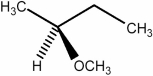
(Short Answer)
4.8/5 (81)
(81) Deduce the identity of the following compound from the spectral data given.
C8H10: 1H NMR, δ 1.20 (3H, triplet), 2.60 (2H, quartet), 7.12 (5H, singlet) (ppm); IR, 3050, 2970,  MS, m/z 91
 (Short Answer)
4.9/5 (95)
(95) Deduce the identity of the following compound from the NMR data given.
C4H6O2: 1H NMR, δ 2.28 (2H, multiplet), 2.50 (2H, triplet), 4.35 (2H, triplet);
13C NMR, δ 177.81 (singlet), 68.58 (triplet), 27.70 (triplet), 22.17 (triplet) (ppm)
(Short Answer)
5.0/5 (80)
(80) How many peaks appear in the proton spin decoupled 13C NMR spectrum of the compound below? 
(Short Answer)
4.9/5 (74)
(74) What is the relationships between Ha and Hb in the following structure? 
(Multiple Choice)
4.8/5 (77)
(77) Predict the number of signals expected in the proton spin decoupled 13C spectrum of 3-hexanone, CH3CH2COCH2CH2CH3.
(Short Answer)
4.9/5 (88)
(88) Provide a structure that is consistent with the data below.
C4H8O
IR (cm-1): 2950
1H NMR ( d): 3.2 (4H, t), 1.2 (4H, t)
13C NMR (d ): 68 (t), 27 (t)
(Essay)
4.9/5 (80)
(80) Predict the number of signals expected (disregarding splitting) in the 1H spectrum of m-xylene (1,3-dimethylbenzene).
(Short Answer)
4.8/5 (81)
(81) Which of the following reasons best explains why aromatic protons have a larger chemical shift than protons one carbon removed from a halogen?
(Multiple Choice)
4.8/5 (81)
(81) In the 1H NMR spectrum of bromoethane the methylene group is split into a quartet by the α and β nuclear spins of the protons on the neighboring methyl group. If the external magnetic field, B∘, directs upward, which sequence of nuclear spins contributes to the second farthest peak down field within the spin-spin splitting pattern?
(Multiple Choice)
4.7/5 (82)
(82) Predict the number of signals expected in the proton spin decoupled 13C NMR spectrum of o-diethylbenzene (1,2-diethylbenzene).
(Short Answer)
4.8/5 (90)
(90) Provide a structure that is consistent with the data below.
C9H9N
IR (cm-1): 3050, 2950, 2240, 1630
1H NMR ( d): 7.5 (2H, d), 7.1 (2H, d), 2.3 (2H, q), 0.9 (3H, t)
13C NMR (d ): 137 (s), 130, (s), 126 (d), 122 (d), 95 (s), 25 (t), 15 (q)
(Essay)
4.7/5 (60)
(60) 
Filters
- Essay(0)
- Multiple Choice(0)
- Short Answer(0)
- True False(0)
- Matching(0)