



 Chat with AI
Exam 13: Nuclear Magnetic Resonance Spectroscopy

Exam 1: Introduction and Review127 Questions
Exam 2: Structure and Properties of Organic Molecules129 Questions
Exam 3: Structure and Stereochemistry of Alkanes129 Questions
Exam 4: The Study of Chemical Reactions128 Questions
Exam 5: Stereochemistry128 Questions
Exam 6: Alkyl Halides: Nucleophilic Substitution and Elimination132 Questions
Exam 7: Structure and Synthesis of Alkenes128 Questions
Exam 8: Reactions of Alkenes132 Questions
Exam 9: Alkynes124 Questions
Exam 10: Structure and Synthesis of Alcohols132 Questions
Exam 11: Reactions of Alcohols124 Questions
Exam 12: Infrared Spectroscopy and Mass Spectrometry120 Questions
Exam 13: Nuclear Magnetic Resonance Spectroscopy130 Questions
Exam 14: Ethers, Epoxides, and Thioethers127 Questions
Exam 15: Conjugated Systems, Orbital Symmetry, and Ultraviolet Spectroscopy130 Questions
Exam 16: Aromatic Compounds128 Questions
Exam 17: Reactions of Aromatic Compounds129 Questions
Exam 18: Ketones and Aldehydes132 Questions
Exam 19: Amines129 Questions
Exam 20: Carboxylic Acids125 Questions
Exam 21: Carboxylic Acid Derivatives128 Questions
Exam 22: Condensations and Alpha Substitutions of Carboxyl Compounds125 Questions
Exam 23: Carbohydrates and Nucleic Acids125 Questions
Exam 24: Amino Acids, Peptides, and Proteins127 Questions
Exam 25: Lipids127 Questions
Exam 26: Synthetic Polymers128 Questions
Select questions type


What 1H NMR spectral data is expected for the compound shown? 
(Multiple Choice)
4.9/5  (81)
(81) Predict the number of signals expected (disregarding splitting) in the 1H spectrum of o-chlorophenol (2-chlorophenol).
(Short Answer)
4.9/5 (90)
(90) Provide a structure that is consistent with the data below.
C9H7Cl
IR (cm-1): 3050, 2950, 2220, 1620
1H NMR ( d): 7.8 (2H, d), 7.2 (2H, d), 2.1 (3H, s)
13C NMR (d ): 140 (s), 132, (s), 125 (d), 122 (d), 88 (s), 83 (s), 18 (q)
(Essay)
4.8/5 (96)
(96) Deduce the identity of the compound whose molecular formula is C8H14 from the spectral data provided: IR (cm-1): 2950, 2180; 1H NMR (δ): 0.9 (3H, t), 1.0 (9H, s), 2.3 (2H, q) (ppm).
(Short Answer)
4.8/5 (83)
(83) How many peaks appear in the proton spin decoupled 13C NMR spectrum of the compound below? 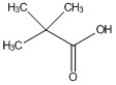
(Short Answer)
4.9/5 (66)
(66) How many peaks appear in the proton spin decoupled 13C NMR spectrum of the compound below? 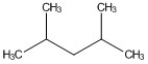
(Short Answer)
4.9/5 (92)
(92) If a molecule contains 4 elements of unsaturation and signals in the 1H NMR spectrum between δ 7.0 and 8.0 ppm, what structural group is likely to be present?
(Multiple Choice)
4.8/5 (72)
(72) What 1H NMR spectral data is expected for the compound shown? 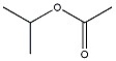
(Multiple Choice)
4.9/5 (76)
(76) Deduce the identity of the following compound from the 13C NMR data given.
C6H12O: δ 29.80 (quartet), 30.82 (singlet), 56.53 (triplet), 203.36 (doublet) (ppm)
(Essay)
4.9/5 (61)
(61) Predict the number of signals expected in the proton spin decoupled 13C NMR spectrum of the compound shown below. 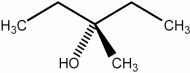
(Short Answer)
4.8/5 (76)
(76) Predict the number of signals expected in the proton spin decoupled 13C spectrum of p-dibromobenzene (1,4-dibromobenzene).
(Short Answer)
4.8/5 (71)
(71) Deduce the identity of the following compound from the 1H NMR data given.
C5H10O: δ 1.1 (6H, doublet), 2.2 (3H, singlet), 2.5 (1H, septet) (ppm)
(Essay)
4.8/5 (76)
(76) Deduce the identity of the following compound from the 13C NMR data given.
C8H8O: δ 26.4 (quartet), 128.0 (doublet), 128.3 (doublet), 133.0 (doublet), 137.0 (singlet), 198.0 (singlet) (ppm)
(Short Answer)
4.9/5 (60)
(60) Predict the number of signals expected in the proton spin decoupled 13C spectrum of 3-pentanone, 
(Short Answer)
4.9/5 (76)
(76) Deduce the identity of the following compound from the 13C NMR data given.
C4H7Br: δ 18.0 (quartet), 33.0 (triplet), 128.0 (doublet), 131.0 (doublet) (ppm)
(Short Answer)
4.7/5 (75)
(75) Predict the number of distinct quartets expected in the off-resonance decoupled 13C NMR spectrum of the compound shown below. 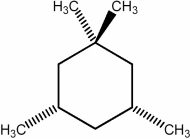
(Short Answer)
4.8/5 (85)
(85) Use the structure below to state the relationship between the indicated protons as equivalent, enantiotopic, diastereotopic, or unrelated.  Ha & Hb:
Ha & Hc:
Hb & Hc:
Ha & Hb:
Ha & Hc:
Hb & Hc: (Essay)
4.9/5 (68)
(68) What is the relative area of each peak in a quartet spin-spin splitting pattern?
(Multiple Choice)
4.8/5 (79)
(79) Label the different 1H environments in the structure below a, b, c.... Then complete the table for each different type of proton. The first one is done for you as an example. (Note: there may be fewer than 7 different proton environments) 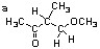 environments a b c d e f g
chemical shift
(+/- 0.5 ppm) 1.9
spin-spin splitting s
environments a b c d e f g
chemical shift
(+/- 0.5 ppm) 1.9
spin-spin splitting s (Essay)
4.9/5 (77)
(77) Deduce the identity of the following compound from the 1H NMR data given.
C3H3Cl5: δ 4.5 (1H, triplet), 6.1 (2H, doublet) (ppm)
(Short Answer)
4.9/5 (67)
(67) 
Filters
- Essay(0)
- Multiple Choice(0)
- Short Answer(0)
- True False(0)
- Matching(0)