



 Chat with AI
Exam 15: Conjugated Systems, Orbital Symmetry, and Ultraviolet Spectroscopy

Exam 1: Introduction and Review127 Questions
Exam 2: Structure and Properties of Organic Molecules129 Questions
Exam 3: Structure and Stereochemistry of Alkanes129 Questions
Exam 4: The Study of Chemical Reactions128 Questions
Exam 5: Stereochemistry128 Questions
Exam 6: Alkyl Halides: Nucleophilic Substitution and Elimination132 Questions
Exam 7: Structure and Synthesis of Alkenes128 Questions
Exam 8: Reactions of Alkenes132 Questions
Exam 9: Alkynes124 Questions
Exam 10: Structure and Synthesis of Alcohols132 Questions
Exam 11: Reactions of Alcohols124 Questions
Exam 12: Infrared Spectroscopy and Mass Spectrometry120 Questions
Exam 13: Nuclear Magnetic Resonance Spectroscopy130 Questions
Exam 14: Ethers, Epoxides, and Thioethers127 Questions
Exam 15: Conjugated Systems, Orbital Symmetry, and Ultraviolet Spectroscopy130 Questions
Exam 16: Aromatic Compounds128 Questions
Exam 17: Reactions of Aromatic Compounds129 Questions
Exam 18: Ketones and Aldehydes132 Questions
Exam 19: Amines129 Questions
Exam 20: Carboxylic Acids125 Questions
Exam 21: Carboxylic Acid Derivatives128 Questions
Exam 22: Condensations and Alpha Substitutions of Carboxyl Compounds125 Questions
Exam 23: Carbohydrates and Nucleic Acids125 Questions
Exam 24: Amino Acids, Peptides, and Proteins127 Questions
Exam 25: Lipids127 Questions
Exam 26: Synthetic Polymers128 Questions
Select questions type


Name the two major products which are formed when 3-bromo-1-methylcyclohexene undergoes solvolysis in hot methanol.
(Essay)
4.7/5  (74)
(74) 
Which compound requires a higher energy photon to cause a p to p* (HOMO/LUMO) transition, 1,3-butadiene or 1,3,5-hexatriene?
(Short Answer)
4.9/5 (97)
(97) Rank the following dienes in order of increasing stability: trans-1,3-pentadiene, cis-1,3-pentadiene, 1,4-pentadiene, and 1,2-pentadiene.
(Essay)
4.9/5 (82)
(82) 
Provide the structure of the major organic product in the following reaction. 
(Essay)
4.8/5 (88)
(88) Draw the resonance structures of the intermediate and then predict the two major products in the following reaction. 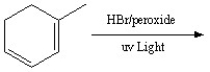
(Essay)
4.8/5 (79)
(79) Among a series of isomeric trienes, the more negative the ΔH° of the hydrogenation reaction of a given triene, the ________ stable it is relative to the others in the isomeric series.
(Short Answer)
4.9/5 (83)
(83) 
Filters
- Essay(0)
- Multiple Choice(0)
- Short Answer(0)
- True False(0)
- Matching(0)